All species › Rodents › Voles and hamsters › Mediterranean Field Vole
Mediterranean Field Vole | Microtus lavernedii
Microtus lavernedii | Microtus lavernedii
Microtus lavernedii is a vole of the field vole complex in Mediterranean and sub-Mediterranean Europe. Crespon described the taxon in 1844 from the marshes between Saint-Gilles and Aigues-Mortes in the Camargue. For a long time afterwards it was treated as a subspecies of the Field Vole; since 2012 it has been recognised as a separate species on genetic grounds, because the DNA of animals from southern France differs strongly from that of Field Voles from Sweden and Britain.
Tracks
The signs are those of the Field Vole. Above ground lies a network of runways three to four centimetres wide through dense tall vegetation, with occasional entrances to a shallow tunnel; the system lies largely above ground. The nest is a ball of finely shredded grass twenty to thirty centimetres across, under a grass tussock or in a sedge tussock; after mowing or after winter these balls lie exposed in wet meadows. Along the runs lie heaps of obliquely clipped grass and droppings of four to seven millimetres, grass green when fresh. Barn and Short-eared Owl pellets are the most reliable source for the vole fauna of an area, but they too lead no further than 'field vole in the broad sense', because the cheek teeth of the three split species overlap.
Identification
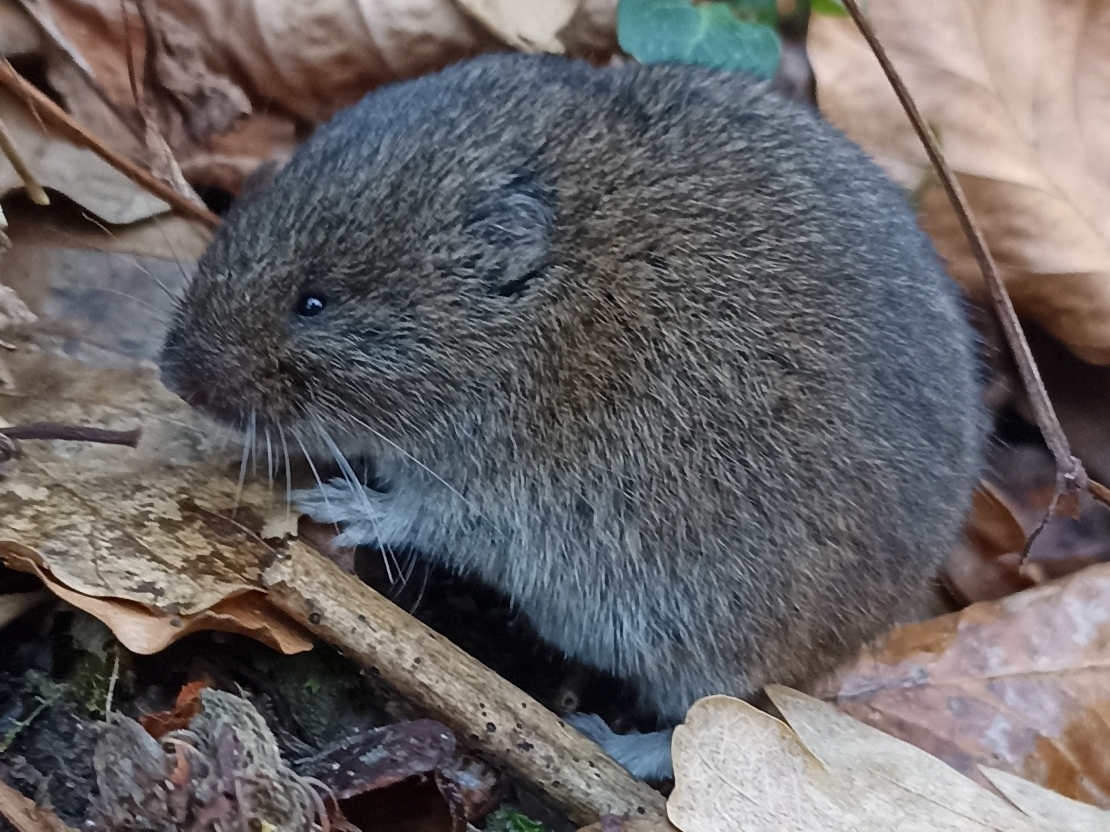
Externally identical to the Field Vole. Head-body 9.7 to 14 cm, tail 2.6 to 5.5 cm, weight 20.5 to 59 grams. The coat is long, soft and shaggy, greyish to dark brown above and grey below; the ears are small and rounded and half hidden in the hairs at their base; the short tail is bicoloured and well haired. The Handbook of the Mammals of the World describes the species as morphologically indistinguishable from the Field Vole and from Microtus rozianus. The only described difference lies in the teeth: the supplementary postero-lingual triangle on the first upper molar is rarely present in this species and usually small on the second upper molar, whereas in the Field Vole it is the rule. This is a difference in frequency, not an identification character.
Similar species
No character separates this species from the Field Vole and from Microtus rozianus in the field, in the hand or in a photograph. Assignment is based on locality. North and east of the Swiss Jura (Germany, Belgium and the Netherlands, Britain, Scandinavia, Poland) lives the Field Vole. This species lives in northern Spain east of about six degrees west, southern France, northern Italy, western and southern Switzerland, southern Austria, Slovenia, Croatia, Hungary, northern Bosnia and north-eastern Serbia. In north-western Iberia (Galicia, western Asturias and León, northern Portugal) lives Microtus rozianus. The Iberian Peninsula therefore holds M. rozianus and M. lavernedii but not the Field Vole itself; the boundary between the two lies at about six degrees west and does not coincide with any visible landscape feature. In the narrow contact zone with the Field Vole in the Jura only genetic identification is possible; there mitochondrial DNA has passed from one species to the other, the Y chromosome has not. From the other voles in its range the species is separated by the same characters as the Field Vole: the Common Vole is smoother, yellower and shorter-coated, with free-standing ears bare inside, and lives in short dry grass; the Bank Vole is reddish brown with large eyes and a tail twice as long; the Mediterranean, Lusitanian and Common Pine Voles are smaller and shorter-tailed, with very small eyes and hidden ears, and throw up soil; Cabrera's Vole is heavier and longer-coated, with a hind foot over twenty millimetres bearing six plantar pads.
Habitat
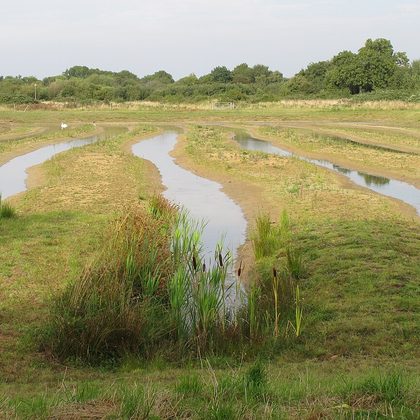
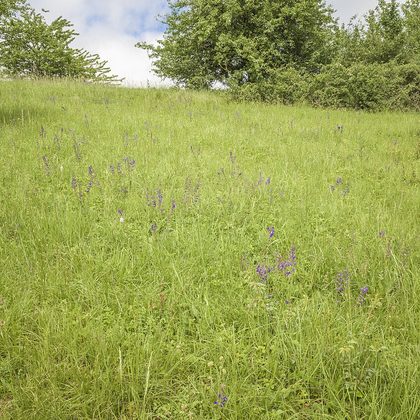
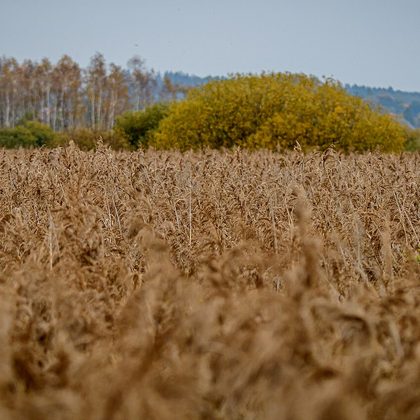
Unmown, damp grassland, almost always near water: tall tussocky stands of tufted hair-grass, purple moor-grass and wood small-reed, rush and sedge beds, meadowsweet stands, reed fringes and the wet herb-rich margins of streams, ditches and irrigation channels. Also wet woodland of grey alder, white willow, poplar, ash and pedunculate oak. In the Mediterranean part of its range the species is restricted to damp sites in an otherwise dry landscape: spring-fed brooks, riverbanks and wet mountain meadows. Its distribution is therefore more fragmented than that of the Field Vole in northern Europe.
Where the animal is most at home, classified with EUNIS — the European standard for habitats.


Distribution
Mediterranean and sub-Mediterranean Europe: northern Spain from Cantabria and the Basque Country along the Pyrenees to Catalonia, including the northern Iberian System, and further southern France, western and southern Switzerland, northern Italy, southern Austria, Slovenia, Croatia, Hungary, northern Bosnia and Herzegovina and north-eastern Serbia. In Spain the distribution is patchy and tied to damp grassland, rush beds and riverbanks. West of about six degrees west the species is replaced by M. rozianus. The boundary with the Field Vole runs through the Swiss Jura and is narrow; its course further east through Austria and the Carpathian Basin has not been established, and the assignment of the animals of north-eastern Italy is provisional. The species is absent from north-western and northern Europe.
- Native
- dark = core range, pale = thinly spread
Way of life
As far as studied, identical to that of the Field Vole; most of what has been published concerns the field vole in the broad sense. Active in short bouts spread over day and night, with surface nests in dense vegetation. Almost wholly herbivorous: grasses and herbs, and in winter also roots and bark. The breeding season runs from March to October, with one to seven embryos per female and a mean of slightly over four. Successive litters, early maturity and a short lifespan allow a population to increase strongly within one summer. It does not hibernate. No data exist on home range, social organisation or movements of this species specifically.
Where and when to look
Search the same kind of sites as for the Field Vole, within the southern range: unmown wet meadows in the French or Italian foothills, the sedge fringe of a mountain brook, the rank margin of an irrigation channel in the Camargue or the Po plain. The grass balls of the nests are easier to find than the animal. An animal seen cannot be identified to species; assignment follows from the locality. Certain identification requires owl pellets or other material examined genetically; for this species that is now a standard method.
Conservation status
Least Concern (2024). The assessment is recent; until shortly before, the species was not assessed separately. The category mainly reflects that the range is large enough and that the species is common within it. Shortly before this assessment the compilers of the Handbook pointed to the need for a separate assessment: the range is comparatively small, and the habitat, wet unmown grassland and streamside tall-herb vegetation in Mediterranean Europe, is being lost in southern France, northern Italy and the Pannonian Basin through drainage, water abstraction for irrigation and canalisation of streams. The species is not rare, but depends on the wettest parts of a landscape that is becoming drier.
Scientific name
Microtus lavernedii | (Crespon, 1844)
Crespon described the species in 1844 as Arvicola lavernedii; because it was later moved to another genus, the author and year stand in brackets. Microtus is Greek, from mikros, 'small', and ous, genitive ōtos, 'ear', after the small ears hidden in the fur. lavernedii honours a Lavernède, in Crespon's words 'a scholar who has always honoured me with his esteem'; probably the Nîmes savant Jean-Étienne-Thomas Lavernède, but Crespon gives no first name. The specimen the first description was based on came from France, Gard.