All species › Even-toed ungulates › Bovids › Nubian ibex
Nubian ibex | Capra nubiana
Nubische steenbok | Capra ibex nubiana
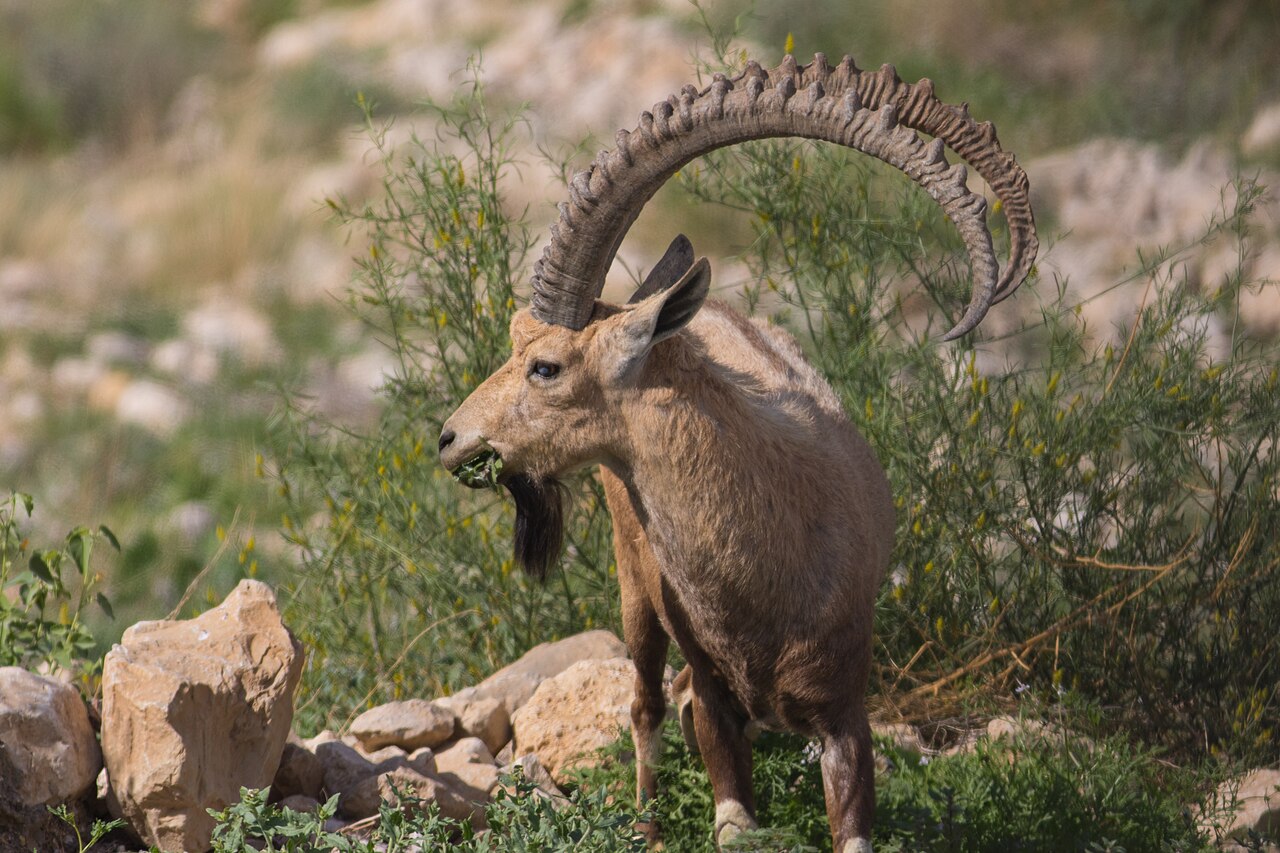
The Nubian ibex (Capra nubiana) is the smallest ibex and lives in the desert mountains of north-eastern Africa and the Arabian Peninsula. In the guide area it occurs in Sinai, in the deserts of Israel and in Jordan. It is active by day and, where it is not hunted, accustomed to people.
Tracks
The track is two-toed and blocky, with a hard rim, and resembles that of a domestic goat. The droppings lie in small heaps on ledges and at resting places under overhanging rock. Because the species drinks almost daily, worn paths lead from the cliffs to springs and pools.
Identification
A slender ibex with a head-body length of 105 to 125 cm, a shoulder height of 65 to 75 cm and a weight of 25 to 70 kg; males weigh about twice as much as females. The coat is pale sandy brown, the hindquarters paler, the belly white. The male has a dark stripe on the front of the forelegs, a dark dorsal stripe and a dark beard; in the rut he turns dark brown to almost black. The male's horns are long and slender, up to about a metre, and describe a half circle upwards, backwards and down, with transverse knobs on the front. The female carries thin horns of about 30 cm.
Similar species
No other wild goat-like animal occurs within the range of the Nubian ibex. Confusion arises with herders' domestic goats, which are usually black, piebald or long-haired and have different horns. The Barbary sheep of North Africa lives further west, has a long throat fringe and horns that curve sideways. The Alpine ibex and the wild goat live in other areas; the Alpine ibex is much heavier, with thicker horns.
Habitat
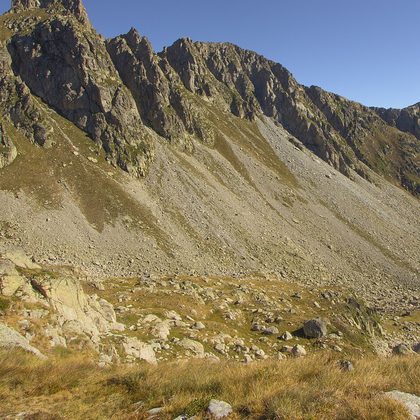
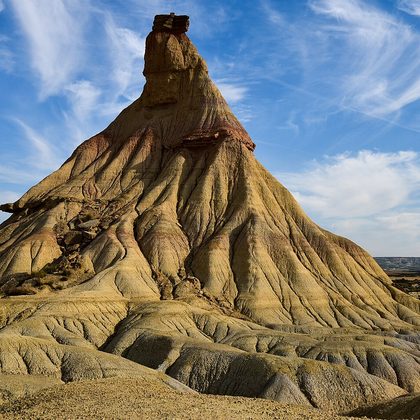
Steep, rocky desert mountains with cliffs, gorges and scree slopes, close to permanent water. The animals feed in wadis and on slopes and retreat to the cliffs when threatened.
Where the animal is most at home, classified with EUNIS — the European standard for habitats.

Distribution
The species occurs in Egypt, Sudan, Israel, Palestine, Jordan, Saudi Arabia and Oman; it has been extirpated in Lebanon and Syria, and a reintroduction is being prepared in Lebanon. In the guide area it lives in Sinai, in the Negev and Judean Desert in Israel and along the Dead Sea, and in the mountains of Jordan along the Dead Sea and the Wadi Araba. The world population is estimated at about 4,500 mature animals.
- Native
- dark = core range, pale = thinly spread
Way of life
The Nubian ibex is active by day. Females, young and males up to about three years live in herds of usually up to twenty animals; older males live apart or in their own groups. The food is mainly grasses and leaves, including those of acacias, and varies with rainfall. The animals drink almost daily. The rut usually falls in October and November; after a gestation of about five months one or two young are born between March and July, most of them in late March and April. Natural enemies are the Arabian leopard, the Arabian wolf, the golden jackal, the caracal, the red fox, the golden eagle and the bearded vulture; the young are the most vulnerable.
Where and when to look
Ein Gedi nature reserve on the Dead Sea is where the species is easiest to see: the animals come to the springs and the vegetation along the streams by day. In Mitzpe Ramon, on the rim of the Makhtesh Ramon, ibex walk into the town. In Jordan the Wadi Mujib and the Dana area are suitable. In the midday light scan the shaded ledges: resting animals often lie there motionless.
Conservation status
Vulnerable (VU, 2020). The main threats are competition with livestock for water and food, hunting, climate change, fragmentation and destruction of habitat, and chemical pollution. In Israel the presence of visitors has been shown to affect the behaviour and use of space of the animals in nature reserves.
Scientific name
Capra nubiana | F. Cuvier in É. Geoffroy Saint-Hilaire & F. Cuvier, 1825
F. Cuvier in É. Geoffroy Saint-Hilaire & F. Cuvier described the species in 1825 and placed it straight away in the genus where it still stands. Capra is the Latin word for 'she-goat'. nubiana means 'of Nubia', the country on the Nile south of Egypt. The specimen the first description was based on came from Egypt.