All species › Even-toed ungulates › Bovids › Spanish Ibex
Spanish Ibex | Capra pyrenaica
Spaanse steenbok | Cabra Montesa
The Spanish ibex (Capra pyrenaica) is a wild goat found only in the Iberian Peninsula. Of the four described subspecies two are extinct: the Portuguese in 1892 and the Pyrenean, the bucardo, in January 2000. The two remaining subspecies increased strongly in the twentieth century, and the species has since been returned to Portugal, Galicia and the French Pyrenees.

Tracks
The track is two-toed and blocky, with a hard hoof rim and a soft sole, and resembles that of a domestic goat. The droppings are small dark pellets in heaps on ledges and at resting places. Under overhanging rock lie resting places with droppings and hair, used over long periods.
Identification
A goat with a head-body length of about 120 cm in the female and up to 148 cm in the male, a shoulder height of 60 to 77 cm and a weight of 30 to 45 kg in the female and up to 120 kg in the male. The coat is brown to cinnamon. Adult males have black patches on the front of the legs, which can extend over the flanks, shoulders and belly, and a dark goatee. The male's horns are about three times as long as the female's; they curve first outwards and upwards and then backwards and inwards, in a shape that differs between subspecies. The female is plain brown, without a beard, with short horns. The tail is black and 12 to 13 cm long.
Similar species
Free-ranging and feral domestic goats are the most frequent confusion; they are often piebald, white or black and have a different horn shape. In south-eastern Spain the Barbary sheep lives in the same mountains; it is uniformly sandy brown, has a long throat fringe and horns that sweep sideways and back in a half circle. The Pyrenean chamois is smaller and slimmer, with a facial pattern and small hooked horns. The mouflon has a pale saddle patch and curled horns.
Habitat
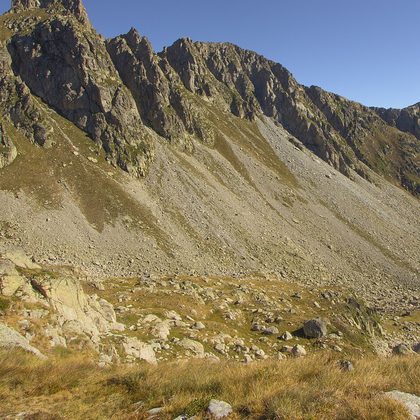
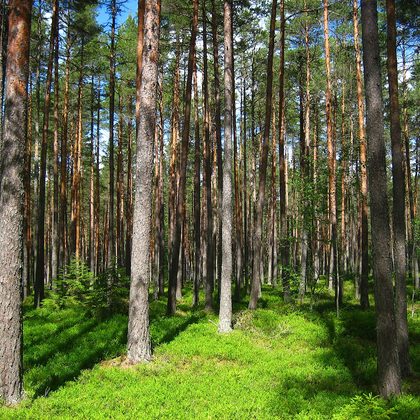
Rocky mountains with cliffs, scree and gorges, from sea level to high mountains, with Mediterranean scrub, garrigue, pine and oak woodland and, in the highest ranges, alpine grassland. Everywhere the species is tied to steep rocky terrain close to food.
Where the animal is most at home, classified with EUNIS — the European standard for habitats.





Distribution
The Spanish ibex occurs in Spain, with large populations in the Sierra de Gredos (subspecies victoriae, about 10,000 animals), the Sierra Nevada, the Sierra de Cazorla and the Tortosa–Beceite mountains (subspecies hispanica), and in many other ranges of the east and south. The Portuguese subspecies lusitanica became extinct in 1892 in the Serra do Gerês and Galicia. The last bucardo (C. p. pyrenaica) died in January 2000 in Ordesa; a cloned animal born in July 2003 died a few minutes after birth. Releases have returned the species to Galicia (since 2003), to the Cantabrian Mountains from Riaño and to the French Pyrenees (since 2014); from Galicia it has reached Portugal again. The total population is estimated at about 50,000 animals.
- Native
- dark = core range, pale = thinly spread
Way of life
The Spanish ibex is active by day. Outside the rut males and females live in separate groups. It is a mixed feeder that, depending on availability, eats grasses as well as the leaves and twigs of shrubs. The rut falls in November and December; the young are born in May, usually one, sometimes two.
Where and when to look
In the Sierra de Gredos ibex around the Laguna Grande and the Circo de Gredos are used to walkers and can be seen at close range. Other suitable areas are the Sierra Nevada, the Sierra de Cazorla, Els Ports and the Montserrat massif near Barcelona. Come in November or December for the rut, when the males clash their horns; the sound carries a long way.
Conservation status
Least Concern (LC, 2021). The species recovered strongly in the twentieth century, but two of its four subspecies are extinct. Sarcoptic mange is the main destabilising factor in many populations and can reduce numbers sharply in places; the disease affects males and females unequally and limits reproduction.
Scientific name
Capra pyrenaica | H. R. Schinz, 1838
H. R. Schinz described the species in 1838 and placed it straight away in the genus where it still stands. Capra is the Latin word for 'she-goat'. pyrenaica means 'of the Pyrenees', from where Schinz described the animal. The specimen the first description was based on came from Pyrenees.