All species › Even-toed ungulates › Bovids › Argali
Argali | Ovis ammon
Argali | Argalí
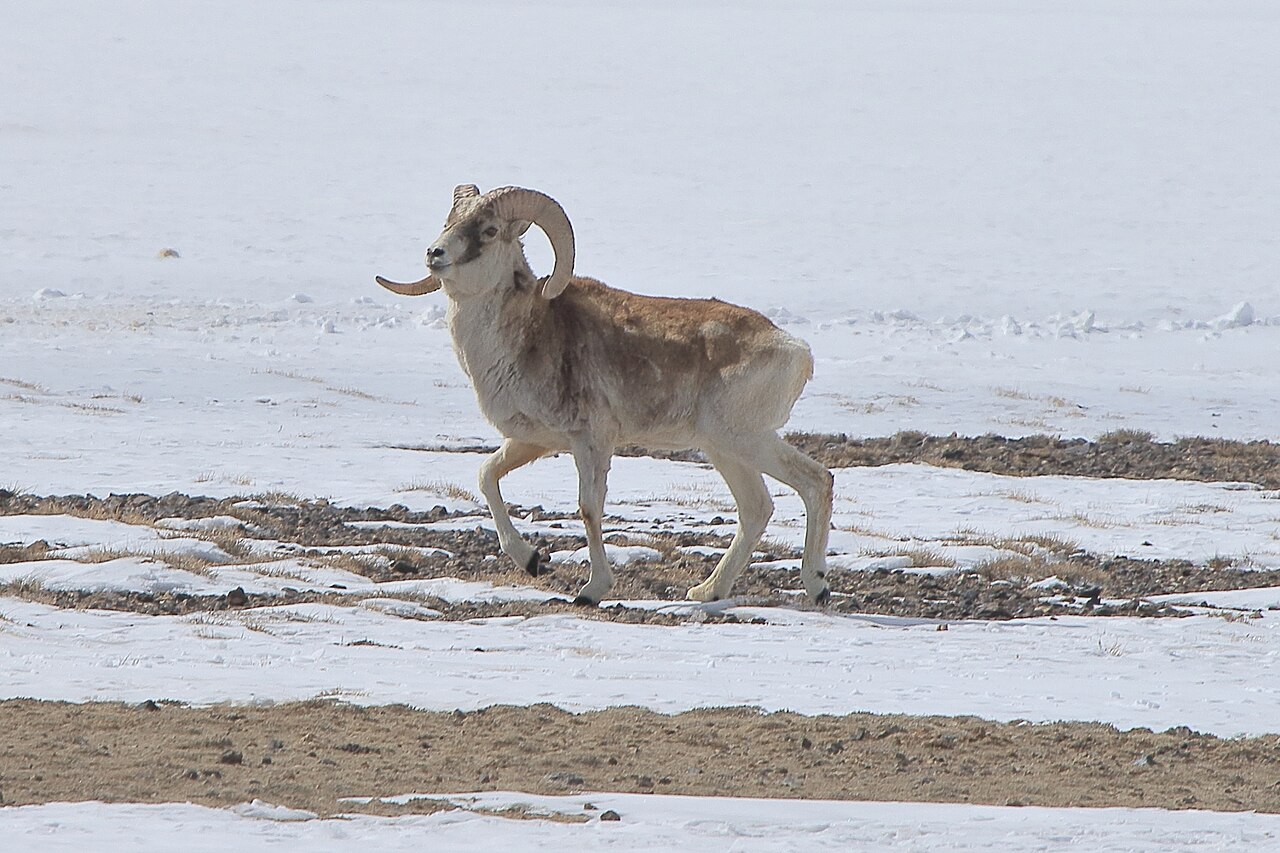
The argali (Ovis ammon) is the largest wild sheep in the world and lives in the mountains and uplands of Central Asia, from Kazakhstan to China and the Himalaya. The guide area touches the range only in Russia: there the species lives in the republics of Altai and Tuva in southern Siberia. In Europe the argali does not occur in the wild.
Tracks
The slot is cloven and resembles that of a large domestic sheep, with blunt halves. Droppings are dark, oval to round and lie in heaps at resting and sleeping places, often on ledges and slopes with a view. Where salty soil is exposed, the animals lick it.
Identification
A large, long-legged wild sheep of 136 to 200 cm head-body length and 85 to 135 cm shoulder height. Rams weigh 97 to 328 kg, ewes 43 to 100 kg. The tail is short, 9.5 to 17 cm. The colour varies from pale yellow and reddish brown to dark greyish brown; animals in Russia are paler than those in the Himalaya. Face, tail and rump are yellowish white, and rams have a pale neck ruff and a dorsal crest. The ram carries heavy horns twisted outwards in a spiral, up to 190 cm long and 23 kg in weight; the horns of the ewe are usually shorter than 60 cm.
Similar species
In the guide area the mouflon (Ovis gmelinii) is the wild sheep that most resembles the argali. The mouflon is much smaller and darker reddish brown, and the ram has a pale saddle patch on the flank and horns that curl closer around the head. The Barbary sheep (Ammotragus lervia) of North Africa and south-eastern Spain has a long mane of hair on throat and forelegs and horns curving backwards and outwards without a spiral. The argali overlaps with neither species.
Habitat
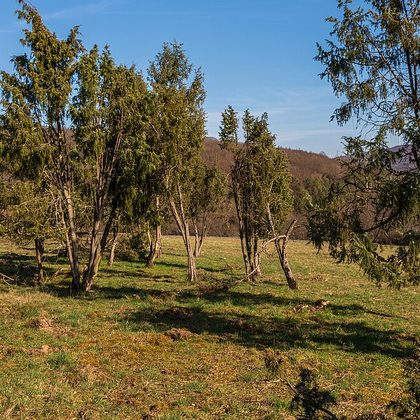
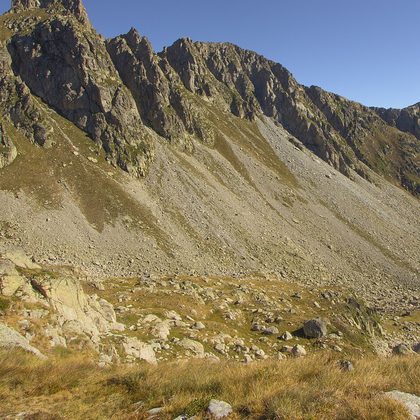
Open mountain slopes, high plateaus and steppes between 300 and 5800 m, with a preference for gently sloping, broken terrain where the animals can see predators approaching from a great distance. In summer they move higher. Where many livestock graze or hunting is heavy, they move to rougher terrain.
Where the animal is most at home, classified with EUNIS — the European standard for habitats.


Distribution
From central Kazakhstan to Shanxi Province in China and from the Altai to the Himalaya, with nine recognised subspecies. In Russia the argali lives only in the republics of Altai and Tuva, at the edge of the range; it has disappeared from parts of southern Siberia, north-eastern China and Mongolia. In western and central Europe argali are kept only in captivity.
- Native
- dark = core range, pale = thinly spread
Way of life
The argali is active by day. Outside the breeding season rams and ewes live apart, in groups of 2 to 150; groups of ewes number up to 92, groups of rams usually 3 to 30. Seasonal movements occur when food becomes scarce, and in response to insects, drought or poaching. The animals eat 16 to 19 kg of plant material a day: grasses, sedges and herbs at high altitude, shrubs as well lower down. The rut lasts from October to mid-January. Gestation lasts a little over 165 days; usually one lamb, sometimes two, is born in late March or April. Wolves are the main natural predator of adults, along with snow leopard, leopard, lynx and wolverine; lambs are also killed by foxes, dogs and birds of prey.
Where and when to look
The nearest places to Europe to see argali are the Russian Altai, including Sailyugemsky National Park, and Kazakhstan. The animals keep a great distance and are best found early in the morning with a telescope on open slopes. During the rut, in November and December, rams and ewes are together and groups are largest.
Conservation status
Near Threatened (NT, 2020). The argali is hunted for meat and horns, and poaching is the main threat. Competition with livestock for food and the transmission of diseases from livestock to wild sheep are also important. In Kazakhstan the species is hunted extensively. It has disappeared from parts of its former range, including southern Siberia.
Scientific name
Ovis ammon | (Linnaeus, 1758)
Linnaeus described the species in 1758 as Capra Ammon; because it was later moved to another genus, the author and year stand in brackets. Ovis is the Latin word for 'sheep'. ammon is Ammon, the Egyptian god Amun, whom the Greeks and Romans pictured with ram's horns; it stands as a proper noun in apposition, after the heavy spiralled horns. The specimen the first description was based on came from Altai.