All species › Bats › Bent-winged bats › Pallid Long-fingered Bat
Pallid Long-fingered Bat | Miniopterus pallidus
Miniopterus pallidus | Miniopterus pallidus
The pallid long-fingered bat was described by Oldfield Thomas in 1907 as a subspecies of Schreibers's long-fingered bat, with the south coast of the Caspian Sea in Iran as type locality. Mitochondrial and nuclear DNA studies led to its recognition as a separate species. Its range extends from Anatolia and the Levant to Afghanistan; only the western edge, in Anatolia and the Levant, lies within the guide area.
No photograph of a living wild animal of this species with a suitable Creative Commons licence exists. Do you have one that meets the rules? Send it in.
Tracks
Signs are found in caves, abandoned mines and tunnels: droppings beneath roosting spots, consisting of finely chewed moth remains, and dark staining of the ceiling above roosts used for many years. The bats hang in dense clusters against the ceiling, in colonies of usually a few hundred, sometimes 1,000 to 1,500 bats, often in the same cave as horseshoe bats and Myotis species. At emergence the bats leave the entrance in a sustained stream. Droppings and roosts cannot be told from those of Schreibers's long-fingered bat.
Identification
Built like Schreibers's long-fingered bat: a short, domed head, short muzzle, small, triangular ears with a slender, slightly forward-curved tragus of 4.9 to 6.3 mm, and a long, narrow wing in which the second phalanx of the third finger is folded back at rest. The fur is short and silky, uniformly greyish brown on the back and paler below; the hairs are bicoloured. Tail and wing membranes are relatively long and dark. Head-body 56 to 65 mm, tail 58 to 66 mm, forearm 43 to 44.8 mm, weight 14.7 to 15.2 g. The chromosome number is 2n = 46. Echolocation consists of downward frequency-modulated calls with a peak frequency around 55.5 to 57.9 kHz.
Similar species
Schreibers's long-fingered bat (M. schreibersii) cannot be told from the pallid long-fingered bat externally; measurements overlap and fur colour varies in both. Both species occur in Anatolia, where limited hybridisation has been documented; where the boundary between them lies in Anatolia, the Levant and Iraq cannot be established without genetic analysis. Where the two occur together, M. pallidus uses mainly inland, continental areas and M. schreibersii more humid coastal areas, but this is a tendency, not an identification feature. The peak echolocation frequency falls in the same range as that of Schreibers's long-fingered bat and of the soprano pipistrelle (Pipistrellus pygmaeus). In shared caves, Myotis species are recognised by their longer ears with a straight tragus and horseshoe bats by their noseleaf.
Habitat
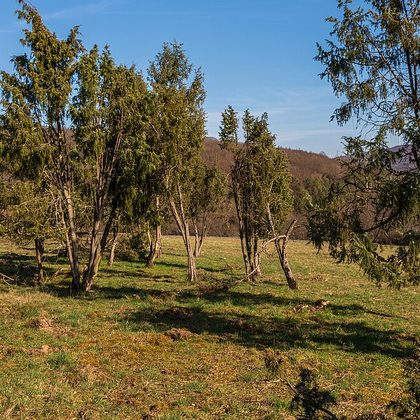
The species uses a range of dry and semi-arid landscapes: Mediterranean scrub at sea level in the west of the range, semi-arid steppe above 1100 m on the Central Anatolian Plateau and semi-arid mountains above 1400 m in Iran. Where it occurs together with Schreibers's long-fingered bat it uses the continental areas and avoids the humid Hyrcanian forests along the Caspian Sea. It forages in valley bottoms and along riparian vegetation near water. Day roosts are caves, abandoned mines and tunnels.
Where the animal is most at home, classified with EUNIS — the European standard for habitats.




Distribution
Eastern and central Anatolia, southern Armenia, Azerbaijan, Syria, Lebanon, north-western Jordan, Iran, southern Turkmenistan and southern Afghanistan. The range limits in the Levant and Iraq are unclear, because records from before the split are filed under M. schreibersii and need genetic testing. Within the guide area, which extends east to 37° E, this concerns central Anatolia and the Levant.
- Native
- dark = core range, pale = thinly spread
Way of life
Nocturnal. The species hunts flying insects in open air and, with its manoeuvrable flight, also in semi-cluttered space; in samples from Iran, Syria and Jordan more than 95% of the diet consisted of moths, supplemented by beetles, flies and other insects. In western Iran mating takes place in late October; after hibernation the embryo implants in early March (delayed implantation) and the young are born in early June, so that the period from mating to birth is 7.5 to 8 months. A newborn weighs about 3.7 g and at two months, when it flies independently, 11.3 g, more than 90% of adult weight. Hibernation takes place in caves. Colonies number a few hundred to 1,500 bats.
Where and when to look
Within the guide area a Miniopterus in central Anatolia or the Levant cannot be identified to species in the field and is recorded as Miniopterus sp. unless DNA has been examined. Watching emergence at a cave entrance on a summer evening, from outside the cave, is the way to see the bats; a bat detector at about 56 kHz records the calls. Caves with colonies are not entered during the maternity period or in winter. A licensed researcher can take a skin biopsy for DNA analysis without killing the bat.
Conservation status
Near Threatened (NT, 2021). Because the bats gather in a limited number of caves, disturbance or loss of a single roost affects a large part of a local population. The range lies almost entirely outside the European Union, so the Habitats Directive does not apply there. For much of the range it is not known which colonies belong to this species and which to Schreibers's long-fingered bat, and therefore not how large the population is.
Scientific name
Miniopterus pallidus | O. Thomas, 1907
O. Thomas described the species in 1907 and placed it straight away in the genus where it still stands. Miniopterus is Greek, from minyos, 'small' (compare minythein, 'to lessen'), and pteron, 'wing'; Bonaparte gave no explanation, but he presumably meant the very short first phalanx of the third finger, which lets the long wing-tip fold back. pallidus is Latin for 'pale', from pallere, 'to be pale': Thomas described the animal as the pale form alongside schreibersii. The specimen the first description was based on came from Iran, Golestan.