All species › Carnivores › Dogs, wolves and foxes › Red fox
Red fox | Vulpes vulpes
Vos | Zorro
The red fox has the largest natural range of any land carnivore and occurs in Europe, North Africa and the Middle East from the tundra to city centres. Track, trail and scat can be distinguished from those of a dog in sand, snow and mud.

Tracks
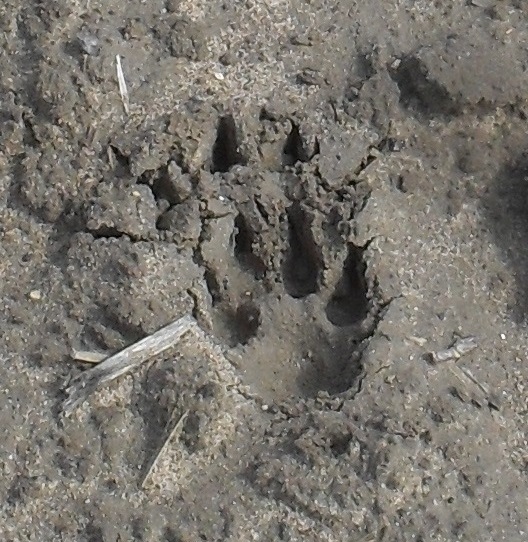
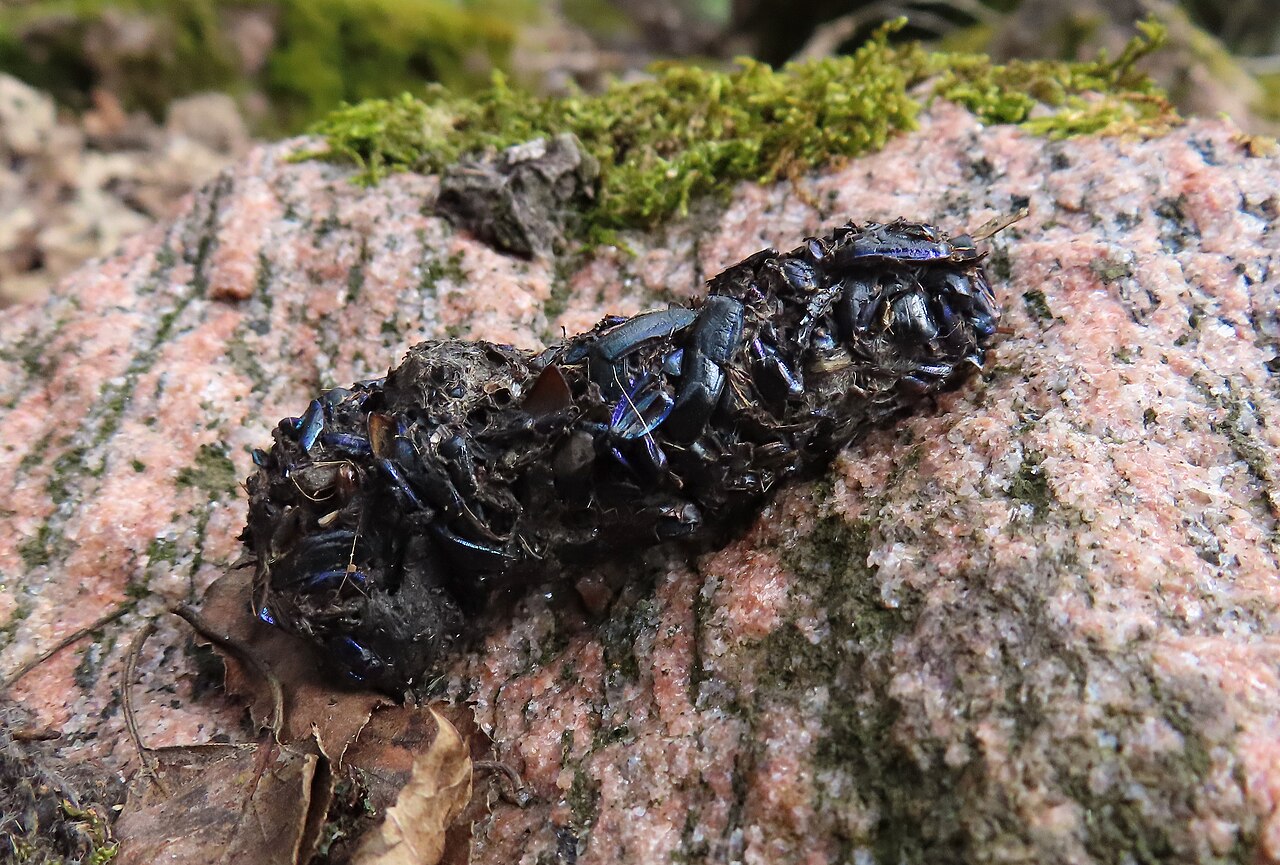
The fore track is about 4 to 5 cm long and 3.5 to 4 cm wide, the hind foot slightly smaller and narrower. Four toes with sharp, pointed claw marks. A straight edge laid across the front margins of the two outer toes clears the middle toes in a fox but touches them in a dog; the dog track is also rounder and broader, with the toes splayed and the claws blunt. In the trail the fox registers directly: the hind foot falls in the print of the fore foot, the prints lie almost in a single straight line, and the stride is 30 to 40 cm. A dog walks in two lines and less regularly. The scat is 5 to 10 cm long and one and a half to two centimetres thick, twisted, and drawn out at one end into a thin point of matted hair; that point is the character. Colour follows the food: black and glossy on meat and bone splinters, grey and hair-rich on voles, blue-black on ground beetles, and in late summer purple to wine-red on blackberries, cherries or cornel, with the stones visible. The scat usually lies on a raised spot — molehill, stone, tussock, stump, post — or in the middle of a path, and is a scent mark. Around the earth and along the runs there is a sharp, sweetish musky smell, detectable at some distance in still weather. The earth has entrances 20 to 25 cm across, higher than wide, often in a slope or taken over from a badger; prey remains and feathers lie outside, and in May the grass is trodden flat by the cubs. A badger sett is clean by comparison, with fresh spoil heaps and a separate latrine. A bird eaten by a fox is recognised by bitten-through feather shafts bearing tooth marks; a goshawk pulls the feathers out intact.

In its habitat

Head close-up
A colour morph
.jpg)
The young
Identification
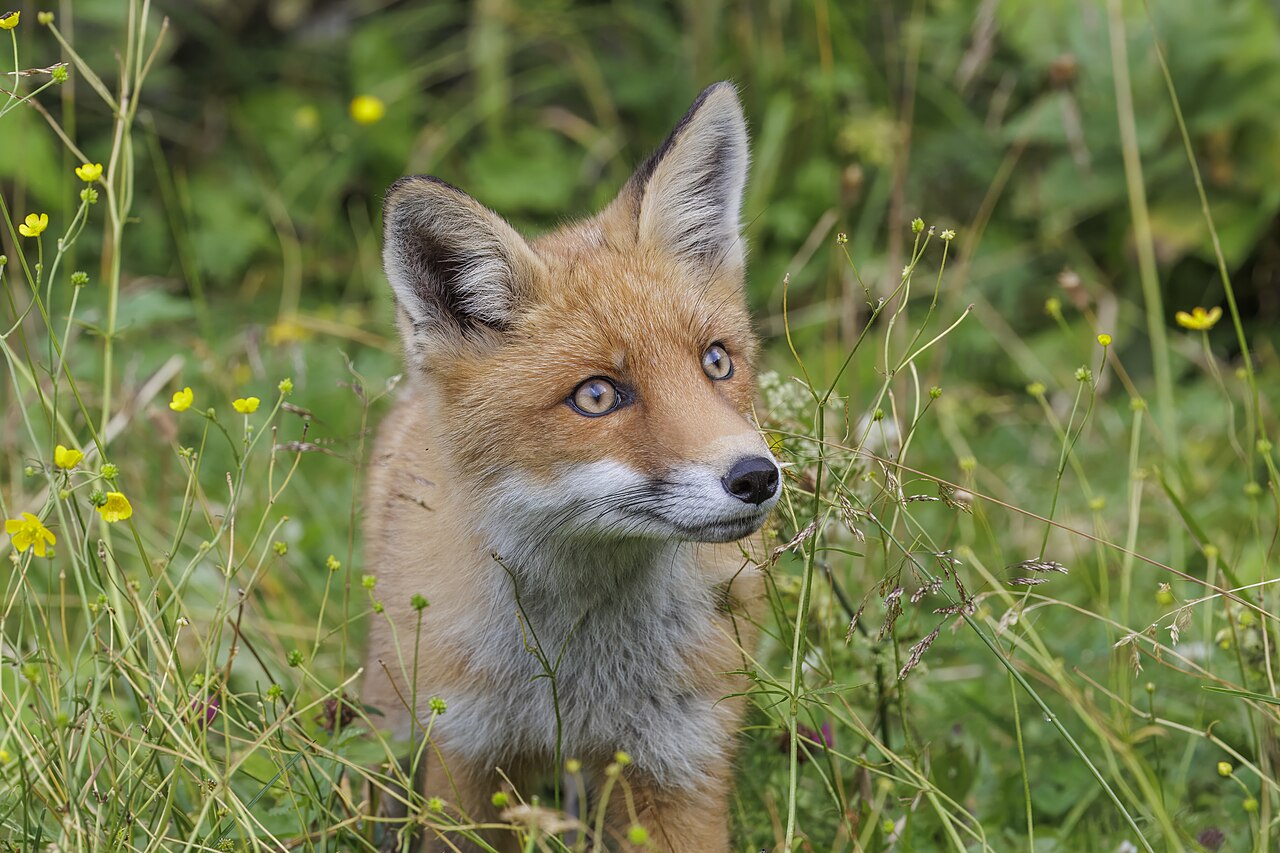
Slender, low on the legs, with a tail nearly two thirds of the head-body length. Rusty red to yellowish, with white throat, chest and belly, black backs to the ears and black 'stockings' on the fronts of the legs; the brush usually, but not always, ends in a white tip. Pointed muzzle, white lips and vertically slit pupils — the only European canid with a vertical pupil. The winter coat is fuller and looks heavier; in June and July a moulting fox is thin and barely red. Dark colour forms (cross fox, silver fox) occur in the north; in Iberia, the Maghreb and the Levant the species is smaller, paler and larger-eared. The gait is fluid, with a level back and the tail carried horizontally.
Similar species
Confusion arises mainly in the dark and at a distance. The raccoon dog is shorter and stockier, dark-masked, with short legs, small round ears and a short tail without a white tip. The golden jackal, spreading from the Balkans into central Europe, is grey-yellow rather than red, longer in the leg, with a shorter tail ending dark and a straighter outline; the howl is diagnostic. The arctic fox overlaps in the Scandinavian uplands: shorter muzzle, small round ears, densely furred feet and no white tail tip. Small reddish dogs cause the most confusion; the black ear rims, the slit pupil and the heavy, low-carried brush decide it. In North Africa and the Middle East the red fox occurs alongside Rüppell's fox, which is sand-coloured, smaller and larger-eared and also has a white tail tip; there size, muzzle length and habitat decide.
Habitat
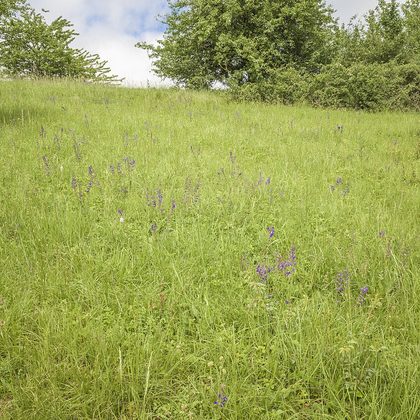
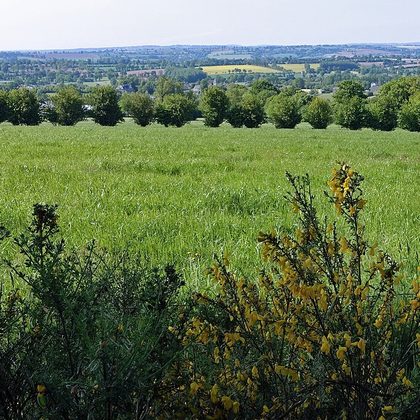
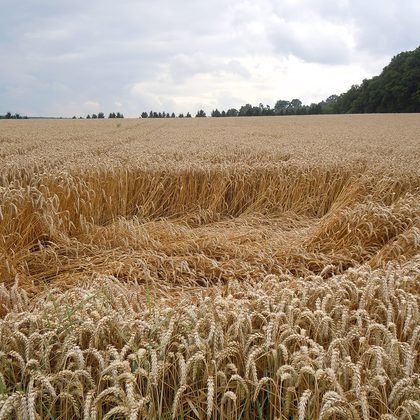
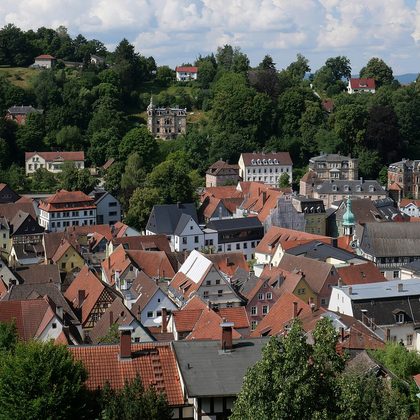
The red fox inhabits almost any landscape with cover in which to spend the day: broadleaved and mixed woodland with herb-rich edges, hedgerows and banks in farmland, rough dykes and railway embankments, dunes, heath, maquis, orchards and allotments. In the north the habitat extends into the birch tundra, in the Alps above the treeline and in the south into garrigue. The highest densities are not in closed woodland but in small-scale landscapes with many edges and abundant voles. The species has been a regular inhabitant of British suburbs since the 1930s and of continental towns since the 1990s, lying up under sheds and on railway banks.
Where the animal is most at home, classified with EUNIS — the European standard for habitats.


Distribution
The red fox occurs from North Africa to the North Cape and from Ireland to beyond the Urals, the largest natural range of any land carnivore. In Europe the species is absent from Iceland, Malta and a number of smaller islands; it is present on Sicily, Sardinia, Corsica and Cyprus. In the Netherlands and Belgium it was scarce on the clay soils and in the north-east of the Netherlands until the 1970s; since then it has occurred throughout, including the polders, the urban areas and several Wadden islands. It is common in Britain and Ireland, with urban populations in London and Bristol among others.
- Native
- dark = core range, pale = thinly spread
Way of life
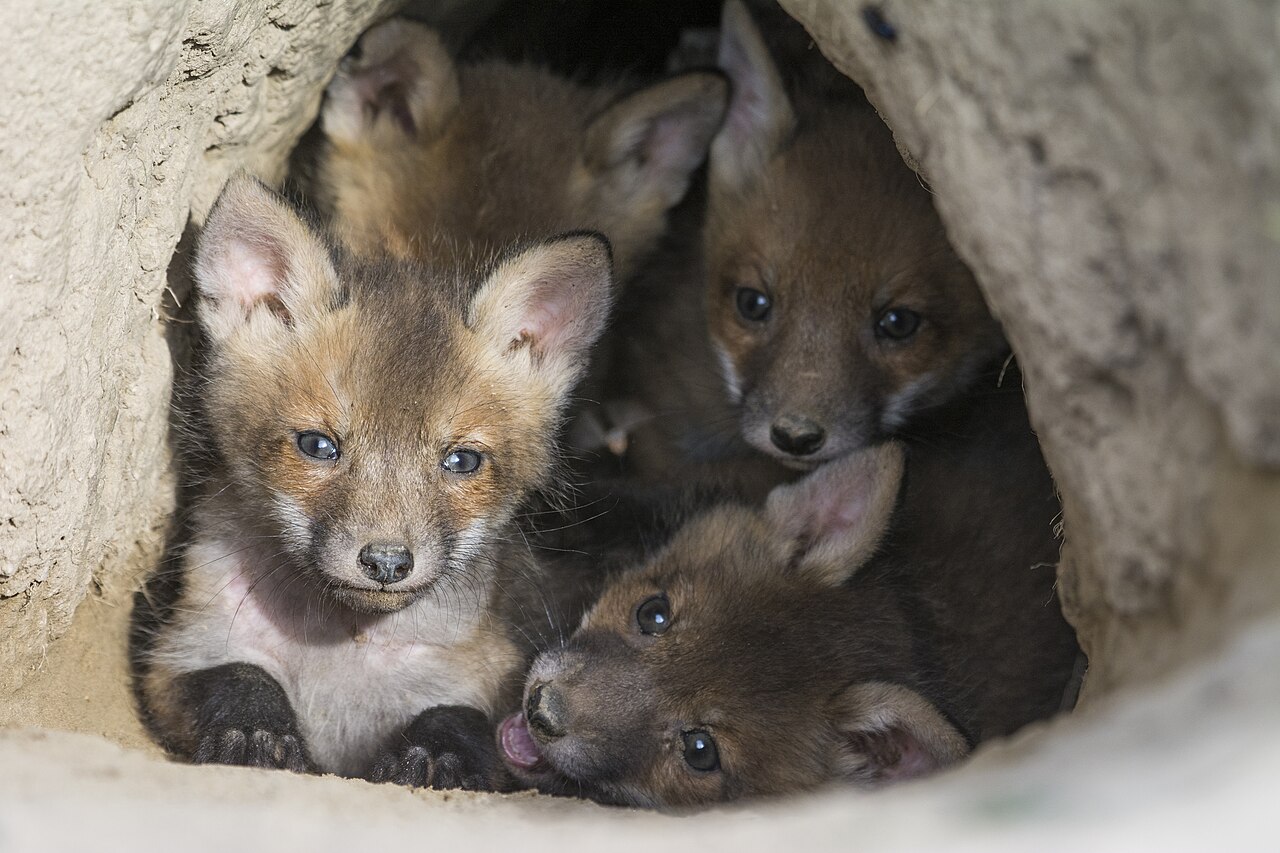
The red fox is mainly nocturnal and most active in the first hours after sunset; also active by day in quiet areas and in towns. It is omnivorous, with a strong preference for voles, located by ear and pinned with a pounce from above; also rabbits, young hares, birds, eggs, earthworms in wet weather, beetles, carrion, fruit and, in towns, refuse. Surplus is cached, one item per hole. The territory covers half a square kilometre to several in the countryside and down to less than a tenth of that in towns; it holds a pair, sometimes a family group in which a non-breeding sister helps. The rut falls in December and January, with the hoarse barking of the dog fox and the drawn-out scream of the vixen at night. After about 52 days four to six cubs are born in March or April, blind, dark grey and blunt-muzzled; they come above ground at about four weeks, become independent in summer and disperse in autumn — young dog foxes for tens of kilometres. The species does not rest in winter and is active year-round; in the wild it rarely lives beyond three or four years.
Where and when to look
The first hour after sunset is the most suitable time, along a wood edge, a dyke or a field margin, where the fox quarters back and forth with its head low in search of voles. In snow the trail leads to the animal: the straight line of registering prints can be followed back to the run. In towns a park or a railway bank after midnight is productive; urban foxes allow a close approach. In May an earth with cubs can be watched, but this requires a hundred metres' distance and a telescope: a disturbed vixen moves her litter. In January the species is audible; the barking and the scream on a winter night are diagnostic.
Conservation status
Least Concern (LC, 2021). Across much of Europe the population has grown since the 1980s, chiefly because rabies was eliminated by the distribution of vaccine baits and that source of mortality fell away; the species has since also occupied the cities. It is hunted everywhere, mostly without a demonstrable effect on numbers. Mange causes local crashes; in urban areas traffic is the chief cause of death. Where the species conflicts with other interests — meadow-bird management, poultry, and terns and gulls breeding on islands — the debate is not about its survival but about the numbers accepted in a farmed landscape.
Scientific name
Vulpes vulpes | (Linnaeus, 1758)
Linnaeus described the species in 1758 as Canis Vulpes; because it was later moved to another genus, the author and year stand in brackets. Vulpes is the Latin word for 'fox'. The specific name repeats the genus name. The specimen the first description was based on came from Sweden.