All species › Hedgehogs, shrews and moles › Moles and desmans › Russian Desman
Russian Desman | Desmana moschata
Russische desman | Desman Ruso
The Russian Desman is the largest member of the mole family and lives in the oxbow lakes and slow rivers of the Volga, Don and Ural basins. It is the only species in its genus and one of the two surviving desmans. In the nineteenth and early twentieth centuries it was hunted on a massive scale for its fur and musk, and its range has since broken up into scattered populations. In 2023 the IUCN moved it from Endangered to Critically Endangered, after an estimated decline of 83 per cent in ten years in Russia.
No photograph of a living wild animal of this species with a suitable Creative Commons licence exists. Do you have one that meets the rules? Send it in.
Tracks
The main sign is the burrow. The desman digs a tunnel system into steep banks with an underwater entrance and a nest chamber above the high-water mark; all entrances lead down from the nest to below the surface. The number of occupied burrows per kilometre of bank is therefore the measure used in counts; current populations hold from 0.5 to over 15 burrows per kilometre. Around the burrows lie empty shells of freshwater mussels and snails as food remains. A strong musky smell at a burrow also points to the species. Because the entrances are underwater, the burrows show best at low water and in early spring, before bank vegetation has grown up. Footprints and droppings are rarely used as evidence in counts.
Identification
A stocky, rat-sized aquatic animal with a long, mobile, trunk-shaped snout, grooved on top, that projects well beyond the mouth. The eyes are tiny and there are no external ears. The fur is dense and two-layered, with underfur and longer guard hairs, reddish-brown to dark brown above and silvery grey below. Fore and hind feet are webbed, and the soles are fringed with stiff hairs; the hind feet are large. The tail is about as long as the body, scaly and laterally flattened, thick at the base and furnished there with glands that secrete a musky substance. Head-body 19.3 to 24.0 cm, tail 18 to 21 cm, hind foot 51 to 58 mm, weight 370 to 450 g.
Similar species
The only other desman, the Pyrenean Desman (Galemys pyrenaicus), lives more than 2500 km to the west and weighs less than a fifth as much; there is no possibility of confusion between the two. Within the Russian Desman's range the risk is swimming rodents. The muskrat (Ondatra zibethicus), introduced into the same waters, is larger, has a blunt rodent head with visible eyes and ears, and a black, vertically flattened tail without musk glands at the base. The water vole (Arvicola amphibius) has a round, hairy tail and a blunt snout. A swimming American mink is long and slender with a bushy tail. What sets the desman apart at a glance is the trunk-like snout; at a distance in the water that is rarely visible, and a sighting without a photograph or video cannot be confirmed.
Habitat
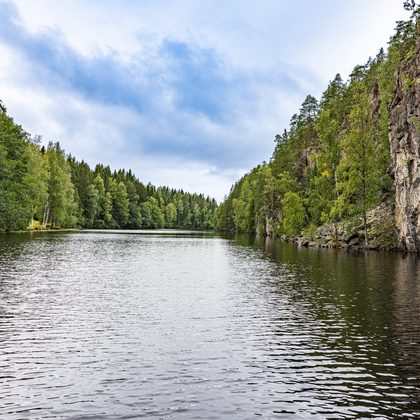
Oxbow lakes, cut-off meanders and slow rivers on broad floodplains, preferably 2 to 6 m deep, with a muddy bed, rich marsh and aquatic vegetation, shrubs and primary forest on the banks, and plenty of bottom-living invertebrates. The banks must be firm enough to dig into and rise above normal high water. The species depends on a natural flood regime: in spring the animals move to higher banks during high water and return to the oxbows afterwards. Where floodplains have been embanked, drained or replaced by reservoirs, the species disappears.
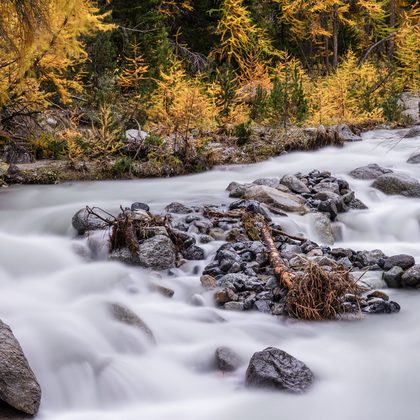
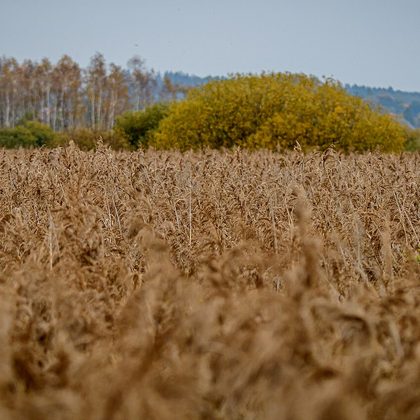
Where the animal is most at home, classified with EUNIS — the European standard for habitats.



Distribution
Now restricted to scattered populations in the Volga, Kama, Don and Ural basins in European Russia, north-west Kazakhstan along the Ural, and eastern Ukraine. In Ukraine it formerly lived along the Dnieper and the Siverskyi Donets; the Dnieper population vanished in the 1930s and the Donets population in the 1970s. The only surviving Ukrainian population, along the Seym and two tributaries in Sumy oblast, derives from animals released from 1961 onwards in neighbouring Kursk oblast in Russia; the last documented sighting there dates from 2018. Outside the guide area it has been introduced into the Ob basin in western Siberia. Fossils show that desmans once ranged much further west, as far as the British Isles.
- Native
- dark = core range, pale = thinly spread
Way of life
Active mainly at dusk and at night. The desman swims with its hind feet and tail and can stay underwater for several minutes, searching the bottom with its snout. The diet includes bivalves, snails, leeches, insect larvae, crustaceans, earthworms, and also frogs and small fish, supplemented by aquatic plants such as horsetail, water plantain, pondweed, reed and water lily. Outside the breeding season it is tolerant: up to eight animals may share a burrow. Pairs are monogamous during the breeding season. Breeding is possible year-round, with a spring peak; after a gestation of 40 to 45 days one to five young are born, most of them in June to August. Males mature at four to six months, females at nine to eleven. Adults move over several kilometres: up to 7 km downstream and 2 to 3.5 km upstream. In winter they remain active under the ice.
Where and when to look
The Russian Desman is rarely seen in the wild: it is shy, mainly nocturnal, and lives in waters where it withdraws beneath the bank at the slightest disturbance. Records come mainly from counts of occupied burrows in nature reserves along the Oka, the Khopyor and the middle Volga, carried out by conservation agencies and researchers. A visitor to those areas can contribute most by not disturbing the species: setting or leaving no fishing nets in oxbow lakes, and keeping away from steep banks with burrows. A record of a live or dead animal, with a photograph and a precise location, is used by conservation programmes.
Conservation status
Critically Endangered (2023). Around 1930 the total population was estimated at 600,000 to 800,000 animals; a 2018 review still gave just over 13,000 animals in Russia, and the latest assessment puts the number in Russia at probably fewer than 4000, with an estimated decline of 83 per cent over the preceding decade. In Ukraine at most a few hundred remain. Before the First World War 100,000 pelts a year were sold in Ukraine alone, but the present causes lie elsewhere. The main one is by-catch in stationary fishing nets, which are often left submerged for long periods and in which desmans drown. Added to this are changes to floodplains through dams, drainage and reduced spring floods, drought and climate change, pollution, livestock on the banks, predation by introduced American mink and competition with muskrats. In Ukraine the effects of the war have been added since 2022. The species is legally protected in Russia, Ukraine and Kazakhstan and is listed in the national Red Data Books of all three countries.
Scientific name
Desmana moschata | (Linnaeus, 1758)
Linnaeus described the species in 1758 as Castor moschatus; because it was later moved to another genus, the author and year stand in brackets. Desmana is the Swedish word desman, 'musk', from desmansråtta, 'musk rat'; it reached Swedish through Low German from medieval Latin bisamum, 'musk'. moschata is Late Latin for 'musk-bearing', from moschus, 'musk', after the strong scent of the glands at the base of the tail. The specimen the first description was based on came from Russia.