All species › Rodents › Blind mole-rats › Sandy Mole Rat
Sandy Mole Rat | Spalax arenarius
Spalax arenarius | Spalax arenarius
Spalax arenarius, the Sandy Mole Rat, is a blind mole-rat that occurs only in the Oleshky Sands on the left bank of the lower Dnieper, the largest area of shifting sand in Europe. The range covers about three thousand square kilometres, the smallest range of any Ukrainian mammal. Reshetnik described the taxon in 1939 as a subspecies of Spalax polonicus, from animals at Hola Prystan near the Black Sea; Ognev raised it to a species in 1947, and that status has been broadly accepted since. The species is in the Red Data Book of Ukraine and is depicted on a Ukrainian coin; since 2022 its range has been in the front zone.
Tracks
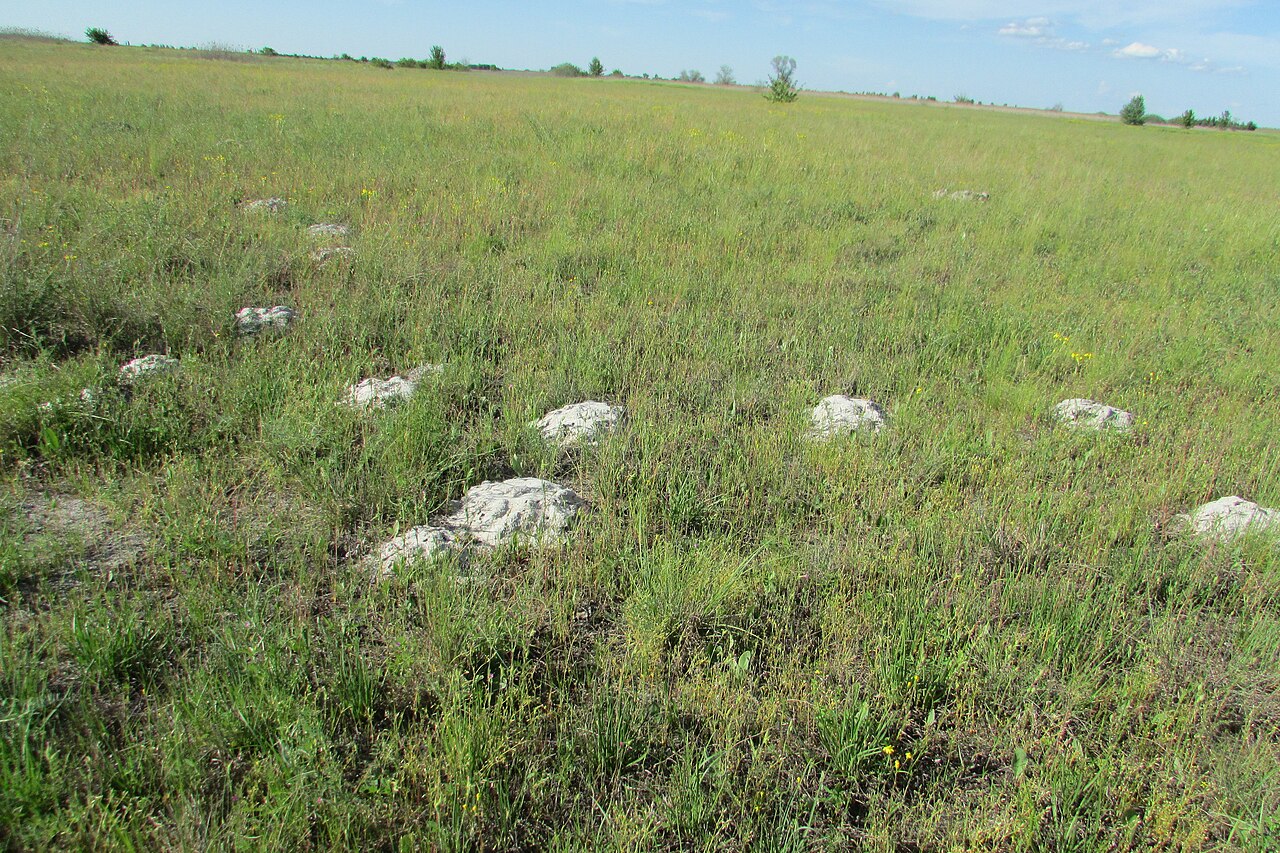
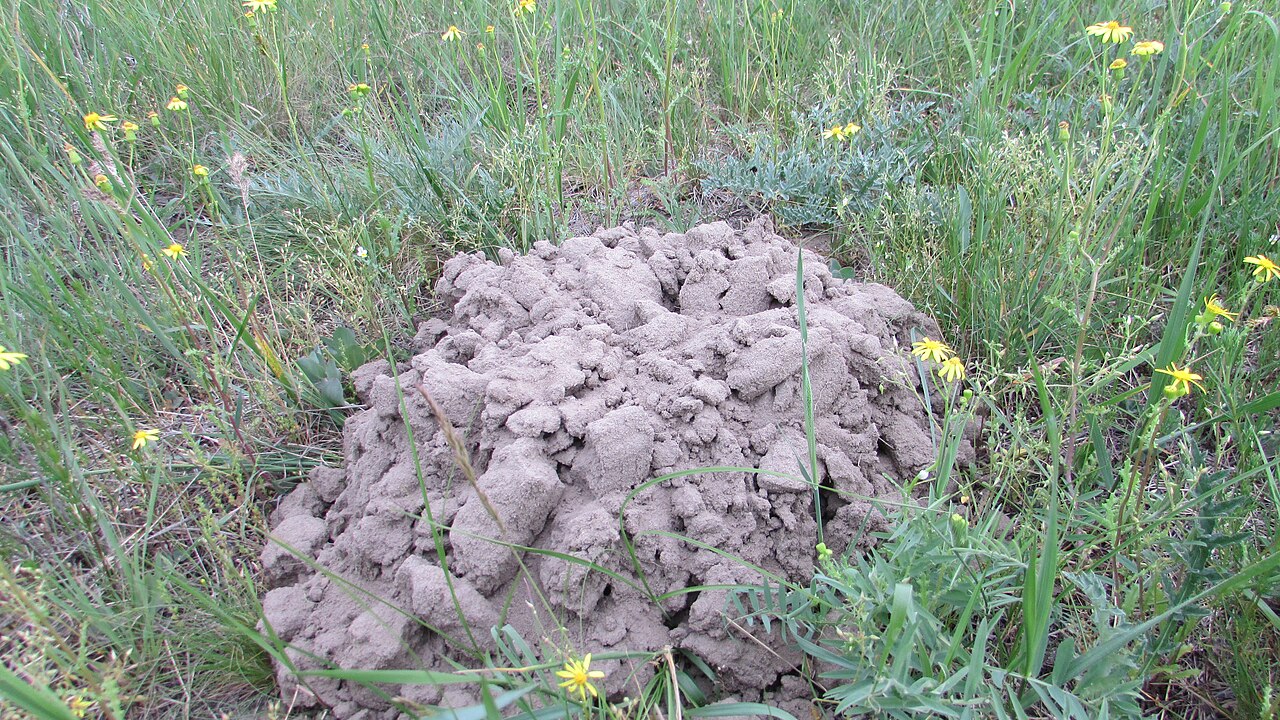
The mounds are usually all that is seen of this animal, and on the pale sand they are clearly visible: round, broad, low-domed heaps thirty-five to ninety-three centimetres across and twenty to forty-five centimetres high, built of coarse clods, without a visible tunnel mouth, because the tunnel is plugged from inside, and lying in groups that make the ground look churned. Fresh mounds are dark and damp; older mounds bleach to a flat, pale patch where the vegetation has been smothered, and such bare patches remain visible for years. Below ground the feeding tunnels run at forty to fifty centimetres, with a total length of up to two hundred metres; vertical shafts connect them to chambers a little over a metre deep. One animal uses an area of more than eighty square metres. Store chambers have been found holding ten to fifteen kilos of gathered root material. There are also gnawed roots of field eryngo, field wormwood and goatsbeard in the tunnel, and patches at the surface where a plant has been pulled down from below.
Head close-up
Identification
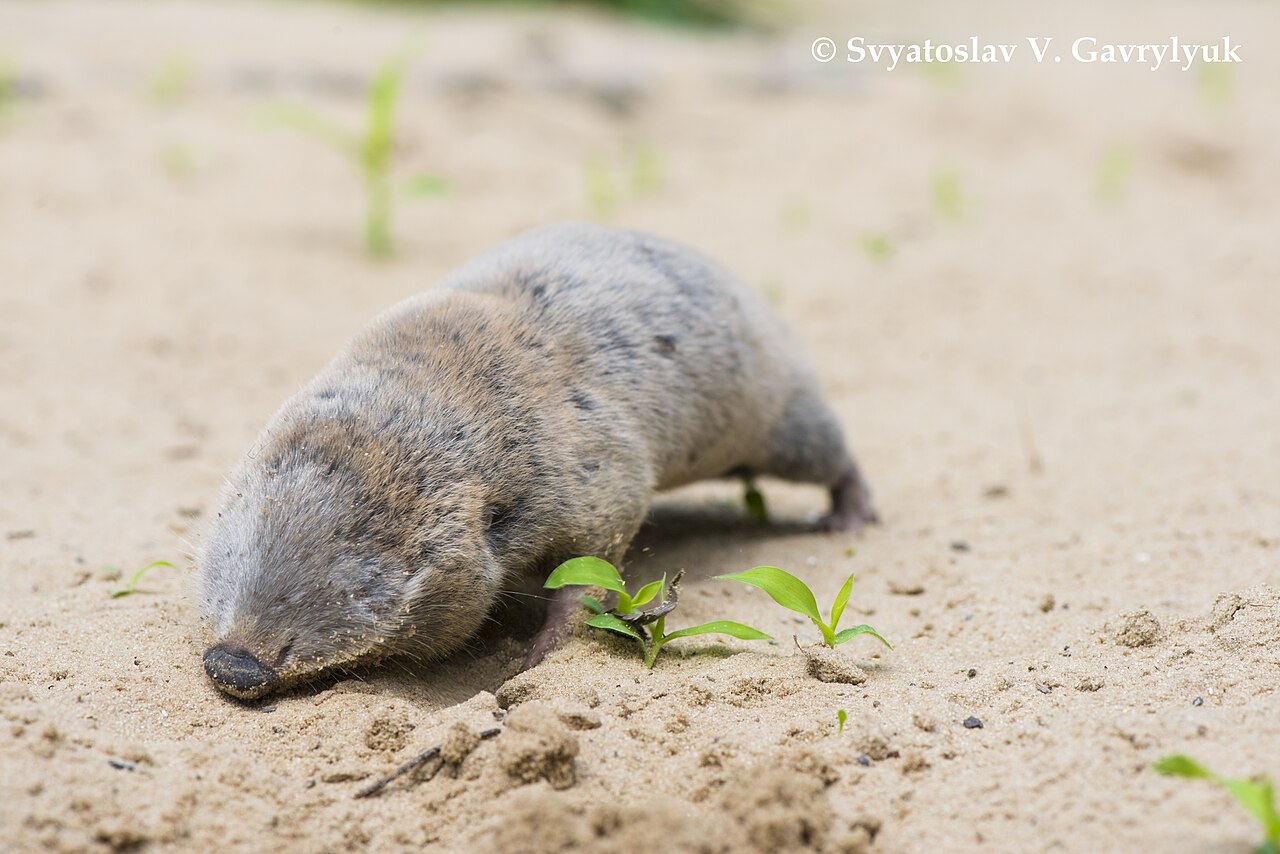
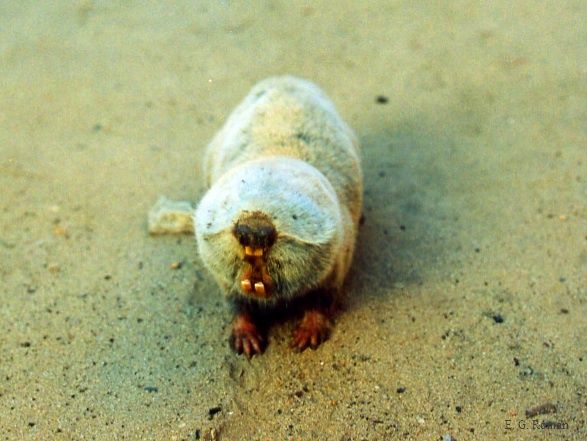
A large and strikingly pale blind mole-rat of 19 to 27.5 centimetres and 380 to 660 grams; males are larger than females. The fur is pale straw-yellow grey, the palest of all European blind mole-rats, with a lighter greyish-white forehead and a pale mouse-grey belly. From the nose pad a fringe of pale yellowish-grey hair runs back to the ear region. Otherwise the build is that of all related species: neckless and cylindrical, with a broad, flat head, a heavy forequarter, no ear pinnae, no visible eyes and no external tail; for the tail none of the sources consulted gives a measurement. The incisors protrude in front of the lips. The chromosome number is 2n = 62; within Spalax 2n = 60 and 62 occur.
Similar species
Within its own genus the species cannot be recognised by sight: all Spalax species have 2n = 60 or 62, so that even a chromosome preparation is not conclusive, and separation rests on skull characters and mitochondrial DNA. The sister species is S. zemni, from which this species is separated by the Dnieper: zemni lives on the right bank, arenarius on the left. The pale coat and the sandy soil are an indication, not proof. The genus can be established by eye, and that is the only field character in this group: a Spalax is twenty to over thirty centimetres long and weighs four to seven hundred grams, a Nannospalax weighs about as much as a large rat and seldom reaches half a kilo; this difference has also been confirmed by DNA (Németh and colleagues, 2013). The mounds show the same: those of this species measure thirty-five to ninety-three centimetres across and twenty to forty-five centimetres high and lie in dense groups, while a Nannospalax places its mounds in a thin line twenty to thirty metres apart. In this area the confusion does not arise: the nearest Nannospalax lives only west of the Tylihul Estuary near Odesa, beyond the range of S. zemni. To be excluded are the mole, much smaller, with shovel-shaped forefeet and a short tail, and the Water Vole, with normal ears, eyes and tail.
Habitat
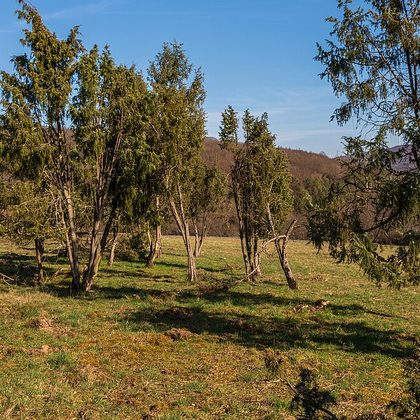
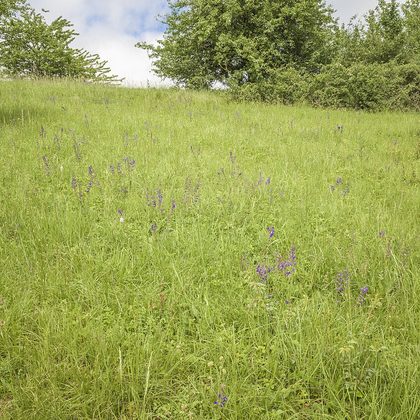
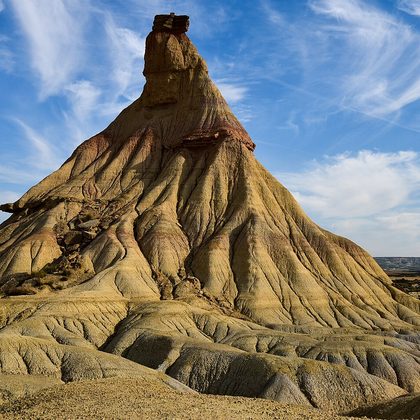
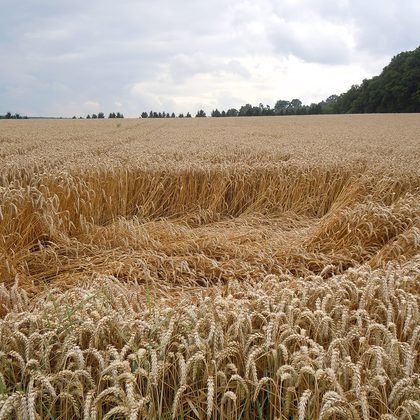
Sparsely vegetated wormwood and spurge steppe on loose sand. The species requires light, moderately moist sandy soil with a low water table and is never found in moving sand, in dry feather-grass steppe or on saline soils; these three limits define its distribution precisely. These conditions come together on the Oleshky sand plain behind the left bank of the Dnieper, with open sand steppe, low scrub and planted pine forest. The afforestation of the sands, intended to fix them and to produce timber, makes the habitat unsuitable.
Where the animal is most at home, classified with EUNIS — the European standard for habitats.

Distribution
Southern Ukraine only. The entire range lies in Kherson Oblast, on the sandy soils along the lower Dnieper on the Black Sea coastal plain, and according to Zagorodniuk and Korobchenko (2023) covers about three thousand square kilometres; the IUCN assessment uses an extent of occurrence of about two thousand. The type locality is Hola Prystan. The area actually occupied is much smaller: about fifty-five square kilometres, known from fewer than five localities. The core lies in and around the Oleshky Sands National Nature Park and the Black Sea Biosphere Reserve. No blind mole-rats occur in the British Isles, the Low Countries or the Iberian Peninsula.
- Native
- dark = core range, pale = thinly spread
Way of life
Entirely subterranean, active round the clock, with most digging at the beginning and end of the day; nothing further has been published on the daily rhythm of this species separately. The species neither hibernates nor keeps a winter rest and lives through the winter on its store chambers. The diet consists of underground plant parts; named in particular are field eryngo, field wormwood and the Ukrainian goatsbeard. The animals are solitary and aggressive towards conspecifics. Density is five animals per hectare in the best habitat and about one per hectare elsewhere. Breeding takes place once a year: mating in March, young in April and May, and a lactation period of about a month. Predators are Red Fox, mustelids, feral dogs and birds of prey.
Where and when to look
The best period is April or May, when the grass in the open sand steppe of the Oleshky Sands is still short. An occupied system is recognisable as a group of broad, low, coarsely clodded mounds close together in the sparse vegetation. Fresh, damp, dark soil means that the animal is living there now; flat, bleached, bare patches are old mounds. Search the open, sparsely vegetated parts, not the pine plantations or moving sand, where the species does not occur. The animal itself is rarely seen. The area has been a war zone since 2022; large parts cannot be entered safely, and a visit is advised against for the time being.
Conservation status
Endangered (2024), with a considerable chance of a higher category at the next assessment. The starting situation was already unfavourable: an extent of occurrence of about two thousand square kilometres, an area of occupancy of about fifty-five, fewer than five known localities and a total population estimated at fifteen to twenty thousand animals. The long-standing threat is the afforestation of the sands, planted against sand drift and for timber production, which removes the sparse steppe on which the species depends. Since 2022 the war has been added: the destruction of the Kakhovka dam flooded part of the area, and trenches, shelling and fires have further damaged the habitat. The population is estimated to have declined by about half in 2022 and 2023. The species is in the Red Data Book of Ukraine and protected in the Black Sea Biosphere Reserve and the Oleshky Sands National Nature Park, but that protection cannot be enforced in the front zone.
Scientific name
Spalax arenarius | Reshetnik, 1939
Reshetnik described the species in 1939 and placed it straight away in the genus where it still stands. Spalax is Greek spalax, also aspalax, 'mole'. arenarius is Latin for 'of the sand', from arena, 'sand'; the animal lives in the blown sands of the lower Dnieper. The specimen the first description was based on came from Ukraine, Nikolaev.