All species › Rodents › Voles and hamsters › Sicilian Pine Vole
Sicilian Pine Vole | Microtus nebrodensis
Microtus nebrodensis | Microtus nebrodensis
Microtus nebrodensis is the only vole on Sicily and has no vernacular name in common use. Until recently it was treated as a subspecies of Savi's Pine Vole. DNA studies showed that the Sicilian animals are not most closely related to the Italian ones but occupy a basal position in the whole group. The species is therefore regarded as an old, isolated lineage that has persisted on the island in a refugium. Because no other vole occurs on Sicily, identification on the island is unambiguous.
No photograph of a living wild animal of this species with a suitable Creative Commons licence exists. Do you have one that meets the rules? Send it in.
Tracks
The signs are those of the related mainland species; because no other vole occurs on Sicily, they can be assigned unambiguously. In the mountain pastures of the Madonie and Nebrodi, in cereal stubble, in almond and olive groves and along field margins lie lines of small, low heaps of very fine earth with plugged entrances. The tunnels lie shallow, usually within half a metre of the surface, with a diameter of about three centimetres. The mole is absent from Sicily; earth heaps on the island therefore come from this vole or from human digging. The feeding sign is that of the whole group: bulbs, tubers and roots gnawed from below, roots of young almond, olive and citrus trees peeled just below the surface, and ringed stems in winter. Droppings are four to six millimetres long, cylindrical with blunt ends, in latrines in the tunnel. Pellets of the Barn Owl, commonly found under old buildings on Sicily, are the quickest way to establish the presence of the species.
Identification
A medium-sized pine vole; at 9.6 to 10.4 cm head-body length the largest of the savii group. Rounded head, blunt muzzle, very small eyes and short ears sunk in the fur. The tail, at 1.6 to 2.6 cm, is very short, less than a quarter of head-body length. The coat is brown with a buff wash above and silvery grey shaded yellowish below. The literature gives two internal differences from Savi's Pine Vole: females have six nipples (two inguinal pairs and one pectoral pair) against four in Savi's Pine Vole, and the vertebral column has 45 vertebrae against 47 in Savi's Pine Vole.
Similar species
No other vole occurs on Sicily; any short-tailed, small-eyed, burrowing vole on the island is this species. The other small rodents are easily separated: the Wood Mouse has very large ears, bulging eyes and a tail as long as the body, and moves by bounding; the House Mouse is grey, with a pointed muzzle and a naked, scaly tail; Black Rat and Brown Rat are much larger. Confusion is more likely with the shrews of Sicily, which have a pointed, mobile snout. On the Italian mainland Savi's Pine Vole lives in the north and centre and Microtus brachycercus in the south; both are externally indistinguishable from this species. The Strait of Messina forms the boundary, so that assignment by locality is possible.
Habitat
Open and half-open country with diggable soil: dry and moderately moist grassland, cereal fields, fallow, field margins, almond, olive and citrus groves, and the edges of oak and beech woodland and Mediterranean maquis. The species occurs from 175 to about 1,700 m, from the coastal plain into the high Madonie. The main requirement is soil deep and soft enough to dig; bare rock and hard, strongly dried-out ground are avoided.
Where the animal is most at home, classified with EUNIS — the European standard for habitats.
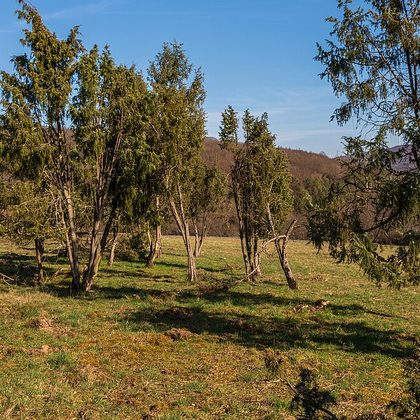
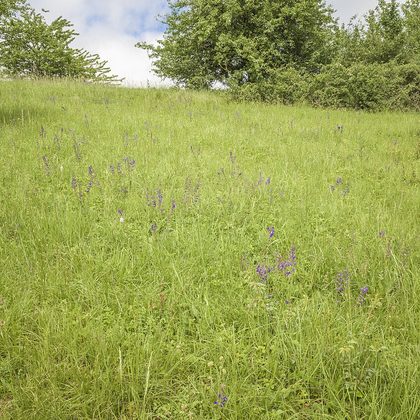
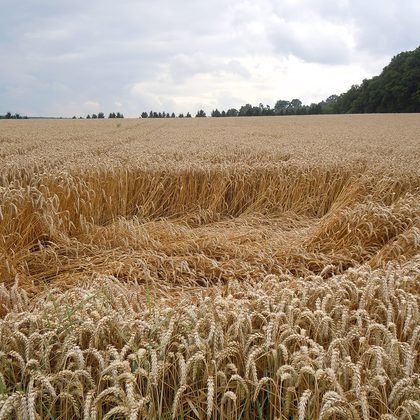


Distribution
Sicily only. The species is distributed across the island, with the Madonie, where the type locality lies, and the Nebrodi as its core area. It has not been recorded on the surrounding islands (Egadi Islands, Aeolian Islands, Pantelleria, Lampedusa); the Italian mainland is occupied by two other species of the group. GBIF holds six records with coordinates; this number reflects the low research effort, not abundance.
Way of life
Almost nothing has been recorded. It is established that the species digs and spends most of its life underground, that it is herbivorous with a large share of underground plant parts, and that it remains active all year. Diet, litter size, breeding season, social organisation and home range have not been studied on Sicily. What the literature states on these points derives from Savi's Pine Vole on the mainland, now regarded as a different species, and does not necessarily apply to this species.
Where and when to look
In spring, after a night of rain, walk the edges of fields and groves in the mountain pastures of the Madonie or Nebrodi; lines of fresh earth heaps without an open hole are on Sicily made by this species. In almond and olive groves, young trees wilting without visible cause indicate feeding damage; peeled roots confirm it. The animal itself can only be observed with much patience or through trapping studies. Barn Owl pellets from old barns or church towers give certain identification on an island with a single vole species.
Conservation status
Least Concern (2024). The species was recognised in its own right only recently and was previously assessed within Savi's Pine Vole. It is distributed across Sicily and locally numerous. Its main vulnerability is that of any island endemic: there is no second range. In groves and gardens it is regarded as a pest and controlled, with the same side effects for Barn Owl, Kestrel and Weasel as elsewhere. Almost all data on population size, trend and ecology are lacking.
Scientific name
Microtus nebrodensis | (Minà-Palumbo, 1868)
Minà-Palumbo described the species in 1868 as Arvicola nebrodensis; because it was later moved to another genus, the author and year stand in brackets. Microtus is Greek, from mikros, 'small', and ous, genitive ōtos, 'ear', after the small ears hidden in the fur. nebrodensis means 'of the Nebrodi', the mountains of northern Sicily; the ancient name Nebrôdê is read as 'mountains of the fawns', from Greek nebros, 'fawn'. The specimen the first description was based on came from Italy, Sicily.