All species › Rodents › Voles and hamsters › Altai Vole
Altai Vole | Microtus obscurus
Microtus obscurus | Microtus obscurus
Microtus obscurus is a vole of the Common Vole group that cannot be distinguished from the Common Vole externally, by the skull or by the teeth. The difference lies in the chromosomes: both species have 46, but the Common Vole has four pairs with the centromere at the end and this species ten. Most of the range lies in Central Asia; in Europe the species occurs only in the extreme south-east, including Crimea, where some of the grey voles recorded as Common Vole belong to this species.
No photograph of a living wild animal of this species with a suitable Creative Commons licence exists. Do you have one that meets the rules? Send it in.
Tracks
The signs are those of the Common Vole and do not settle the species, only the presence of grey voles. In short, dense grassland the runway system lies under the sward: swept tunnels three to four centimetres wide linking the burrow entrances. The entrances are round holes about three centimetres across, usually without a spoil heap, often five to fifteen together. The tunnels descend to twenty to twenty-five centimetres and the systems reach thirty to thirty-five centimetres deep, with several nest chambers. Along the runs lie clipped grass stems: obliquely cut lengths of two to five centimetres in small heaps at the side. Droppings are four to seven millimetres long, cylindrical with blunt ends, grass-green when fresh and brown later, in small latrines at fixed points. After the thaw the winter nests of finely clipped grass lie on the field as fist-sized yellow balls. In winter bark is gnawed at the base of young fruit trees. All these signs apply equally to the Common Vole; they indicate the group, not the species.
Identification
Externally identical to the Common Vole: a thickset greyish-brown vole with a rounded blunt head, small eyes and ears projecting just above the fur, and a short tail about a third of head-body length. The coat is dull yellowish grey to yellowish brown above and off-white to pale grey below, with a fairly sharp division on the flank; the tail is lightly haired and bicoloured. The measurements given are those of the Common Vole. No separately measured series exists for this species within the same source, and separate figures would imply a difference that has not been demonstrated.
Similar species
Against the Common Vole there is no field character. Coat, size, tail length, ear shape, cheek teeth and enamel pattern are the same; the relationship is so close that whether one or two species are involved has not been settled definitively. The difference lies in the karyotype: both have 2n = 46, but the Common Vole has four pairs of acrocentric chromosomes and this species ten. The two lineages separated about 130,000 years ago, during the Eemian. In central Russia they meet in a parapatric contact zone at most ten kilometres wide, in the Vladimir, Nizhny Novgorod, Kursk and Lipetsk regions. Hybrids occur there, but gene exchange is one-directional: nearly all hybrids carry the mitochondrial DNA of the Common Vole. The same region holds the Southern Vole (M. rossiaemeridionalis), which also looks the same but is unambiguously recognisable with 2n = 54 from a chromosome preparation. From other species this vole can be separated in the field: the Field Vole is shaggier and darker, with smaller ears hairy inside; the Bank Vole has a reddish-brown back and a tail about half the body length; the European Ground Squirrel has an entirely different build; Microtus socialis in the southern steppes is smaller, paler yellow and shorter-tailed.
Habitat
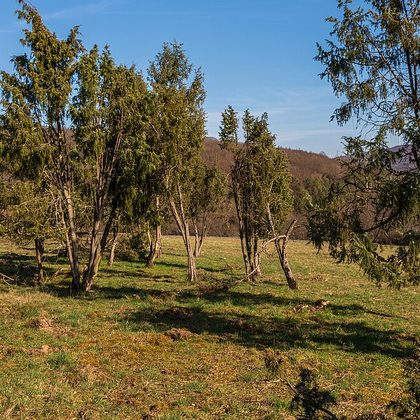
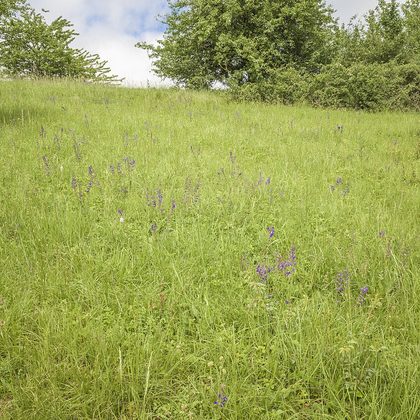
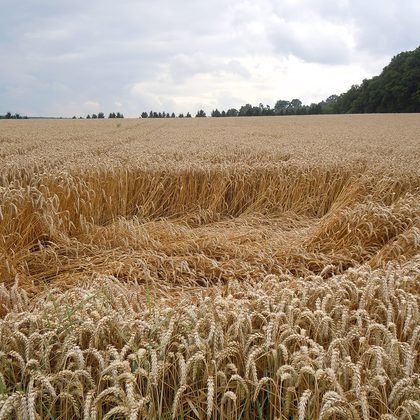
Open, dry to moderately moist grassland and arable land: steppe and steppe-like pasture, cereal fields, lucerne, field margins, fallow, road verges and railway embankments, and in the mountains alpine and subalpine meadows, in the Caucasus and the Anatolian ranges above two thousand metres. Like the Common Vole, the species requires a dense sward on diggable soil and avoids woodland, marsh and dense scrub.
Where the animal is most at home, classified with EUNIS — the European standard for habitats.



Distribution
Most of the range lies in Asia: the Altai and Tien Shan, Mongolia, north-western China, Kazakhstan, Iran, the Caucasus and eastern Anatolia. In Europe the species occurs only in the extreme south-east. The best-documented European populations live in Crimea, where the grey voles of the uplands and the southern coast are assigned to this species; there are also records from eastern Ukraine and along the lower Don and Kuban. Further west lives the Common Vole; where the two species meet in central Russia, the contact zone is at most ten kilometres wide. The species does not occur in western and central Europe; reports under this name from western Europe rest on an older, broader use of the name and refer to the Common Vole.
Way of life
As the Common Vole: active in short bouts spread over day and night, with the emphasis on daytime, living in colonies in a shallow tunnel system with nest and store chambers, and almost wholly herbivorous: grasses, herbs, cereals, lucerne, roots and tubers, and in winter bark and rhizomes. Breeding runs from early spring into autumn, with litters every three weeks. Numbers show the same multi-year fluctuations as in the Common Vole, with consequences for predators in steppe and farmland. There is no winter dormancy; the species is most active under snow. Whether and how its way of life differs from that of the Common Vole has not been studied, because the two species cannot be told apart in the field.
Where and when to look
In the field nothing can be observed in this species that cannot also be seen in the Common Vole. Certain identification requires karyological or genetic study. When recording an observation the locality determines the most probable species: in Crimea and on the Black Sea coast of the Caucasus a grey vole is probably this species rather than the Common Vole. Signs can be found in the runways in the grass, and Barn Owl pellets give information on the presence of the group. An observation without genetic confirmation is best recorded as 'grey vole, Microtus arvalis group'.
Conservation status
Least Concern (2025). Over a large range from eastern Europe to Xinjiang the species is locally very numerous. In the farmland of Kazakhstan, the Caucasus and Anatolia it is, like the Common Vole, regarded as a pest and controlled, with the same consequences for raptors and carnivores that feed on it. Because the species is not recognised in the field, it is not counted separately and is included under the Common Vole in monitoring data. No data are therefore available on its status and trend in the European part of the range.
Scientific name
Microtus obscurus | (Eversmann, 1841) (GBIF: Microtus arvalis)
Eversmann described the species in 1841 as Hypudaeus obscurus; because it was later moved to another genus, the author and year stand in brackets. Microtus is Greek, from mikros, 'small', and ous, genitive ōtos, 'ear', after the small ears hidden in the fur. obscurus is Latin for 'dark, dusky', after the dark coat of the animals Eversmann described. The specimen the first description was based on came from Russia.