All species › Rodents › Birch mice › Southern Birch Mouse
Southern Birch Mouse | Sicista subtilis
Driekleurige muis | Ratón Listado De Las Estepas
The Southern Birch Mouse (Sicista subtilis) is a birch mouse of open steppe with a black dorsal stripe, flanked on either side by a pale band and beyond that by a second, fainter dark stripe. It is nocturnal, feeds largely on insects and hibernates from September to April. Since the taxonomic revision of 2016 the name covers only the eastern steppe populations; the European populations formerly included have been assigned to other species.

Tracks
Prints, droppings and feeding signs of this species cannot be identified to species. In summer it builds an underground summer nest, usually in an abandoned tunnel of another rodent or dug in the loose steppe soil; the nest is ball-shaped and made of fine grass. In September hibernation begins in the same place or in a deeper chamber, the animal curled with the tail round its body; it lasts until April. Above ground it climbs: a small rodent climbing the stems of tall steppe herbs at night and holding on with its tail is a birch mouse and not a vole or a true mouse. The species is recorded with pitfall traps, the only method that reliably catches birch mice because they do not enter ordinary live traps, and in pellets of barn and short-eared owl, in which the small jaws can be identified to genus. Identification to species requires genetic analysis.
Identification
A very small steppe rodent, head and body averaging about 6.5 cm and seldom over 7.5 cm, with a tail 110 to 130 per cent of the head-body length; the tail is thin and two-toned, dark above and pale below. The hind foot is shorter than 15.7 mm. The back is pale grey-buff to dark grey, the belly whitish. The pattern is diagnostic for the group: a sharp black dorsal stripe from the nape to the base of the tail, flanked on both sides by a pale band and outside that by a second, less sharply defined dark lateral stripe beginning at the shoulder. The Dutch name, driekleurige muis ('three-coloured mouse'), refers to this pattern. The ears project above the fur, the eyes are large and black, the muzzle is pointed.
Similar species
In the field this species cannot be separated from its closest relatives. The striped steppe birch mice S. subtilis, S. loriger (Nordmann's Birch Mouse), S. severtzovi, S. cimlanica and S. trizona share the same three-part pattern, the same measurements and the same build. Until 2016 they were treated under one name; since then the split has rested on chromosome numbers, mitochondrial and nuclear DNA and, to a lesser degree, the shape of the penis bone. There is no character usable in the field or on a photograph. The stripe pattern does place the group: a birch mouse with only a black mid-line and no pale flank bands belongs to the betulina group, that is the Northern Birch Mouse itself or Sicista strandi; these live in woodland and forest-steppe rather than open steppe. Within the striped group the species follows from the distribution. S. subtilis in its present narrow sense lives in the steppes east of the Don and the Volga and on into Siberia. Striped birch mice in Hungary, Romania, Ukraine and Moldova are S. trizona or S. loriger. True mice are excluded by these features: the Harvest Mouse is russet without a stripe, the Wood Mouse is much larger with large ears, and neither combines a dorsal stripe with a tail longer than head and body.
Habitat
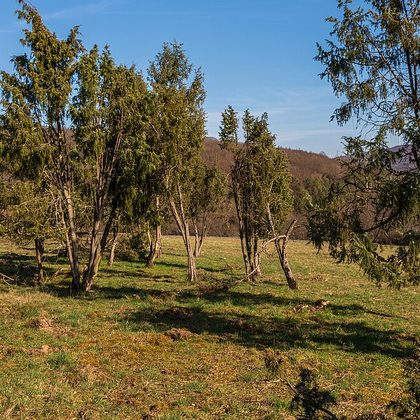
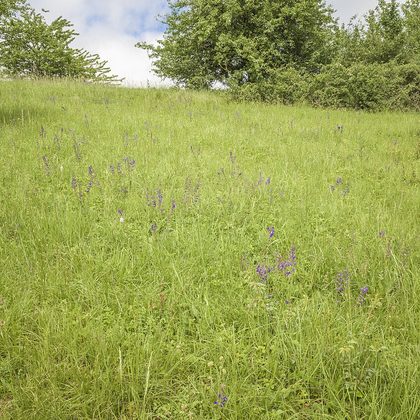
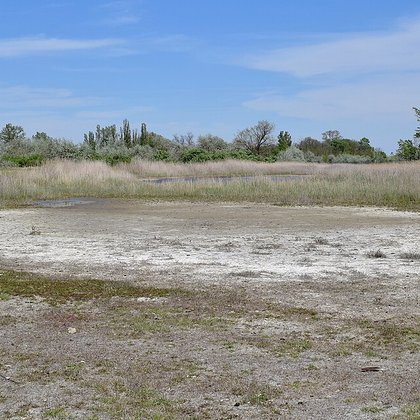
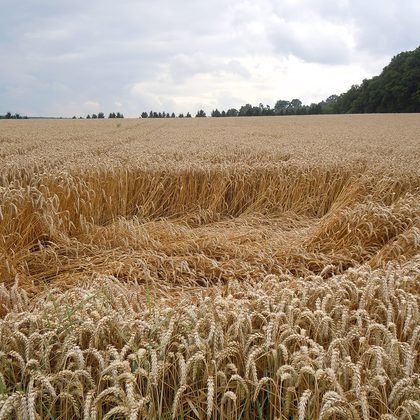
Open, unploughed steppe: feather-grass and herb-rich steppe, dry and slightly saline grassland, tall-herb stands and field margins, locally also forest-steppe and the edge of semi-desert. The species needs a dense, tall herb layer for climbing and cover, and loose soil for its summer and winter burrows; ground grazed bare or ploughed every year is unsuitable. Densities are highest in undisturbed old steppe with a varied vegetation structure; it also occurs in neglected field edges, railway embankments and fallow land.
Where the animal is most at home, classified with EUNIS — the European standard for habitats.

Distribution
Since the 2016 revision this is a species of the eastern steppes: south-eastern Russia and Kazakhstan, east into Siberia and possibly to northern Mongolia and northern Xinjiang. In Europe it occurs only in the steppes of southern Russia. The European populations that older literature mapped under this name from Austria to Ukraine have been divided over three species: S. trizona in the Carpathian Basin, S. loriger in Ukraine, Moldova, Romania and Bulgaria, and S. severtzovi in the Don region. The species does not occur in central or western Europe. No birch mice live in Britain and Ireland, the Low Countries or the Iberian Peninsula; the westernmost birch mouse is the Northern Birch Mouse (Sicista betulina) in Denmark, Norway, Poland and the Czech and Slovak mountains.
- Native
- dark = core range, pale = thinly spread
Way of life
Nocturnal, sometimes also active at dusk. It climbs in the herb layer, using its long tail. The diet consists mainly of insects and other invertebrates, supplemented with seeds, bulbs, green material and plant debris; the proportion of animal food is high for a rodent. Hibernation lasts from September to April; breeding and building up reserves fall within the active period in between. Breeding runs through the summer with a peak in May and early June; gestation is at least 25 days, the litter averages 5.5 young and lactation lasts 33 to 35 days. Life expectancy is one to two years. Predators include fox, stoat, steppe polecat, great grey shrike and above all barn and short-eared owl.
Where and when to look
The species is mostly encountered by chance and at night. Search with a lamp after sunset in May or June along an unploughed steppe slope or an overgrown field margin in southern Russia or Kazakhstan, and watch the stems of tall herbs: a small animal climbing up them instead of running across the ground is a birch mouse. For a reliable record the method is the same as for other small steppe rodents: collect and dissect barn and short-eared owl pellets and have the species confirmed genetically. Trapping requires a licence, and then with pitfall traps; a birch mouse does not enter an ordinary live trap.
Conservation status
Least Concern (LC, 2017). This assessment covers the species as delimited in 2016, that is the widespread steppe population of south-eastern Russia, Kazakhstan and Siberia, where it is locally common. It does not apply to the European edge populations formerly included under this name, which now belong to other species: S. trizona is listed as Endangered and S. loriger as Critically Endangered. The threats are the same for all species of the group and also affect S. subtilis at the western edge of its range: ploughing of the steppe, conversion to cereals, overgrazing and steppe fires. Because the animals spend a large part of the year hibernating underground, they do not survive deep cultivation. Occurrence depends on the retention of old, uncultivated steppe.
Scientific name
Sicista subtilis | (Pallas, 1773)
Pallas described the species in 1773 as Mus subtilis; because it was later moved to another genus, the author and year stand in brackets. Sicista is neither Latin nor Greek. Gray took the word over in 1827 without saying where from; it is generally referred to a vernacular name for the mouse in the Russian and Tatar language area, but which one is not settled. subtilis is Latin for 'fine, slender'. The specimen the first description was based on came from Russia, Kurgan.