All species › Rodents › Birch mice › Strand's Birch Mouse
Strand's Birch Mouse | Sicista strandi
Sicista strandi | Sicista strandi
Sicista strandi, Strand's Birch Mouse, is a birch mouse of the steppes and forest-steppes of southern Russia and eastern Ukraine. It was recognised as a separate species only recently and can be distinguished from its northern sister species, the Northern Birch Mouse, only by chromosome number and the structure of the baculum. Externally it is a very small animal with a tail one and a half times the body length and a black stripe down the back.

Tracks
For an animal of about ten grams that climbs in the herb layer at night, no prints, droppings or feeding signs are known that can be identified. Birch mice do sometimes leave a ball-shaped nest of grass and leaves in autumn under a fallen trunk, in a hollow stump or in an abandoned mouse burrow, and they dig their own winter burrow, in which they hibernate for up to eight months at a stretch, curled with the tail wound spirally round the body. Such burrows are found almost only during digging. Evidence in practice comes from pitfall traps, the only trapping method that reliably records birch mice, and from pellets of Barn Owl and Short-eared Owl, in which the tiny jaws can be assigned to the genus by their tooth pattern. The species then requires genetic analysis or a measurement of the baculum. In the field behaviour is an indication: birch mice climb, which is unusual in small rodents; a small mouse climbing up between the stems of tall herbs in the dark and holding on with its tail is not a Wood Mouse.
Identification
A very small rodent, head and body 6 to 7.5 cm, with a tail of 8.5 to 10 cm, one and a half times the head-body length, thin, sparsely haired and used with a slight grip when climbing. The back is reddish to yellowish brown with fine black speckling, the belly greyish white. Down the middle of the back, from the nape to the base of the tail, runs a sharp black dorsal stripe; it is narrow and lacks the pale flanking bands of the steppe species. The ears project clearly above the fur, the eyes are large and black, the muzzle is pointed. Animals from the Caucasus are paler. It weighs a few grams and is smaller than a House Mouse.
Similar species
The birch mice of Europe cannot be identified to species in the field. S. strandi is externally almost identical to the Northern Birch Mouse (Sicista betulina), its sister species. Separation rests on two characters not visible in the field: the chromosome number, 44 in strandi against 32 in betulina, and the structure of the baculum, which in strandi is longer and lacks the distal widening of betulina. Beyond that only range helps: betulina lives in the north and in the mountains of central Europe, strandi in the forest-steppe of southern Russia and eastern Ukraine, and the ranges barely touch. The striped steppe species (S. subtilis, S. loriger, S. severtzovi and S. trizona) have, besides the black mid-line, pale flank bands and a second pair of dark lateral stripes; this is the only character in the genus usable with the naked eye, and it separates a group, not a species. The same applies to the Caucasian group (S. caucasica, S. kluchorica, S. kazbegica), which occurs in the same mountains. A mouse with a tail one and a half times its body and a stripe down its back can be recorded in the field as a birch mouse (Sicista); the species requires laboratory analysis.
Habitat
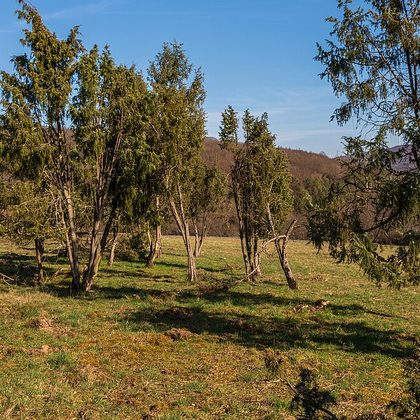
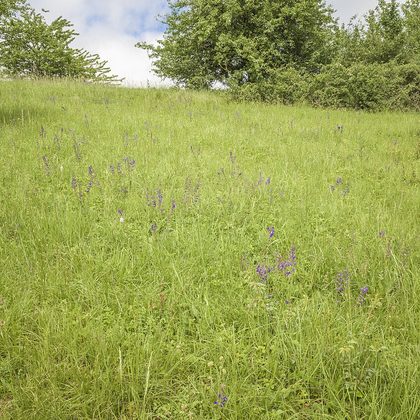
Forest-steppe: island woods, valley woods and floodplain forest on the southern Russian plain and in the northern Caucasus, and the rough transitions where the species is most often caught: ravine slopes with tall herbs, scrub in the steppe, wood edges, shelterbelts and stands of sage and feather grass. It needs a dense, tall herb layer to climb in and loose soil to dig its winter burrow; heavily grazed steppe and bare arable are avoided. In the Caucasus it occurs up to about 2100 metres, and in the Usman pine forest near Voronezh also in coniferous woodland.
Where the animal is most at home, classified with EUNIS — the European standard for habitats.


Distribution
The steppes and forest-steppes of southern Russia and eastern Ukraine: from the southern part of the Central Russian Upland (near Kursk) and the Volga Upland south to the Greater Caucasus, with the northern and eastern limits not yet clearly defined, with the type locality in Karachay-Cherkessia at 2100 metres. In Ukraine the only reliable localities are in Luhansk oblast, nearly all in the protected steppes of Striltsivskyi Step and Provalskyi Step; there the species is listed as Vulnerable in the national Red Book. In Russia it is included in the red books of Lipetsk, Tambov and Kursk oblasts. Within the guide area it is confined to the far east, in the Don steppes and the Caucasus.
- Native
- dark = core range, pale = thinly spread
Way of life
Active at dusk and by night, with some daytime records. The species climbs well in shrubs and tall herbs, using the long tail for support. For a rodent the diet consists to a large extent of animal matter: mainly insects and other invertebrates, supplemented with berries, fruit and seeds of steppe plants and green plant material. Hibernation begins in late summer or early autumn and lasts until April or May, so that the animals sleep up to eight months of the year and the active period is limited to a short summer. Mating begins soon after waking; there are one, sometimes two litters a year of three to six young. The animals rarely live beyond one or two years. Predators are Red Fox, Stoat, Weasel, birds of prey and above all owls.
Where and when to look
The species is rarely seen in the field. The best chance is in May, June or July in the protected steppes of Luhansk or in a valley wood in the black-earth zone: at late dusk, search along a ravine edge with tall herbs for a small animal climbing a stem instead of running along the ground. Joining ongoing research is more practical; birch mice are found almost only in pitfall traps, and that work requires a licence. The species occurs in Barn Owl pellets from the Don steppes, and pellet analysis is the most common way of encountering it.
Conservation status
Least Concern (2016). Across the whole range the species is widespread and not rare, and most of that range lies in thinly populated southern Russian forest-steppe. At the western edge the situation is different. In Ukraine it is regarded as Vulnerable and all reliable localities are confined to a few protected steppe reserves in Luhansk; in three Russian oblasts it is also on the regional red list. The causes are the ploughing of the last rough slopes and wood edges, the felling and fragmentation of island woods, and fires that sweep the steppe in dry years. Because the animals spend up to eight months a year underground, they are also highly vulnerable to cultivation and to fires that burn deep into the litter layer.
Scientific name
Sicista strandi | Formozov, 1931
Formozov described the species in 1931 and placed it straight away in the genus where it still stands. Sicista is neither Latin nor Greek. Gray took the word over in 1827 without saying where from; it is generally referred to a vernacular name for the mouse in the Russian and Tatar language area, but which one is not settled. strandi honours the Norwegian zoologist Embrik Strand (1876–1947), professor at Riga and founder of the journal in which Formozov published the name. The specimen the first description was based on came from Russia, Karachay-Cherkess.