All species › Rodents › Voles and hamsters › Southern vole
Southern vole | Microtus rossiaemeridionalis
Oostelijke veldmuis | Microtus levis
The Southern Vole and the Common Vole are two separate species that do not interbreed, that occur in the same meadows in Ukraine, Belarus and the Balkans, and that cannot be distinguished by appearance. They were separated only in 1972, on chromosome number: 54 against 46. The species is one of the most numerous mammals of eastern Europe and also occurs in urban areas, including Moscow.

Tracks
The signs are the same as those of the Common Vole and indicate the group, not the species. In dense, tall grass and in reedbeds a runway system of swept tunnels 3 to 4 cm wide lies beneath the vegetation. The entrances are round holes about 3 cm across without a spoil heap; it digs extensive systems with many entrances, tunnels descending 20 to 25 cm and complexes up to 30 to 35 cm deep, with several nest chambers. Along the runways lie heaps of obliquely clipped grass stems 2 to 5 cm long, with the seed heads eaten off. Droppings are 4 to 7 mm, cylindrical with blunt ends, grass-green when fresh, in small latrines. After the thaw the winter nests of finely clipped grass lie on the ground as yellow balls. This species is more granivorous than the Common Vole, so its store chambers more often contain grain and seeds. In pellets of Barn, Long-eared and Short-eared Owl the two species cannot be separated either; a cheek tooth is recorded as 'Microtus arvalis group'.
Identification
A thickset, greyish-brown vole, on average slightly larger and longer-tailed than the Common Vole: head-body 10.2 to 13 cm, tail 3.3 to 5.5 cm, weight 21 to 58 g; males are heavier than females. Short, stout build with a large head and blunt muzzle, medium-sized eyes and ears that project clearly above the fur. The back is dark brown with a buff wash and black-tipped hairs, the underside greyish white. Females have eight nipples, in pectoral and inguinal pairs. The measurements overlap almost completely with those of the Common Vole; a large, long-tailed individual is an indication, not proof.
Similar species
Against the Common Vole neither field characters nor characters in the hand are conclusive. Coat, colour, ear shape, tail ratio and the enamel pattern of the cheek teeth are the same in both; the distinction was made in 1972 on the karyotype — 2n = 54 in this species against 2n = 46 in the Common Vole — and confirmed by the failure of crosses in captivity. A refined craniometric method assigns a high proportion correctly in Europe and Asiatic Turkey, but it is a statistical method for series of skulls, not a character for a single animal. Two weak indications, never sufficient on their own: this species is on average larger and longer-tailed, and it occurs more often in tall, dense herbaceous cover, wet meadows, marsh edges and reedbeds, whereas the Common Vole prefers short, dry ground. In the east and south-east Microtus obscurus also occurs, which looks the same and at 2n = 46 shares the Common Vole's karyotype. Separable in the field are: the Field Vole, shaggier and darker, with smaller ears hairy on the inside; the Tundra Vole, larger, darker and longer-tailed, in wet marshes in Fennoscandia; the Bank Vole, with a red back, large eyes and a half-length tail; the Striped Field Mouse, with a black dorsal stripe; and Microtus socialis in the southern steppes, smaller, paler and shorter-tailed.
Habitat
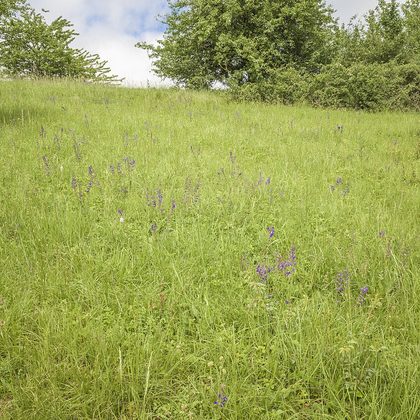
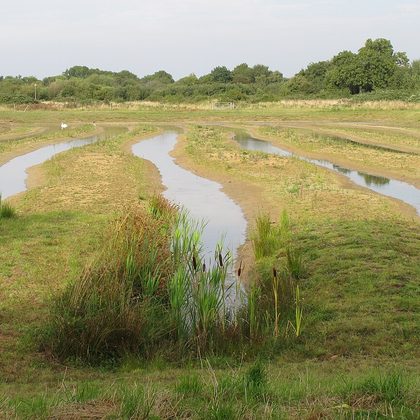
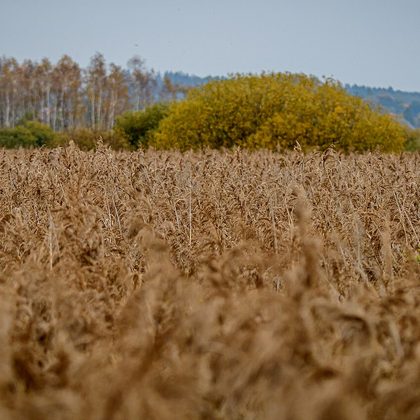
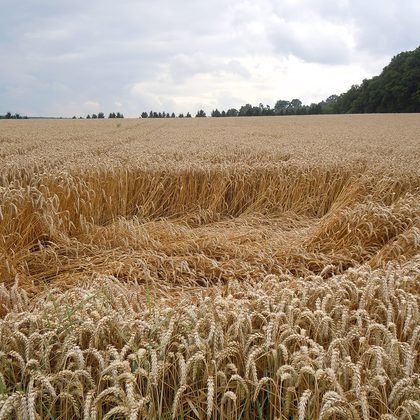
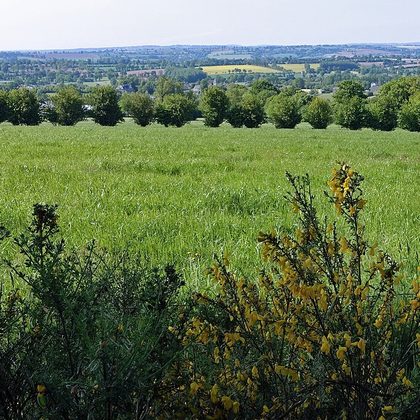
Open country with tall, dense herbaceous or grassy cover: wet and damp meadows, marsh edges, reedbeds, hedgerows and shelterbelts, verges, railway banks, field margins, lucerne and cereal fields on a range of soils including sand, from sea level to about 2,480 m in the southern mountains. Unlike the Common Vole, which seeks short, dry ground, it avoids closely mown and dry land. It also occurs in cities, in verges, parks and allotments, including Moscow.
Where the animal is most at home, classified with EUNIS — the European standard for habitats.

Distribution
Northern and eastern Europe and further east: southern Finland — where more than eight hundred georeferenced records are known from Uusimaa and Kanta-Häme to Satakunta and South Karelia and it is the common grey vole — the Baltic states, Belarus, Ukraine, Moldova, eastern Romania, Bulgaria, North Macedonia, Serbia, Kosovo, Albania and Greece, and further Turkey, the Caucasus, north-western Iran and Kazakhstan; together about 3.8 million square kilometres. It has also been spread by people: on Svalbard a population has lived since some time between 1920 and 1960 in a twenty-kilometre coastal strip near the Russian settlement of Grumantbyen, brought in with hay from the Leningrad area, discovered in 1960 and correctly identified only in 1990; it is the northernmost known occurrence of a vole. It has also been introduced on Jan Mayen and in a few Siberian towns. It is absent from western Europe, including Britain and Ireland, the Low Countries and the Iberian Peninsula.
- Native
- dark = core range, pale = thinly spread
Way of life
Polyphasic, active in short bouts spread over 24 hours, with a clear share of activity by day. It is herbivorous and more granivorous than the Common Vole, which makes it a significant pest in cereal fields. It lives in colonies in extensive tunnel systems. In the Balkans breeding runs from early April into October; after a gestation of 18 to 22 days four to six young are born, with two to ten embryos per female and larger litters in females that have bred before. Young are sexually mature at a mean of 54 days. In behaviour it differs measurably from the Common Vole: it is less neophobic and explores unfamiliar ground more quickly. It does not enter winter torpor.
Where and when to look
Search in southern Finland, Ukraine or Bulgaria in the dense, tall vegetation the Common Vole avoids: along a reedbed, in a rank meadow, on a railway bank or in a city park. The runways lie beneath the grass when it is parted. Record a sighting as 'grey vole' unless the karyotype or DNA is known. In southern Finland this is the common species and the Common Vole is very local, so the locality gives more support there. The Svalbard population carries the fox tapeworm; the Norwegian Polar Institute warns visitors about this.
Conservation status
Least Concern (LC, 2025) and numerous to very numerous throughout its range. In eastern European cereal country it is, alongside the Common Vole, a pest species; control with anticoagulant poisoned grain also affects Barn Owl, Kestrel, Weasel and Red Fox. Because the species is not recognised in the field, it is combined with the Common Vole in virtually all population figures and pest statistics, so that its own population trend is unknown. On Svalbard it has been known since 1999 as an intermediate host of the fox tapeworm Echinococcus multilocularis, which has made this introduced population a public-health issue.
Scientific name
Microtus rossiaemeridionalis | Ognev, 1924 (GBIF: Microtus levis)
Ognev described the species in 1924 and placed it straight away in the genus where it still stands. Microtus is Greek, from mikros, 'small', and ous, genitive ōtos, 'ear', after the small ears hidden in the fur. rossiaemeridionalis is the Latin genitive Rossiae meridionalis, 'of southern Russia', from meridies, 'midday, south'; Ognev distinguished the animal as the southern Russian form of the common vole. The specimen the first description was based on came from Russia.