All species › Carnivores › Mustelids › Steppe Polecat
Steppe Polecat | Mustela eversmanii
Steppebunzing | Turón de la Estepa
The steppe polecat is a polecat of open steppe, grassland and semi-desert, from south-eastern and central Europe through Central Asia to Mongolia, north-east China and the Russian Far East. In the guide area its western limit lies in the Czech Republic and Austria. It closely resembles the European polecat and has been treated as the same species by some authors; little is known of its ecology.
Tracks
The steppe polecat rests in burrows taken over from other animals and hunts by searching the burrows of its prey, so that it can spend long periods underground. It can travel up to 18 km in a night. In the Czech Republic most recent records are road casualties.
Identification
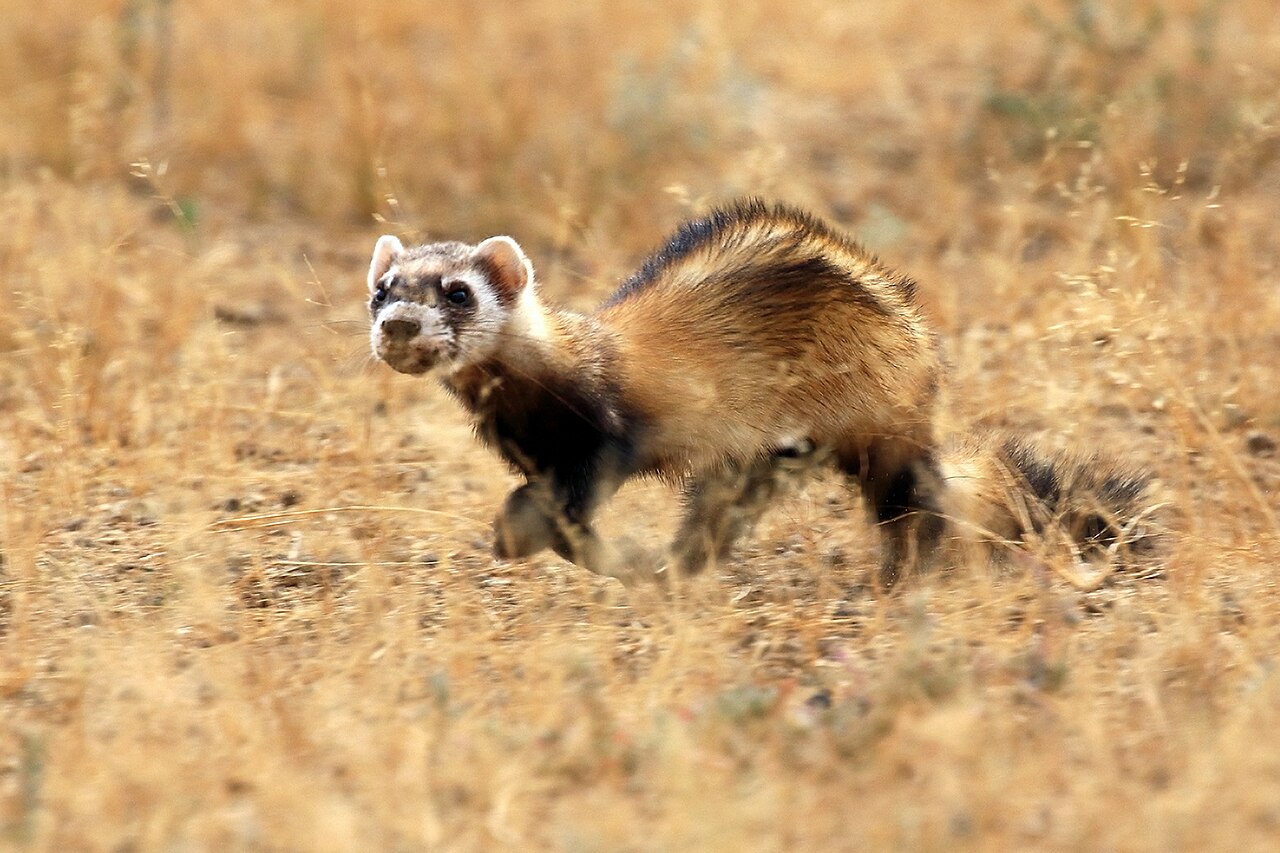
A polecat with a variable, usually pale coat: the body is yellowish white, yellowish brown or grey, and legs, chest and tail are dark brown. The face is pale with a dark mask around the eyes, and the ears are pale; the mask is less distinct in older animals and may be replaced by silvery white hair. Measurements overlap with those of the European polecat; males are larger than females.
Similar species
The European polecat is darker: its guard hairs are dark brown to black and only the underfur is pale, whereas the steppe polecat has a pale body contrasting strongly with dark legs and chest. Young or dark steppe polecats and pale European polecats cannot always be told apart, and the two species occur together in part of central and eastern Europe. Ferrets and ferret-polecat hybrids can look similarly pale at first sight. Certain identification needs a good photograph or an animal in the hand.
Habitat
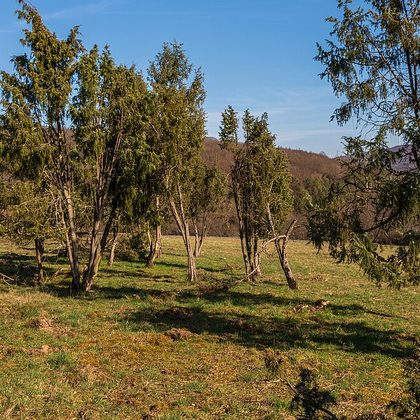
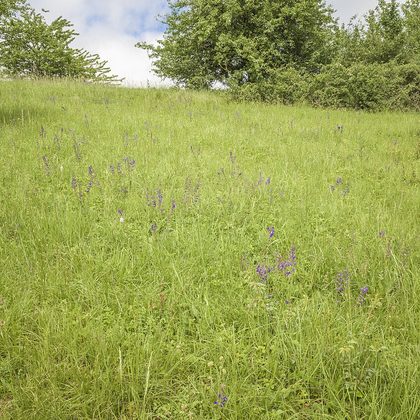
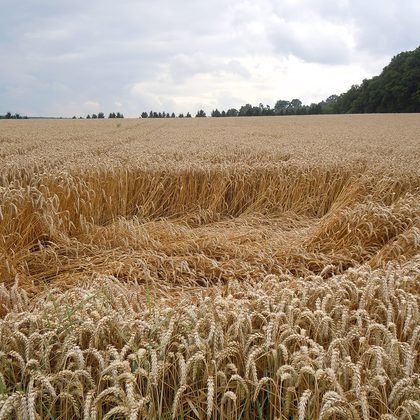
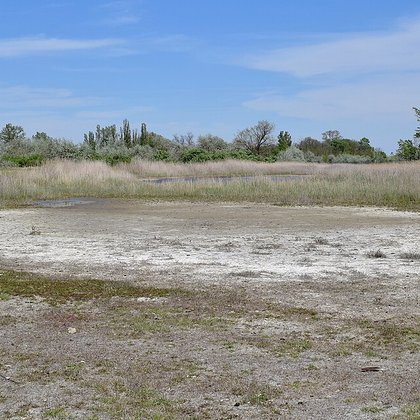
Open steppe, grassland and semi-desert with few trees, as well as pastures, cultivated and fallow fields, ravines and abandoned quarries. Woodland is avoided.
Where the animal is most at home, classified with EUNIS — the European standard for habitats.

Distribution
South-eastern and central Europe, the Caucasus and the Middle East, and on through Central Asia to north-east China, Mongolia and the Russian Far East. In the Czech Republic, at the western edge of the range, it occurs only in the warmest lowlands of Bohemia and Moravia. Within the guide area there are recent records from Romania, Austria, Ukraine and Hungary, and a few from Poland and Germany.
- Native
- dark = core range, pale = thinly spread
Way of life
Mainly nocturnal and solitary. It constantly explores new ground in search of food and may move locally when food is scarce or snow is deep. Food consists of rodents (voles, hamsters, marmots), pikas, ground squirrels, birds, eggs, reptiles and insects. In Hungary small mammals made up 54 to 93% of the diet, peaking in summer; the main prey in all seasons were common vole and common hamster, with the European ground squirrel also taken in spring and autumn. Birds, mainly passerines, made up 38% of the diet in spring and 29% in autumn. Mating is in February and March; after a gestation of 38 to 41 days usually 8 to 10 young are born in April or May. Their eyes open after a month, at one and a half months they hunt with the mother, at three months they disperse, and they mature at nine months.
Where and when to look
In the guide area the chance of a sighting is best in the Pannonian lowland and the steppes of Romania and Ukraine, where hamsters and ground squirrels occur. Search grassland and field margins at night. A road casualty with a pale body and dark legs is worth reporting, with a photograph and location.
Conservation status
Least Concern (LC, 2016) globally; the eastern subspecies M. e. amurensis was regarded as Vulnerable in 2009. In the west of the range the species is heavily affected by persecution. In the Czech Republic it was common in the first half of the twentieth century and is now regarded as critically endangered, with one or two records a year. Little is known of its natural history, ecology and conservation status.
Scientific name
Mustela eversmanii | Lesson, 1827
Lesson described the species in 1827 and placed it straight away in the genus where it still stands. Mustela is the Latin word for 'weasel'. Its further origin is uncertain: it is usually read as a diminutive of mus, 'mouse', after the animal's small size or its mousing. eversmanii honours the German-Russian naturalist Eduard Friedrich Eversmann (1794–1860), who surveyed the animals of the steppes around Orenburg. The specimen the first description was based on came from Russia.