All species › Rodents › Voles and hamsters › Thomas's Pine Vole
Thomas's Pine Vole | Microtus thomasi
Thomas' woelmuis | Topillo de Thomas
Thomas's Pine Vole is the pine vole of the southern Balkans, from Montenegro and Albania to the Peloponnese; it does not occur elsewhere. It is the largest and shortest-tailed species of the group, and its burrow system is the best studied: up to nearly ninety metres of tunnel have been measured under a single meadow. No freely licensed usable photographs of the animal are known; in the field mainly the soil heaps can be observed.
No photograph of a living wild animal of this species with a suitable Creative Commons licence exists. Do you have one that meets the rules? Send it in.
Tracks
The underground tunnels of this species have been measured more thoroughly than those of the other pine voles. A burrow system consists of one main tunnel of 6 to 26 metres with a series of side tunnels; the whole measures between nine and nearly ninety metres. The tunnels are 3.4 to 4.2 cm across and lie shallow, usually ten to seventeen centimetres below the surface, with deeper nest chambers (usually two) and zero to nine store chambers, which are almost always empty. Half of the systems studied had no open entrance at all, the other half at most two. Above ground, therefore, not the entrances but the soil heaps are visible: ten to eighty-five per system, pushed out with head and hind feet, five to twenty-five centimetres across and three to fifteen centimetres high. They lie in an irregular line above the tunnel and thus show the course of the system. A molehill is much higher and conical, consists of clods and comes from a vertical shaft; the blind mole-rat (Nannospalax), which occurs in the same Greek meadows, makes considerably larger, flat mounds. No latrines have been found in these systems; unlike in most voles, the droppings lie scattered. Further signs are gnawed-through roots, rhizomes, bulbs and tubers, peeled young roots in olive groves and, in late summer, olive stones in the tunnel. Pellets of Barn Owl and Eagle Owl provide the most reliable records.
Identification
For a pine vole large and robustly built, with a head-body length of 7.1 to 11.9 cm and a weight of up to just over forty grams; northern animals are clearly larger (mean 10.2 cm) than southern ones (8.8 cm). The characteristic feature is the tail: 1.2 to 3 cm, only 16 to 23 per cent of head-body length, the shortest tail of any European pine vole. The head is large and rounded, the body thickset, the eyes small and the ears short and sunk in the fur. The back is deep reddish brown, the flanks buff, the belly dark grey. The skull is heavily built, with expanded zygomatic arches and a prominent angular process on the lower jaw.
Similar species
Within the range hardly any related species occur, so that identification is straightforward for this group if the locality is known. In Albania, Montenegro, southern Bosnia and most of Greece this is the only pine vole; only in the northern Balkans does its range border that of the Common Pine Vole (Microtus subterraneus), which is smaller and has a longer tail (twenty to thirty-six per cent against sixteen to twenty-three), and in North Macedonia and northern Greece that of Felten's Vole (M. felteni). In the zones of overlap the species, as throughout the group, cannot be separated on a photograph; teeth or chromosomes are decisive. In the field the species can, however, be distinguished from the surface-living voles: Harting's Vole and the other species of the guentheri group are paler, longer-legged, with larger eyes, visible ears and a longer tail, and use runways in the grass; the Bank Vole is reddish brown with large eyes and a medium-length tail. The species has 44 chromosomes, but the X and Y chromosomes vary so much in shape and heterochromatin that two separate races are recognised: the thomasi race in the north and most of Greece and the atticus race in the Peloponnese and Attica. Some authors treat atticus as a separate species.
Habitat
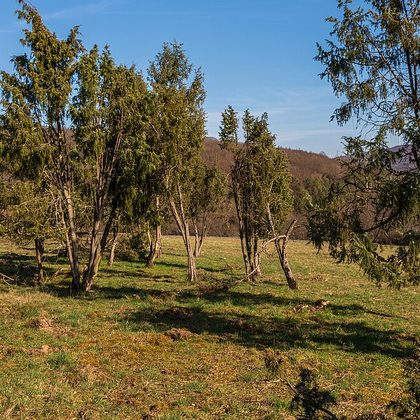
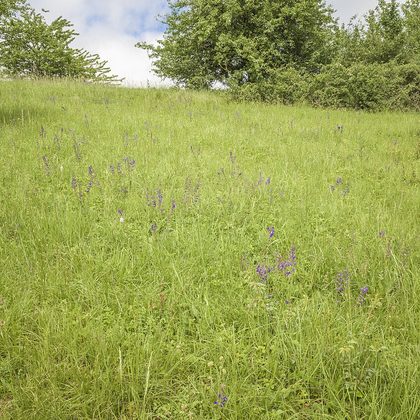
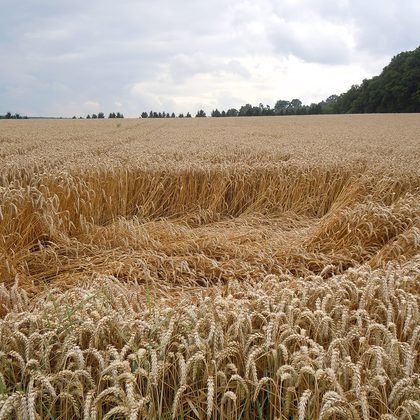
Dry to moderately damp meadows, light woodland and wood pasture, arable land, kitchen gardens, olive groves and orchards, from sea level to about 2,000 m. Burrow systems have been found in grassland, in arable land and in open places in woodland. The species depends on a workable soil under a closed herb layer; bare rock and waterlogged ground are not inhabited. It therefore occurs mainly in the farmed landscape of Greece and Albania, often close to villages and fields.
Where the animal is most at home, classified with EUNIS — the European standard for habitats.



Distribution
Endemic to the Balkans. The thomasi race lives in Bosnia and Herzegovina, Montenegro, Albania and most of Greece; the atticus race in the Peloponnese, on Euboea and in Attica. Beyond this the species occurs nowhere; on the Greek islands it has not been recorded except on Euboea.
Way of life
The activity rhythm is polyphasic: short bouts of feeding and digging, around the clock. Whether the species prefers twilight when above ground has not been properly studied; its classification as crepuscular is therefore uncertain. It lives almost entirely underground and rarely comes to the surface. Food consists of underground plant parts: rhizomes, roots, bulbs and tubers, supplemented with green parts, seeds and fruits, including olives. A female carries two to eight embryos, four to six on average, which is high for this group. A burrow system is shared, and contrary to long-held belief more than one animal of the same sex can live in a single system; it is therefore a group rather than a pair. There is no winter dormancy; in the Greek winter, when the grass grows, the species is at its most active.
Where and when to look
Look for the soil heaps. From November to March, the Greek growing season, walk meadows or olive groves in Epirus, the Peloponnese or Attica and watch for groups of small, fresh soil heaps running in an irregular line through the grass. Do not dig; count the heaps and follow the line, which shows the course of the burrow system. They are clearest after rain. Entrances are usually not to be found, and that is characteristic of the species. The animal itself can almost only be seen during research. To establish whether the species occurs in a district, pellets can be collected under Barn Owl or Eagle Owl roosts; this is how its distribution in the Balkans has largely been established.
Conservation status
Least Concern (2016). The species is common throughout its Balkan range and locally numerous in farmland; in olive and fruit growing it is locally regarded as a pest. Research focuses mainly on taxonomy: several authors treat the atticus race as a separate species, and as long as that question remains open, the extent of the range of Microtus thomasi in the strict sense is not precisely known.
Scientific name
Microtus thomasi | Barrett-Hamilton, 1903
Barrett-Hamilton described the species in 1903 and placed it straight away in the genus where it still stands. Microtus is Greek, from mikros, 'small', and ous, genitive ōtos, 'ear', after the small ears hidden in the fur. thomasi honours Oldfield Thomas (1858–1929) of the British Museum, who described more species of mammal than anyone else. The specimen the first description was based on came from Montenegro, Podgorica.