All species › Rodents › Voles and hamsters › Tatra Vole
Tatra Vole | Microtus tatricus
Tatrawoelmuis | Topillo de Tatra
The Tatra Pine Vole was described in 1952 from the Vel'ká Studená valley in the High Tatras and is endemic to the Carpathians; it has not been recorded outside that mountain system. It has thirty-two chromosomes (2n = 32) and six plantar pads on the hind foot, against five in the other pine voles. Both characters can only be established on an animal in the hand; in the field the species cannot be separated from the Common Pine Vole.

Tracks
The species lives partly underground and partly above ground, which makes its signs easier to recognise than those of the other pine voles. It builds extensive tunnel systems in the loose, damp soil under ferns and sedges, but feeds mainly above ground, so that surface runways lie beside the tunnels. On screes and along the edge of the dwarf pine zone there are swept paths three to four centimetres wide under the vegetation and between the blocks, and at the foot of stones or spruces round holes two to three centimetres across, often with a small heap of fine soil beside them. In summer small piles of stems bitten off to equal length, of wood sorrel, coltsfoot and alpine herbs, lie at the tunnel entrances, remains of food eaten close to cover. In winter digging continues under the snow; after snowmelt in May and June the network of winter runs, consisting of felted cords of grass, lies exposed on the alpine meadows, with finely gnawed remains of stems between them. Droppings are four to six millimetres long, cylindrical with blunt ends, and lie in small latrines. As in all species of this group, pellets are the most reliable source: pellets below the roosts of Tengmalm's Owl and Tawny Owl, and in the mountains also of Kestrel, reflect the species composition of a valley.
Identification
A fairly large pine vole with a head-body length of 8.3 to 11.5 cm; males average thirty grams, females twenty-five. The tail is long for the group, 3.1 to 4.7 cm, or 35 to 41 per cent of head-body length, bicoloured and with a distinct terminal tuft. The eyes are small, at most two and a half millimetres across; the ears are medium-sized and just visible. The fur is coarser than in related species and resembles that of the Field Vole: dark brown back, silver-grey belly with a slight buff tinge, whitish feet. Females have four nipples in two inguinal pairs. The skull is large and deep, with distinct supratemporal ridges. Under the hind foot there are six plantar pads; the other pine voles have five.
Similar species
Range excludes most species. In the Carpathians the only other pine vole is the Common Pine Vole (Microtus subterraneus), which is smaller, has a shorter tail (twenty to thirty-six per cent of head-body length against thirty-five to forty-one) and has five plantar pads on the hind foot instead of six. The measurements overlap, however, and the difference in tail length cannot be assessed on a live animal in the grass; in the field and on a photograph the two are not separable. Liechtenstein's Pine Vole and Fatio's Pine Vole occur in the Alps and the Dinarides and not in this range. On site the following can be excluded: the Bank Vole, with a reddish-brown back, large protruding eyes, projecting ears and a tail half the body length; the Field Vole, larger and more coarsely furred, with clearly visible ears; and the Snow Vole of rocky slopes, grey-white with a long white tail and large ears, which occurs on the same screes but is recognisable at a distance. The two subspecies, M. t. tatricus in Slovakia and Poland and M. t. zykovi in Ukraine and Romania, differ in DNA and not in external characters.
Habitat
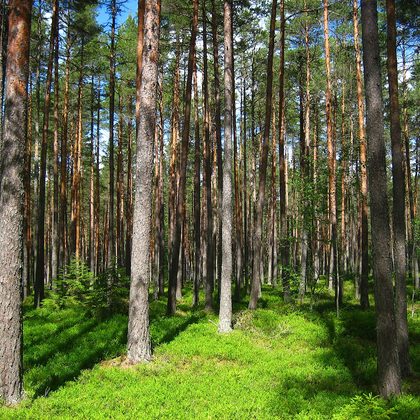
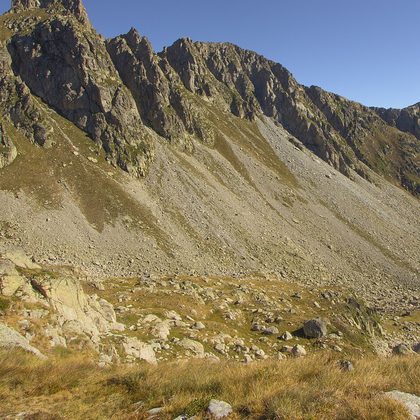
Montane forest and the zone above it: spruce forest with a dense fern layer, mixed montane and larch forest, the dwarf pine belt and the alpine meadows above it, and above all screes and block fields with light, damp soil between the stones. The species has been found between 600 and 2,340 m and is most numerous between 1,100 and 1,700 m. It depends on a loose, rootable soil under a dense herb layer; the localities lie in the damp, cool, herb-rich parts of the mountain forest, not in the meadows of the valley floor.
Where the animal is most at home, classified with EUNIS — the European standard for habitats.




Distribution
Only the Carpathians, and within them in isolated sub-areas. In the Western Carpathians the species occurs in the High and Low Tatras, the Malá and Vel'ká Fatra in Slovakia and on the Polish side of the Tatras; in the Eastern and Southern Carpathians in the Ukrainian Carpathians and in Romania. The range is fragmented because the species is tied to a particular altitudinal zone, so that the populations of the individual massifs are isolated from each other. The western population covers about 840 square kilometres.
- Native
- dark = core range, pale = thinly spread
Way of life
Nocturnal in summer, partly fossorial and active all year, including under the snow. Summer food consists mainly of green leaves, stems and roots, with clearly more dicotyledons than grasses, such as wood sorrel, purple coltsfoot and alpine herbs, supplemented with mosses and berries. The breeding season lasts about a hundred and forty days: it begins in April, peaks in June and ends in September. A female carries one to four embryos, two and a half on average, and raises seven to nine young per season; the Common Vole produces about ten times as many young in the same period. Sexual maturity is reached only in the second year of life, late for a vole. In Slovakia territories of 836 square metres for males and 586 for females have been measured; males move over greater distances.
Where and when to look
The chance of a sighting is small, and without the animal in the hand an identification is not conclusive. In practice locality and signs are the starting point. In June and July, in the High Tatras, the Malá Fatra and the Ukrainian Carpathians, the screes at the upper edge of the spruce forest, with ferns and wood sorrel between the blocks, are the places to search; there the holes, the swept paths and the small piles of bitten stems lie between the stones. Directly after snowmelt, in late May, the network of winter runs is visible on the alpine meadows and gives an indication of activity under the snow. The animal itself is seen almost only during research: all usable images of this species were made of trapped individuals.
Conservation status
Least Concern (2008). The assessment means that no decline has been demonstrated. The western population is estimated at 200,000 to 250,000 animals, and no population fluctuations or outbreaks have been recorded, which is unusual for a vole. Its vulnerability lies in the structure of the range: a small total area, divided among isolated mountain massifs, and a species with specific requirements and a low reproductive rate. Hunting and poison are not named as threats, but climate change is: if the zone of spruce forest, dwarf pine and damp scree shifts upwards, the available habitat in each massif decreases.
Scientific name
Microtus tatricus | (Kratochvíl, 1952)
Kratochvíl described the species in 1952 as Pitymys tatricus; because it was later moved to another genus, the author and year stand in brackets. Microtus is Greek, from mikros, 'small', and ous, genitive ōtos, 'ear', after the small ears hidden in the fur. tatricus means 'of the Tatra', the high range on the Slovak–Polish border from where Kratochvíl described the animal. The specimen the first description was based on came from Slovakia.