All species › Carnivores › Walrus › Walrus
Walrus | Odobenus rosmarus
Walrus | Morsa
The walrus is by far the largest carnivore in Europe: a Svalbard bull weighs a ton and a half, ten times as much as a female polar bear and five times as much as a large grey seal. It eats no fish but shellfish, which it locates on the seabed with its whiskers, and it hauls out in tightly packed groups whose smell is detectable for kilometres.

Tracks
The walrus leaves two signs that no other European mammal makes. The first is on the seabed: feeding, it roots through soft sand and mud with its snout and blows the sediment away with a jet of water, leaving long sinuous furrows five to ten metres long, sometimes twenty or more, and beside them clusters of shallow pits less than a metre across, up to thirty-five to the hectare. On flat sandy bottoms those furrows can be mapped with sonar, and they make the walrus one of the largest bioturbators on earth. The second sign is ashore: the haul-out on a shingle or boulder beach, a bare, trampled strip where tens to hundreds of animals lie against one another. Such a place is known by the deeply worn gullies up from the waterline, by the banks of crushed shell and bone, by the black sodden ground and by the penetrating stench that carries downwind for kilometres. On old haul-outs the bleached skulls and tusks left by the whalers still lie among the boulders. In snow and on ice it draws a drag lane over a metre wide, with the flipper impressions on either side and sometimes the paired puncture marks of the tusks with which it hauls itself out of the water.
In its habitat

Identification
The walrus has an enormous, wrinkled, reddish to grey-brown body with thick scarred hide and pinkish-red patches that flush when the animal lies in the sun and blood flow to the skin increases. The head is small for the body, with a broad, square upper lip full of thick bristling whiskers — four to seven hundred of them in thirteen to fifteen rows — and small bloodshot eyes. Both sexes carry tusks, elongated upper canines that in an old bull reach a metre and weigh five kilos; in the female they are slimmer, shorter and often more curved. Unlike the seals it can turn its hind flippers under the body and walk on them, so that ashore it stands high on its legs instead of shuffling. Young animals are dark grey-brown with short tusks or none.
Similar species
A walrus cannot be confused with any other animal in Europe. Even without tusks — in a young animal or one that has broken them — the wrinkled hide, the size, the square whiskered muzzle and the gait are diagnostic. At long range in the water a swimming walrus can be taken for a Bearded Seal or a group of seals, and the outline of a hauled-out heap can look like rocks from a distance; then movement and the tusks, which appear as pale streaks at a distance, decide. The odd Elephant Seal, which can turn up as a vagrant on European coasts, is as heavy but has no tusks and a smooth, unwrinkled hide, the bull carrying a short pendulous snout.
Habitat
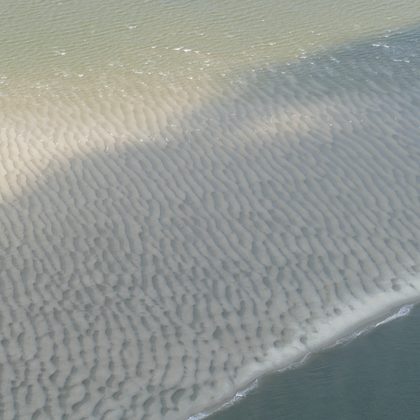
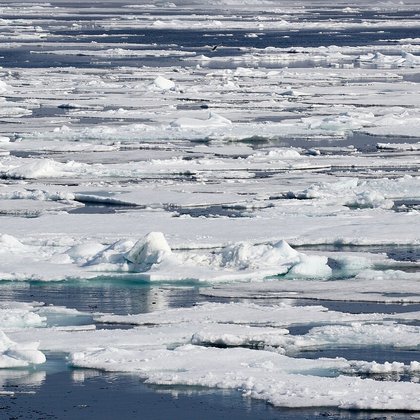
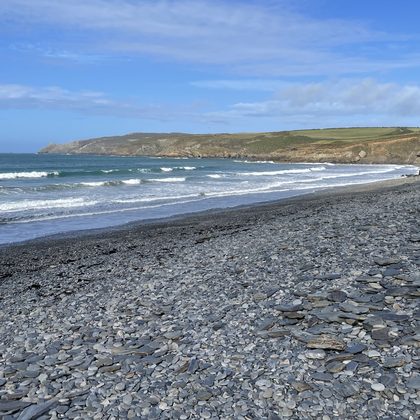
The walrus lives in shallow sea over soft sediment, where its shellfish occur: it feeds almost entirely on bottoms shallower than eighty metres and usually far shallower. It also needs places to rest, preferably drift ice, but in summer and autumn also boulder beaches, shingle spits and low rock platforms. The combination of shallow bottom and ice or beach determines where the species can occur. It eats mainly bivalves, above all soft-shell and carpet clams, which it sucks from the shell, and also worms, sea cucumbers and crabs; a few old bulls specialise on seals and seabirds.
Where the animal is most at home, classified with EUNIS — the European standard for habitats.




Distribution
The walrus lives around the Arctic Ocean in two subspecies: the Atlantic walrus (rosmarus) from eastern Canada and Greenland to Svalbard, Franz Josef Land and the Kara Sea, and the Pacific walrus (divergens) in the Bering Sea. In Europe the species occurs almost only on Svalbard and Bjørnøya, north of 74°N, with well-known haul-outs on Moffen, Prins Karls Forland, Torellneset and Nordaustlandet. Further south it appears along the northern Norwegian coast and as a vagrant: lone wandering animals have been recorded in Britain, the Netherlands, Denmark and Sweden, sometimes young bulls that stay for days in a harbour.
- Native
- dark = core range, pale = thinly spread
Way of life
The walrus is highly social: outside the mating season the animals lie in separate groups of cows with young and of bulls, and on the haul-out they lie literally across one another. It forages by day and night in dives of five to ten minutes, sweeping the bottom with its whiskers and emptying dozens of shells to a dive; an adult eats thousands a day. In winter, from January to March, the animals mate in the water at the ice edge, the bulls making a series of knocking and bell-like sounds under water that go on for hours. The calf is born after a fifteen-month gestation, usually in April or May, and stays with its mother for two to three years; she carries it on her back through the water and defends it fiercely. Cows therefore calve at most every two to three years, which makes any population slow to recover. The walrus can live forty years or more.
Where and when to look
Svalbard can be visited from June to September by expedition ship: the haul-outs at Moffen (where a three-hundred-metre approach ban applies), Torellneset, Poolepynten on Prins Karls Forland and Smeerenburg are the best-known sites, and the animals there are undisturbed and can be watched well at a distance. The prescribed distance is essential: when disturbed, a haul-out stampedes into the sea and calves are crushed. Swimming animals often follow an inflatable out of curiosity and come close of their own accord; head and whiskers are then best seen. Elsewhere in Europe a walrus is a chance event; a wandering animal usually stays several days in the same harbour.
Conservation status
Vulnerable (VU, 2016). The Atlantic walrus was hunted commercially for three and a half centuries: on Svalbard it was killed for oil, hide and ivory from the early seventeenth century onward, and when it was protected there in 1952 probably only a few hundred were left. Since then the population has grown steadily: a survey in 2006 put the Svalbard subpopulation at about 2,500 animals, and later counts are higher. The worries now are the sea ice — if the drift ice over the shallow banks goes, cows with calves must use land haul-outs, which lie further from the food and where panicking animals trample one another to death — and the growing ship traffic, tourism and oil and gas work in the Barents Sea. A limited subsistence hunt continues in Greenland and Russia.
Scientific name
Odobenus rosmarus | (Linnaeus, 1758)
Linnaeus described the species in 1758 as Phoca Rosmarus; because it was later moved to another genus, the author and year stand in brackets. Odobenus is Greek, from odous, genitive odontos, 'tooth', and bainein, 'to walk': the tooth-walker, after the walrus hauling itself onto the ice by its tusks. rosmarus is the Scandinavian name of the walrus, Old Norse rosmhvalr, which reached science through Olaus Magnus's ros marus; the further origin of rosm- is uncertain.