All species › Rodents › Mice and rats › Western Broad-toothed Field Mouse
Western Broad-toothed Field Mouse | Apodemus epimelas
Westelijke rotsmuis | Ratón de campo de dientes anchos occidental
The Western Broad-toothed Field Mouse is the largest mouse in Europe and differs markedly in appearance from other mice: grey rather than brown, with very long whiskers, large ears and a heavy head. It lives among the limestone of the Balkans. Until 2005 it was treated together with the eastern species as one; work on mitochondrial and nuclear DNA separated the two and placed the boundary at the Aegean. In the field this means: a very large grey mouse on limestone on the Balkan mainland is this species.
No photograph of a living wild animal of this species with a suitable Creative Commons licence exists. Do you have one that meets the rules? Send it in.
Tracks
Signs are scarce and lie mainly under stones. The species digs no extensive burrow systems but shelters in rock crevices and excavates its nest beneath boulders; so searching is worthwhile among stones rather than in sand. On a wall, a stone heap or a boulder field its presence is shown by polished passages between the stones and, at a regular entrance, an accumulation of husks, skins and snail shells. The droppings are the usual dark spindle-shaped grains of an Apodemus, but large with the animal, four to six millimetres. Feeding sign: pine seed from broken cones, acorns and carob opened with a round hole, cereal grain and weed seed, and with some regularity emptied snail shells and eggshell; the species takes more animal food than most mice. In Barn Owl and Eagle Owl pellets in the Balkans its size makes it immediately recognisable, and this is how the species is most often recorded.
Identification
The Western Broad-toothed Field Mouse is an exceptionally large mouse: head-body 10 to 15 cm, tail 10.2 to 14.6 cm — about as long as the rest of the animal — and a weight of 28 to 56 g, which at the top end is twice a Wood Mouse. The upperparts are grey, not brown, the underparts greyish white. The head is heavy, the whiskers conspicuously long and the ears large; together they make the animal resemble a young rat more than a wood mouse. The legs are sturdy and the hind foot long, 24 to 28 mm. The 'broad-toothed' of the English name refers to the wide molars, which cannot be seen in the field; in the field the decisive feature is the combination of size, grey coat and stony ground.
Similar species
Within its range there are few confusion species. Wood Mouse and Yellow-necked Mouse are smaller, reddish to yellowish brown rather than grey, and their bellies are white with a sharp edge; their whiskers are shorter and their heads lighter. In case of doubt: an adult broad-toothed mouse is rarely under ten centimetres head-body, which no wood mouse reaches. The Black Rat is the main confusion species in the Balkans, since it is also grey, large and a climber; it is, however, clearly larger, with a tail clearly longer than the body and small eyes relative to the head; the broad-toothed mouse has the big bulging eyes of an Apodemus. The Eastern Broad-toothed Field Mouse can only be separated by locality: the two are barely separable on appearance and were counted as one species until 2005. The line lies at the Aegean: mainland Balkans and the Ionian islands hold the western species, Crete, Rhodes, the eastern Aegean islands, Anatolia and the Levant the eastern one. On a photograph without a locality, 'broad-toothed field mouse' is the only defensible answer.
Habitat
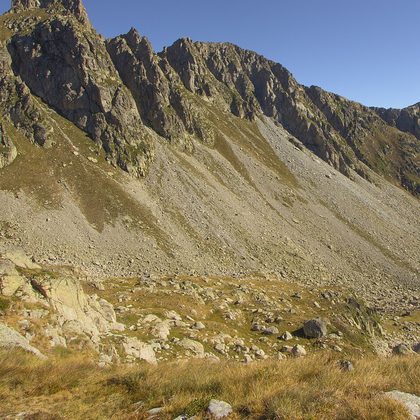
The Western Broad-toothed Field Mouse lives on stony ground: karst plateaus, rock faces, scree slopes, boulder fields, old walls and stone heaps, with low scrub alongside: maquis, garrigue, thorny phrygana and dry grassland with rock in it. It likes dry ground with scrubby vegetation and also enters evergreen oak and pine woodland, provided the soil is stony. It occurs from sea level to 1620 m. Away from stony ground it is absent: on deep soils and in closed humid woodland the Wood Mouse occurs instead.
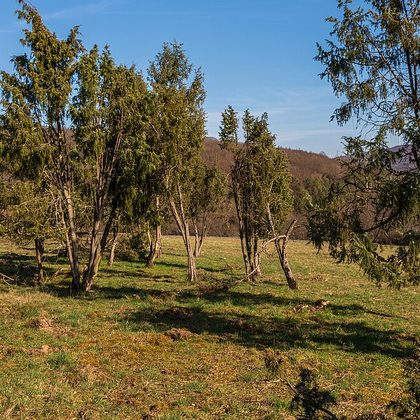
Where the animal is most at home, classified with EUNIS — the European standard for habitats.




Distribution
The Western Broad-toothed Field Mouse occurs in the western Balkans and Greece: Croatia, Bosnia and Herzegovina, Montenegro, Serbia, Kosovo, Albania, North Macedonia, Bulgaria and Greece, with the Ionian and some Aegean islands. It occurs nowhere else; it is confined to the Dinaric and Hellenic karst. Until 2005 this area counted as the western half of the range of the eastern species; the genetic work showed that the Balkan animals form their own, older lineage, and since then the species has borne the name Nehring gave in 1902 to an animal from Parnassos. It is absent from western, northern and south-western Europe, including France, Spain and Italy.
- Native
- dark = core range, pale = thinly spread
Way of life
The Western Broad-toothed Field Mouse is nocturnal and crepuscular and lives almost entirely on the ground: it climbs only moderately, leaps well between stones and is never far from cover. It eats green plant material, seeds, fruit and insects, an omnivore with a broader menu than the seed specialists of the north. It does not hibernate. Breeding runs from May to September, with a gestation of about twenty-five days and litters of two to eight. The nest lies in a rock crevice or in a self-dug chamber under a boulder. Very little is known of its social organisation and home range; it is one of the least studied mammals in Europe, not because it is rare but because trapping studies in karst are difficult.
Where and when to look
May and June are suitable in the karst of the Dinaric Alps and Greece, after dark with a torch along an old dry-stone wall, a stone heap by an abandoned village or the foot of a rock face. These mice are inquisitive and use fixed routes between the stones; after half an hour of sitting still one is usually seen. Monastery and fortress ruins are particularly suitable. The size, noticeably larger than that of wood mice, is the best field character. The locality determines which of the two broad-toothed field mice is involved.
Conservation status
Least Concern (LC, 2008), but the assessment predates general acceptance of the species and rests on little data. It is widespread across the Dinaric and Hellenic karst and nowhere scarce, and its habitat, bare karst with scrub, is one of the few European landscapes under no agricultural pressure. Threats are accordingly few: locally the closing-in of open karst once grazing stops, and building along the Adriatic coast. Little is known about a species that is the largest mouse in Europe and has only been recognised as separate since 2005; further research and a new assessment are needed.
Scientific name
Apodemus epimelas | (Nehring, 1902)
Nehring described the species in 1902 as Mus epimelas; because it was later moved to another genus, the author and year stand in brackets. Apodemus is Greek, from apodēmos, 'away from home'. epimelas is Greek for 'blackish', from epi-, here 'somewhat', and melas, 'black', after the dark coat. The specimen the first description was based on came from Greece, Parnassos.