All species › Rodents › Mice and rats › Alpine Field Mouse
Alpine Field Mouse | Apodemus alpicola
Alpenbosmuis | Ratón Alpino
The Alpine Field Mouse is a wood mouse that occurs only in the Alps and is therefore one of the few mammal species endemic to that range. It was described in 1952 as a subspecies of the Yellow-necked Mouse and recognised as a separate species by Storch and Lütt in 1989. It closely resembles the Wood Mouse and the Yellow-necked Mouse; in the zone where all three species occur together, identification on field characters is sometimes not possible.

Tracks
There are few signs specific to this species. Gnawed hazelnuts, beech mast, cherry stones and rose hips in an Alpine wood point to the genus Apodemus and not to the species: a round hole five to eight millimetres across with a smooth rim and incisor grooves across the shell beside it separates a mouse from Bank Vole, squirrel and woodpecker, but not the Alpine Field Mouse from the Yellow-necked Mouse. One difference is known: of the three species, this is the one for which tree seed plays little part in the winter store; the store consists of less nutritious material, herbs and fruit. The droppings are the usual dark, spindle-shaped pellets three to five millimetres long, scattered rather than heaped. In snow, which lies long in its habitat, it leaves a bounding trail of four prints in a group, with the five-toed hind feet ahead of the four-toed forefeet and a thin tail line between; because of the long hind foot and long tail the bound is slightly longer than in the Wood Mouse, but this cannot be established from a single trail. Runs and nests lie among tree roots, between scree blocks and under stones.
Identification
A mouse of the wood-mouse type, with a head-body length of 9.3 to 10.6 cm, a tail of 10.7 to 12 cm, clearly longer than head and body, and a weight of 23 to 35 g. The upperparts are warm brown, the flanks ochre, and the belly is greyish white rather than pure white; this is the most useful character. On the throat there is a yellow patch that may extend downwards as an oval or join into a complete band; the presence or absence of a collar is therefore not a diagnostic character. The hind foot is long, 23 to 25 mm, the ears are large and thin and the eyes bulging and black. The skull is strongly elongated, but that character can only be used in laboratory examination. The most useful proportion is that of the tail: in the Alpine Field Mouse it measures more than 130 per cent of head-body length.
Similar species
Alpine Field Mouse, Wood Mouse and Yellow-necked Mouse form the most difficult group to separate within European Apodemus. Compared with the Wood Mouse, the Alpine Field Mouse has a longer hind foot and a much longer tail: more than 130 per cent of head-body length, whereas the Wood Mouse's tail is shorter than the body. Compared with the Yellow-necked Mouse, the belly is greyish white instead of pure white and the tail exceeds 120 per cent of head-body length. Outside the Alps, where the Alpine Field Mouse does not occur, these characters suffice to separate Wood Mouse and Yellow-necked Mouse. Within the Alps, where the three species live side by side, they are not reliable: even in adults a certain identification is sometimes possible only by biochemical or genetic methods, and in juveniles identification on external characters is not possible. This explains why the species was not recognised until 1989. It is easily separated from the other mice of the mountains: the House Mouse is duller and greyer, without a sharp belly boundary; the Snow Vole is a vole with a blunt muzzle, grey coat, small ears and long whiskers; and the voles of the alpine pastures all have tails much shorter than the body.
Habitat
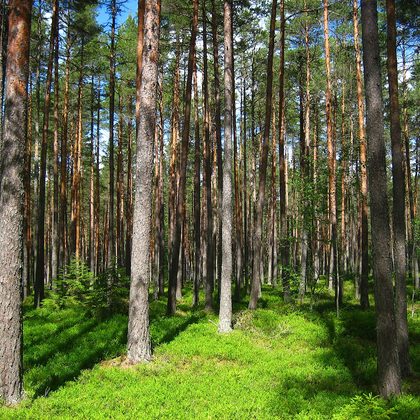
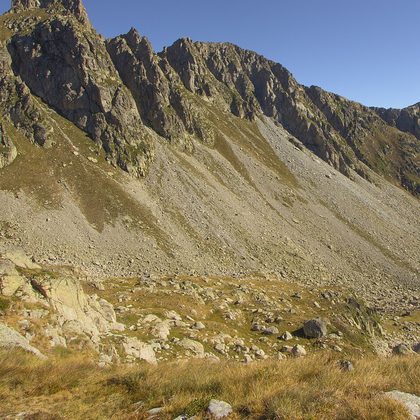
Mountain forest: open broadleaved, mixed and coniferous forest from the montane to the subalpine zone, with spruce–fir–beech forest and pure spruce forest as the core habitat. The species uses sites with both light and cover: glades, clearings, forest edges and steep slope forest with much dead wood and boulders. Above the treeline it occurs in dwarf-shrub heath and on alpine pasture. In Austria it has been found between 550 and 2200 m, with most records in the montane zone. It also occurs in open country, provided structure and cover are present.
Where the animal is most at home, classified with EUNIS — the European standard for habitats.


Distribution
The Alps only: south-eastern France, Switzerland, Liechtenstein, southern Germany, Austria and northern Italy. In Austria the species is known from the Northern Limestone Alps and the Central Alps, in Switzerland mainly from Graubünden and Valais. The actual density of localities and the population size are poorly known: because the species has been recorded separately only since 1989 and can be identified with certainty only in the hand, new provinces and valleys are still being added to the known range. In Upper Austria five localities were known up to and including 2016. The species does not occur outside the Alps.
- Native
- dark = core range, pale = thinly spread
Way of life
Nocturnal, a good climber and jumper, and does not hibernate: it is active all year, also under snow, and lives in winter on stored food. The diet shifts strongly with the season: in April more than half consists of insects, later in the year mainly seeds, fruit and herbs. The winter store differs from that of the related species: tree seed plays hardly any part, and the store is less nutritious. Breeding runs from April to August or September, with two to three litters a year averaging five to six young; females from an early litter become sexually mature in the same year. Life expectancy is about one year, as in all wood mice. Nests lie among tree roots, under stones and in tunnels. Predators are Tawny Owl, Tengmalm's Owl, Stoat, Fox and martens; in the Alps the species is a regular part of the diet of the predators of mountain forest.
Where and when to look
Identification in the field is usually not possible. To see the animal, wait on a still summer evening with a red torch by a pile of dead wood or a boulder field in a mountain forest in Austria, Switzerland or Bavaria between six hundred and two thousand metres. A mouse bounding past is then one of the three Alpine Apodemus species; the long tail, clearly longer than the body, is the only clue visible at a distance. Confirmed records come almost entirely from trapping studies, in which hind foot, tail and belly colour are measured, and from owl pellets, through skull measurements. Record an observation without measurements as Apodemus sp.
Conservation status
Least Concern (LC, 2016). The species is distributed along the entire Alpine arc and there is no evidence of decline, but the assessment rests on fewer data than for almost any other European rodent, because the species has been recorded separately only since 1989. Possible threats are fragmentation of woodland, since as a mountain-forest species with a small range it depends on connected forest blocks, and rodent control in forestry, in which it is not established which mouse species is being controlled. For a species endemic to a single mountain range the data basis is limited, and further fieldwork is needed.
Scientific name
Apodemus alpicola | Heinrich, 1952
Heinrich described the species in 1952 and placed it straight away in the genus where it still stands. Apodemus is Greek, from apodēmos, 'away from home'. alpicola is Latin for 'dweller in the Alps', from Alpes and colere, 'to inhabit'. The specimen the first description was based on came from Germany, Osterachtal.