All species › Rodents › Mice and rats › Yellow-necked mouse
Yellow-necked mouse | Apodemus flavicollis
Grote bosmuis | Ratón Leonado
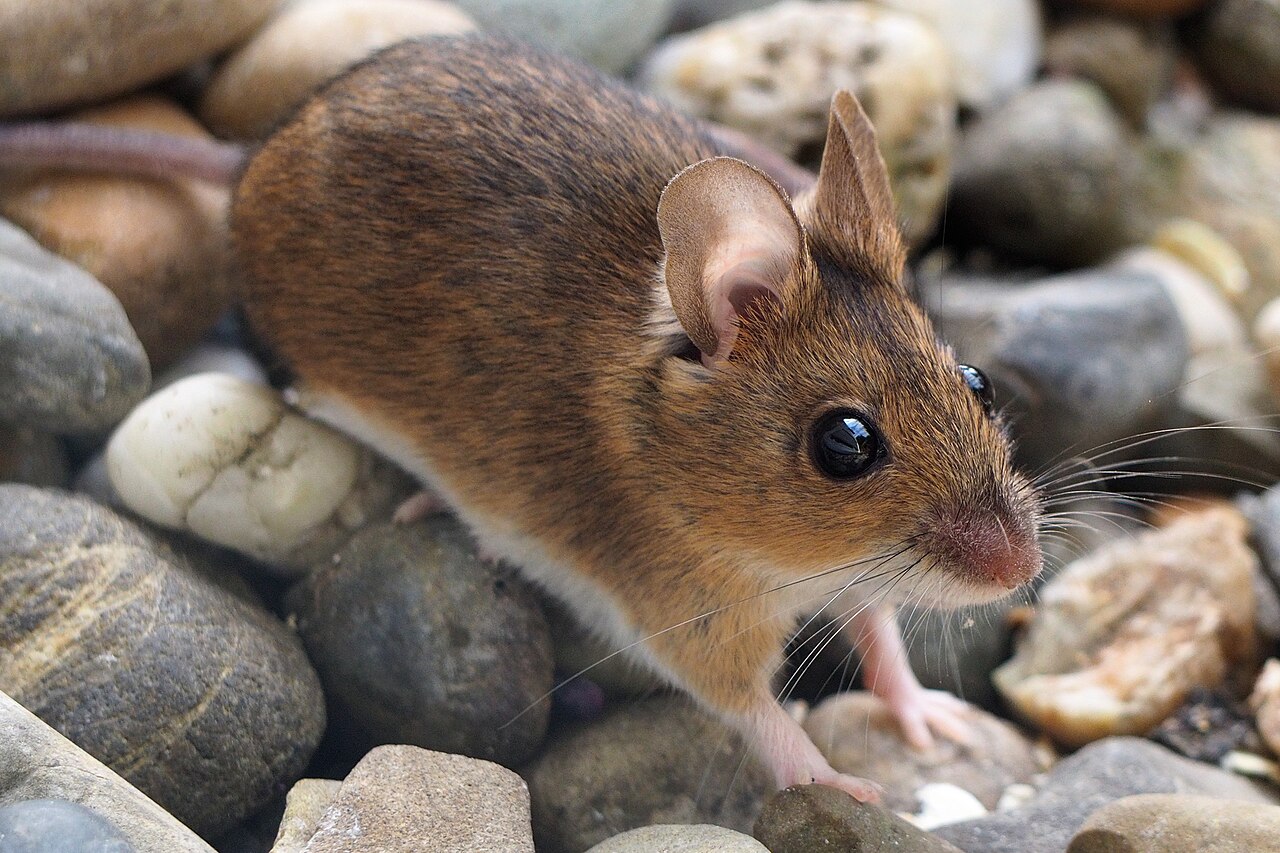
The Yellow-necked Mouse is a wood mouse of old broadleaved woodland, larger and redder than the Wood Mouse, with longer ears and a yellow band across the chest. It climbs better, leaps further and enters houses in winter more often than the Wood Mouse. The distinction from the Wood Mouse can usually be made in the hand, but in the field often not with certainty.
Tracks
The feeding signs are the same as those of the Wood Mouse: an opened hazelnut identifies the genus, not the species. The nut separates mouse, vole, squirrel and woodpecker, not Wood Mouse and Yellow-necked Mouse. Features: a round hole five to eight millimetres across with a smooth rim, and clear tooth marks across the shell next to the hole. The Bank Vole leaves a ragged rim without marks outside the hole, a squirrel splits the nut or gnaws a large ragged opening in it, and a woodpecker chisels an irregular hole in a nut wedged in a crevice. The Yellow-necked Mouse differs in its caches, which are larger and more often above ground: it climbs well and fills nest boxes, hollow trees, tree cavities and lofts with acorns, beech mast and hazelnuts, sometimes litres at a time. The droppings are dark, spindle-shaped pellets three to five millimetres long, slightly larger than those of the Wood Mouse but not reliably separable. In snow it leaves a bounding trail with four prints in a group, the hind feet ahead of the forefeet and a tail line between them; because of the longer hind foot the bounds are slightly longer than in the Wood Mouse. The burrows lie under tree roots and are deeper and more extensive, with separate store chambers.
In its habitat

Identification
A large, long-tailed mouse with a head-body length of 8.1 to 13 cm, a tail of 8.6 to 13.5 cm, as long as or slightly longer than head and body, and a weight of 22 to 56 g, roughly half as heavy again as a Wood Mouse. The upperparts are bright reddish to chestnut brown, with a darker wash of guard hairs along the midline of the back; the underparts are pure white and sharply demarcated from the flank. The character that gives the species its name is the ochre-yellow band across throat and chest, which in an adult runs from shoulder to shoulder and reaches up the sides towards the back, but does not extend down the belly. The eyes are large and bulging, the ears long and thin, the hind foot measures more than 22 mm, and there is a distinct sebaceous pad at the root of the tail. The tail is bicoloured, scaly and sparsely haired.
Similar species
The Wood Mouse is the main confusion species, and the distinction is difficult. The Yellow-necked Mouse is on average larger, redder and more contrastingly marked and has a complete yellow chest band, where the Wood Mouse has at most a yellow spot or short streak that does not reach the sides. However, young Yellow-necked Mice sometimes have an incomplete band, old Wood Mice sometimes a large spot, and the measurements overlap widely. In the hand hind-foot length (over 22 mm) and the chest marking together usually decide; in juveniles identification from external characters is not possible. On a photograph or in a torch beam, 'Apodemus' is then the correct identification. In the Alps a third species occurs, the Alpine Field Mouse, with a greyish-white rather than pure white belly and a tail of more than 120 per cent of head-body length; where all three occur together, certainty can sometimes be obtained only by biochemical methods. The species can be separated from the House Mouse in the field: that species is greyer and duller, with smaller eyes and ears, no sharp line between back and belly, a tail equally dark all round and a strong mousy smell. The Striped Field Mouse is smaller, with small round ears, a short tail and a black dorsal stripe. Voles have a blunt muzzle, small eyes and a short tail.
Habitat
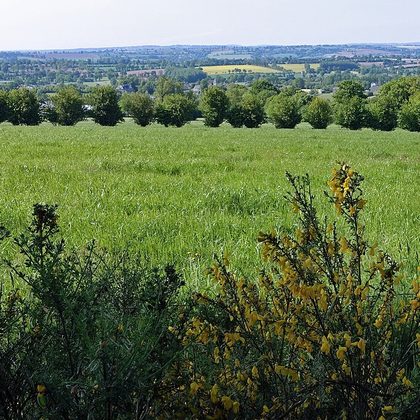
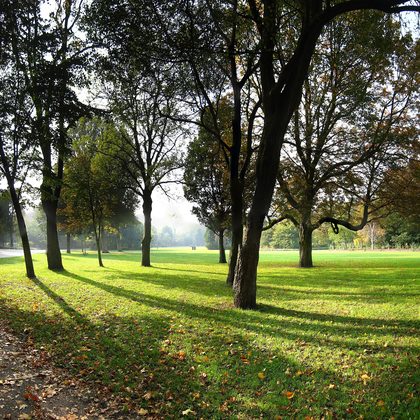
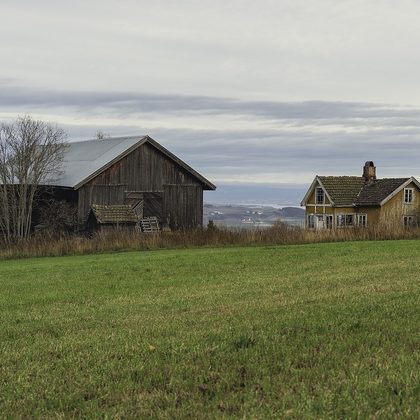
Old broadleaved woodland, preferably old oak and beech woodland with a shrub layer and a good seed crop. Also mixed woodland, woodland edges, hedgerows, parkland, orchards, churchyards, gardens next to woodland and, especially in autumn, sheds, lofts and houses. Where Wood Mouse and Yellow-necked Mouse occur together, the Yellow-necked Mouse occupies closed woodland and the Wood Mouse the edge and open country. The species avoids wet ground and dense grassland. In the mountains of southern Europe it occurs up to 2500 m. In Spain it is a species of humid broadleaved woodland with strict requirements for forest structure; in Navarre it is restricted to areas with more than a thousand millimetres of rain a year.
Where the animal is most at home, classified with EUNIS — the European standard for habitats.



Distribution
From Britain and northern Spain east to the Urals, and south-east through Turkey and the Caucasus to western Syria, Lebanon, northern Israel, north-western Jordan, Armenia and the Zagros Mountains of western Iran. In central and eastern Europe it is common and widespread. In Britain it occurs in Wales, the Welsh Marches and southern England, with a fragmented northern edge; British animals are among the largest in Europe. It is absent from Ireland. In the Netherlands it is confined to Limburg and the eastern strip between Groningen and Winterswijk, where it has clearly increased in numbers and distribution since the 1980s; in Belgium it occurs mainly in the southern and eastern woodlands. In Spain it occupies only the northern third: fairly evenly along the Cantabrian coast and from there into northern León, Burgos, La Rioja and Soria; in the central and eastern Pyrenees it is poorly studied and records are scattered; the southernmost populations are in the Montseny and the Catalan coastal ranges. There it occurs from sea level to about 1000 m in the Cantabrian region, from 680 to 1000 m in Navarre and from 300 to 1500 m in Catalonia. It is absent from the south of the Iberian Peninsula, from Portugal except the far north, and from the Balearics.
- Native
- dark = core range, pale = thinly spread
Way of life
Strictly nocturnal, with most activity well after midnight; the species is almost never seen by day. There is no hibernation and the animals are active all year; in frost several animals share one nest and live on the autumn store. The species is a seed eater (acorns, beech mast, hazelnuts, seedlings, buds and berries), with up to about a fifth of the diet animal food: insects, snails and worms. It climbs and leaps well and forages both in trees and on the ground. The nest is in a hollow tree, a nest box, a tunnel under tree roots or an underground chamber. From March to October three to eight young are born per litter, on average five to seven, with several litters a year. In Serbia density rose in a mast year to eighty-five animals per hectare and fell to three eighteen months later. The home range is small, usually less than half a hectare, with a median of just over six hundred square metres for males and slightly less for females; mean movement is about forty metres. Predators include Tawny and Long-eared Owls, Weasel, Stoat, Red Fox and Pine Marten.
Where and when to look
Search after midnight in old oak or beech woodland with a good seed crop and wait with a red torch at the foot of a tree or by a fallen trunk. Autumn is the best season: numbers are then highest and the animals are building up stores. A second option is nest boxes: when boxes are cleaned in autumn, Yellow-necked Mice are regularly found in wooded areas, sitting on a layer of nuts; look, but do not catch them. A third is the house: from October to December this is the mouse that comes indoors in wooded districts, and in good light the yellow chest band is immediately visible. Do not catch anything without a licence; live-trapping of small mammals is regulated, and in the Netherlands and Belgium the Yellow-necked Mouse is protected.
Conservation status
Least Concern (LC, 2021). Across Europe as a whole the species is common, and numbers fluctuate, as in all wood mice, with the seed crop of oak and beech. At the edges of the range the situation differs: in the Netherlands the species was long listed as vulnerable on the Red List and since 2020 has been classed as 'not currently threatened', after an increase in the east of the country that is not yet explained. As a species of old, closed broadleaved woodland with a rich seed crop it is more sensitive to forestry than the Wood Mouse: clear-felling, conversion to conifers and the loss of thick hollow trees have a greater effect. Where old broadleaved woodland returns, the species re-establishes itself.
Scientific name
Apodemus flavicollis | (Melchior, 1834)
Melchior described the species in 1834 as Mus flavicollis; because it was later moved to another genus, the author and year stand in brackets. Apodemus is Greek, from apodēmos, 'away from home'. flavicollis is Latin for 'yellow-necked', from flavus, 'yellow', and collum, 'neck', after the yellow band across the throat. The specimen the first description was based on came from Denmark, Zealand.