All species › Caryophyllales › Sundew family › Drosera anglica
Drosera anglica
Lange zonnedauw
This is the largest of the sundews native to the Low Countries and at the same time the rarest. Drosera anglica is a plant of the northern hemisphere in the broadest sense — it grows in Ireland and in Japan, in Alaska and in Siberia, on Hawaii and in the last wet remnants of raised bog in western Europe. Seeing it in the field means getting your feet wet, because it grows where the peat still genuinely floats.


Identification
A rosette 2 to 6 cm across whose leaves are held obliquely upright rather than flat. Each leaf consists of a glabrous or sparsely glandular petiole 3 to 7 cm long carrying a narrow, obovate to elongate-spatulate blade 1.5 to 3.5, sometimes 5 cm long and only 3 to 7 mm wide. The upper surface and margins of that blade carry the tentacles: stalked glands each holding a clear sticky droplet that glows red in sunlight. The inflorescence carries one to twelve flowers on a glabrous scape 3 to 25 cm tall, rising well clear of the rosette and coiled at the tip when young. The flowers are 8 to 10 mm across, with white, rarely pinkish, spatulate petals 5 to 6 by 2 to 3.5 mm; they open only in full sun.
Similar species
The confusion lies within the genus. Drosera rotundifolia has a round blade wider than long, lying flat on the moss; that is the clearest distinction, even without flowers. Drosera intermedia is intermediate in shape but smaller, with a shorter, broadly spatulate blade and a scape that leaves from the side of the rosette and rises in an arc, whereas in D. anglica it comes straight from the centre. The hardest is the natural hybrid Drosera × obovata, between D. anglica and D. rotundifolia, which sits exactly between its parents; it is recognised by the absence of ripe seed — the capsules stay empty.
The trap and how it works
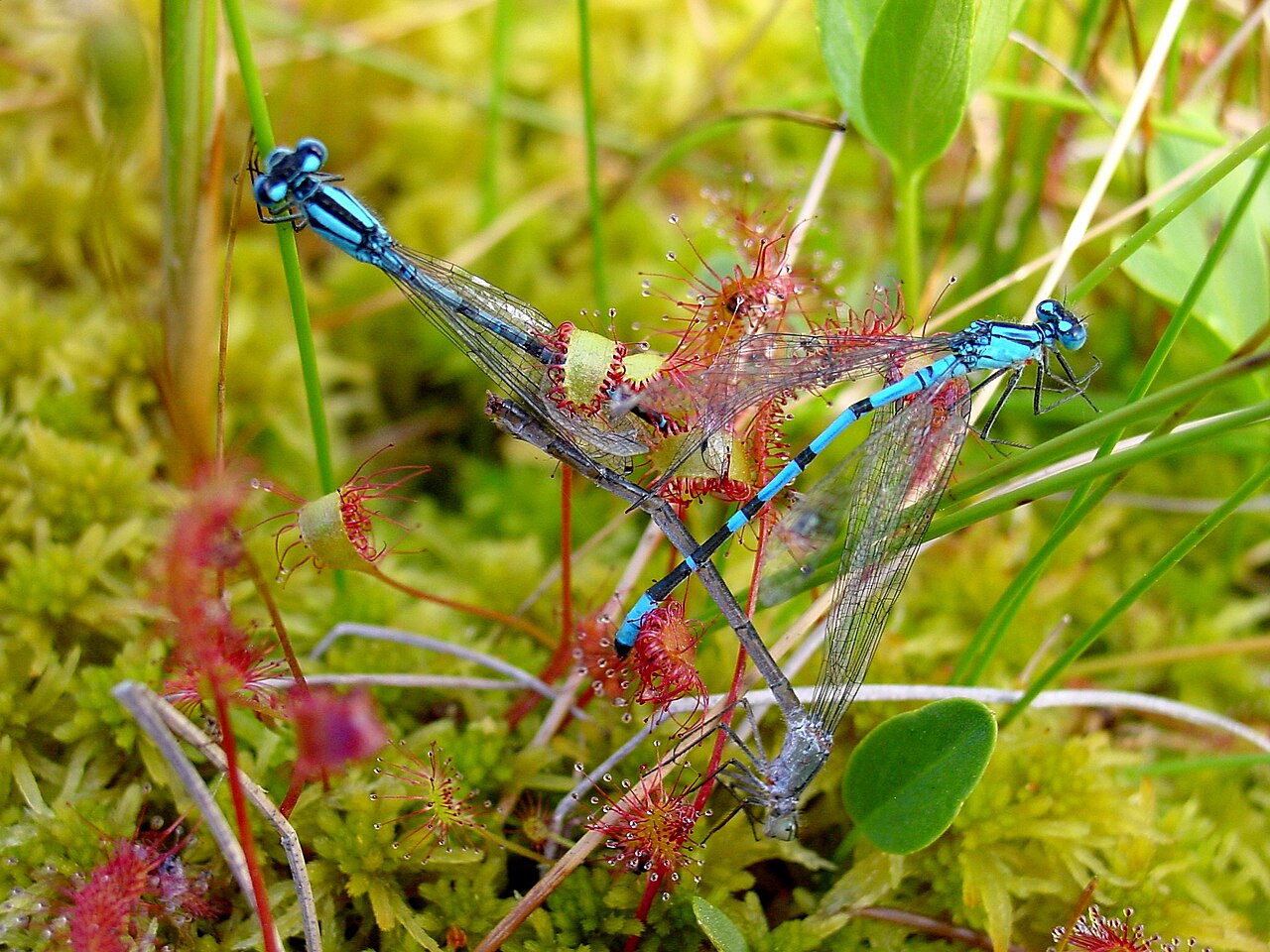
An active flypaper trap, and after the snap trap the most mobile of the mechanisms in this guide. Each tentacle bears a gland at its tip holding a droplet about half of which is a sticky sugar-like substance. An insect touching the droplet sticks fast, and that is only the start: the tentacle touched begins within minutes to bend towards the centre of the leaf, and at the same time passes a signal to the surrounding tentacles, which over half an hour to a few hours turn in as well. The glands then secrete digestive enzymes and take back up the dissolved nitrogen, phosphorus and minerals; the leaf unfolds only when there is nothing left to gain. The catch is mostly midges, gnats and other small flies — exactly what hangs in clouds over a bog.
Habitat and ecology
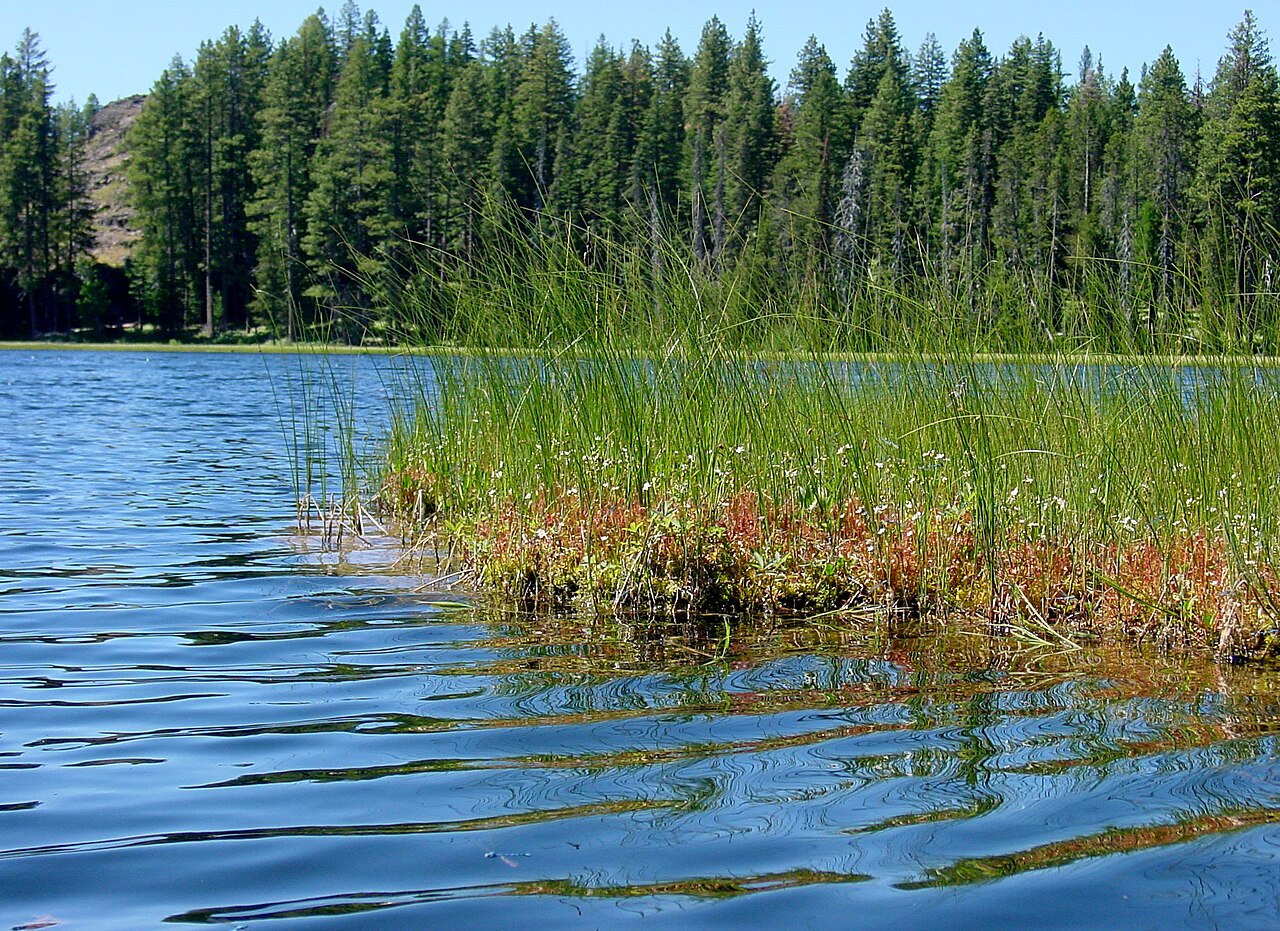
Acid, permanently wet and extremely nutrient-poor peat: the wet hollows of living raised bog, floating carpets of bog moss along acid pools and at the edge of fen lakes, quaking mires, and in the coastal belt young wet dune slacks where the water table reaches the surface (W1, W2, W3). Characteristically the plant sits among bog moss with the rosette at or just below water-table level. It tolerates neither shading nor enrichment: once purple moor grass, reed or birch takes the site over, or once extra nitrogen arrives from the air or the groundwater, it is gone within a few years.
Distribution and elevation
Circumboreal: right around the northern hemisphere through the temperate and boreal zones — from Ireland, Britain and Scandinavia through central and eastern Europe and Siberia to Japan, and in North America from Alaska and Canada south to Quebec, northern Maine, the Great Lakes and California. In the Netherlands it is confined to a handful of districts: wet raised-bog remnants in the east and north-east and a few wet dune slacks. Reliably published altitudinal limits for the species as a whole are lacking, so the elevation field is left empty here.
- Recorded (quarter-degree cells)
Forms and variation
No wild varieties or colour forms are recognised, and there is an evolutionary reason for that: the species itself arose as a stabilised hybrid. Its chromosome number (2n = 40) is double that of D. rotundifolia and D. linearis, and D. anglica is regarded as the doubled, fertile hybrid of those two. That accounts both for the intermediate leaf shape and for the uniformity: there is little genetic room to move. Where it grows with D. rotundifolia the sterile natural hybrid D. × obovata appears, which in this guide belongs with the parents.
Where and when to see it
July is the best moment: the rosettes are full grown and the scapes are up, which makes the plant far easier to pick out among the moss. Go in sunshine and look into the light — the droplets then read as strings of beads and you see at a glance how many plants are there. Search the wettest ground rather than the dry hummocks: the hollows of a raised bog, the edge of a floating mat, the lowest point of a young dune slack. Keep to paths and boardwalks; a floating carpet of bog moss is fragile, barely recovers from being walked on, and almost every site in the Low Countries lies in a reserve where free roaming is not allowed.
Conservation status
The species has not been assessed for the global IUCN Red List and is not listed in CITES, so it carries no international category. Globally there is little cause for concern either: across boreal Canada, Scandinavia and Russia it grows in vast, largely intact mires. At the southern edge of the range the picture is different. Through much of western and central Europe it has declined sharply or disappeared, and in the Netherlands it counts among the most threatened plants of the peatlands and appears on the national red list. The causes are the same everywhere and well understood: the cutting and draining of raised bog, the drying of dune slacks, and above all the deposition of airborne nitrogen, which lets grass overgrow the bog moss and strips the plant of its one advantage, that of being able to live on very little.
Scientific name
Drosera anglica | Hudson, 1778
Described by William Hudson in 1778, in "Flora Anglica" (2nd edition), volume 1, p. 135. Not explicitly stated, but since "Flora Anglica" catalogued the flora of England, England is the likely type region; however, this is not literally confirmed in the sources. From the Latin anglica ("English, of England") — consistent with the English common names "English sundew"/"great sundew" and the title of Hudson's publication.
World Checklist of Vascular Plants (WCVP), via Plants of the World Online (POWO), Royal Botanic Gardens, Kew.