All species › Caryophyllales › Sundew family › Drosera intermedia
Drosera intermedia
Kleine zonnedauw
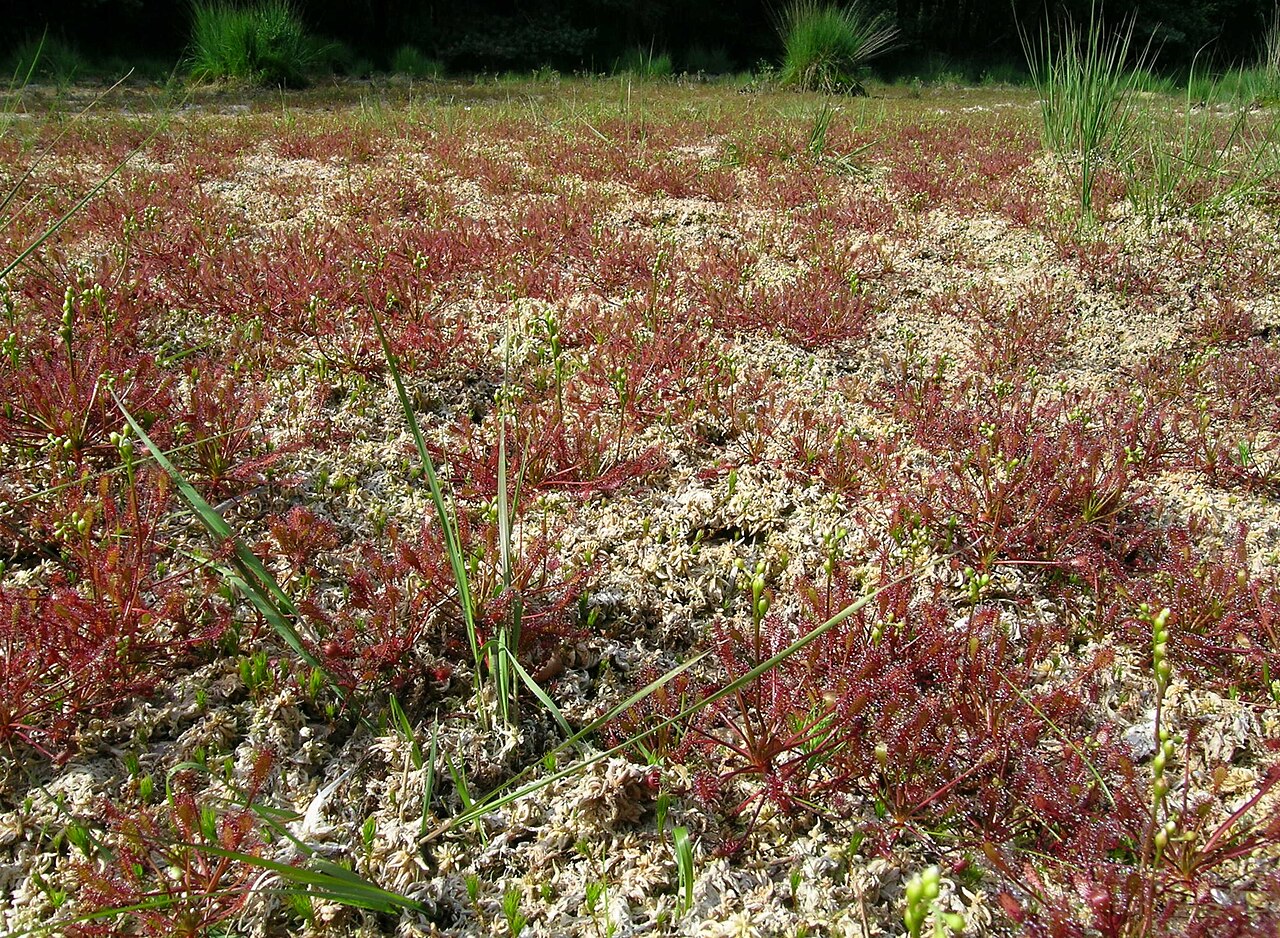
The oblong-leaved sundew, and in the Low Countries the commonest of the three native species — although common is a relative term here. Drosera intermedia is one of the most widespread sundews in the world: it grows in Europe from Portugal to Scandinavia and Russia, in eastern North America from Newfoundland to Texas, and also, surprisingly, on Cuba, Hispaniola and in northern South America. More than its two European relatives it is a plant of bare wet sand and of the shore zones of acid pools, where the water comes and goes.

Identification
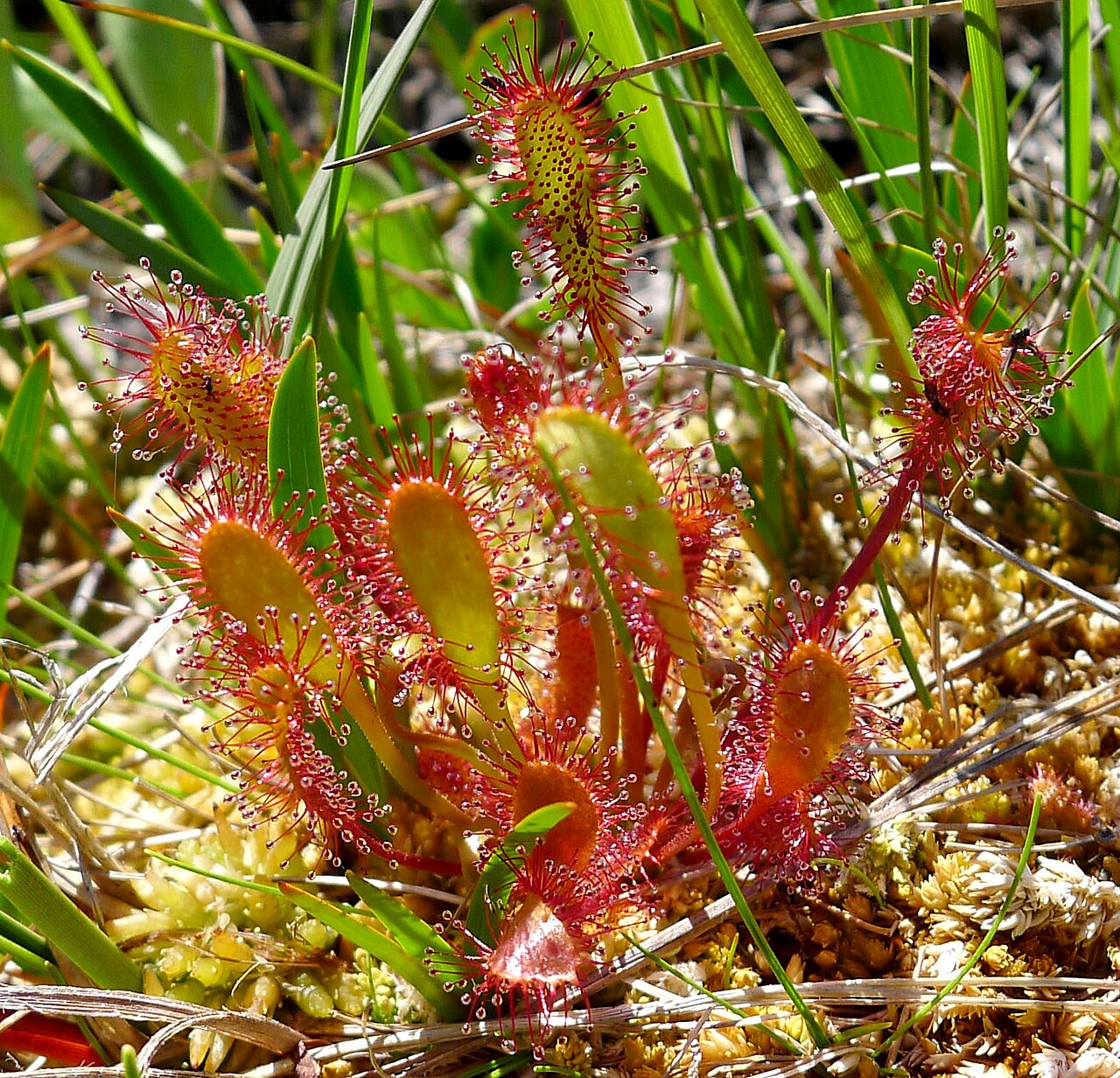
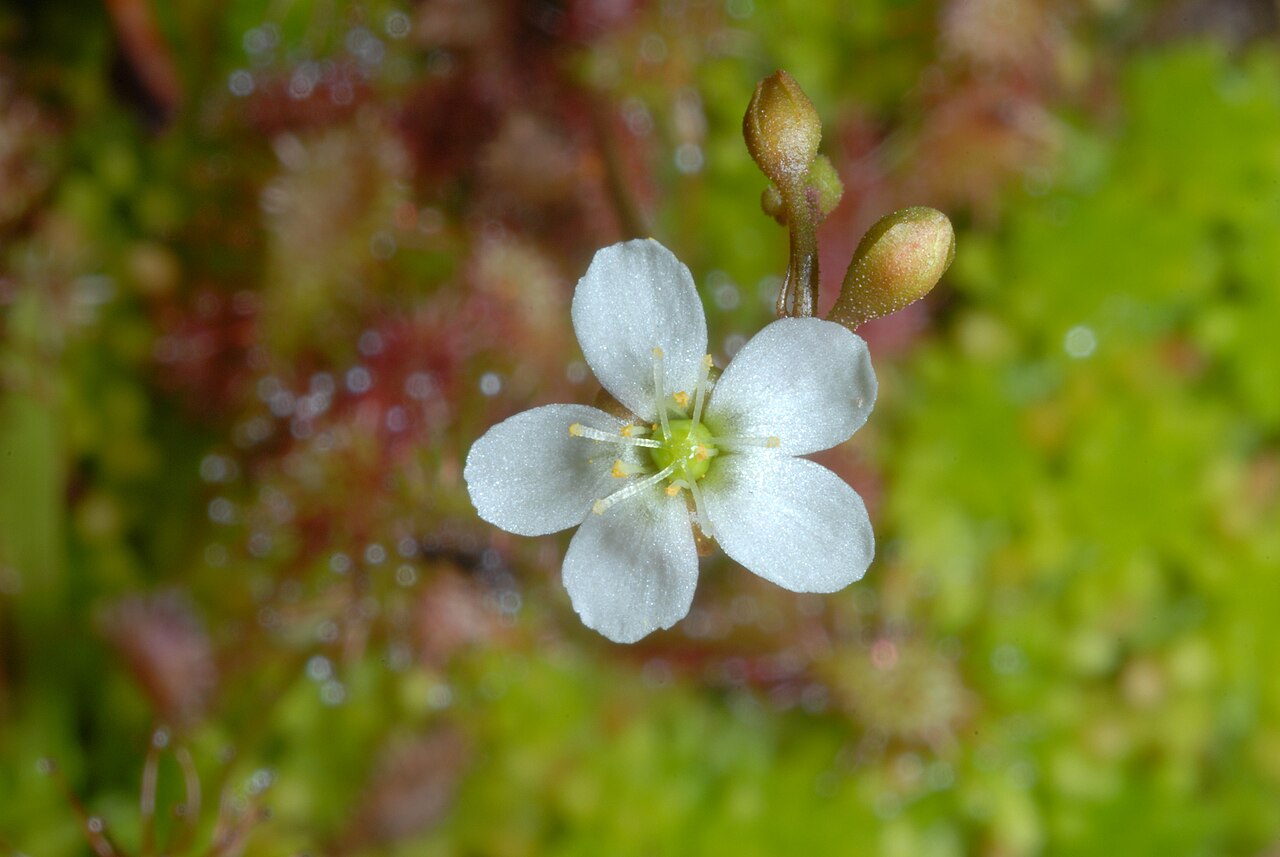
A perennial rosette with obliquely upright leaves, up to about 10 cm tall. Each leaf consists of a long, glabrous petiole and a much shorter, obovate to spatulate blade carrying red tentacles. An important character is the scape: it does not rise from the centre but from the side of the rosette, first arching outwards and then growing up to about 15 cm. It carries three to eight white flowers that open one at a time, only in sunshine. Ovoid capsules with many small seeds follow. In temperate regions the plant overwinters as a hibernaculum; tropical populations do not. Plants that become submerged can go on growing for a while as an elongated underwater form.
Similar species
Drosera rotundifolia has a round blade wider than long, usually lying flat on the moss, and a scape rising straight from the centre. Drosera anglica is larger, has a much longer, narrower blade and also a central scape. In North America young D. capillaris looks very similar; it has a sparsely hairy petiole and usually pink flowers. Hybrids with D. rotundifolia occur occasionally but are rare and sterile.
The trap and how it works
An active flypaper trap. The red tentacles on the blade each carry a droplet of sticky mucilage; an insect that lands in it sticks fast. The tentacles touched bend towards the prey within minutes, the surrounding ones follow, and with larger prey the blade bends too. Enzymes from the glands break the prey down, after which nitrogen, phosphorus and minerals are absorbed. Because the plant so often grows on bare wet sand, the catch includes, besides midges and small flies, many ground-walking animals such as springtails and ants.
Habitat and ecology
Acid, wet, extremely nutrient-poor ground, more often sand than peat: the bare, trampled or freshly scraped shore zones of acid pools and heath ponds (W6), wet hollows and open patches in raised bog (W1), wet dune slacks (W3), and in the Netherlands strikingly often ditches, dug-out places and sod-cut patches in wet heath (H1). The plant benefits greatly from disturbance that bares the sand and tolerates brief flooding well; if necessary it survives high-water periods as seed in the soil. Being overgrown by purple moor grass or shrubs is its end.
Distribution and elevation
Europe, from Portugal, Spain and Italy north to Ireland, Britain, Scandinavia and Finland and east to Poland, the Baltic states, Ukraine, Belarus and western Russia, with outliers in Turkey and the Caucasus; in North America from Newfoundland and Labrador through south-eastern Canada and the eastern United States to Florida and Texas; further on Cuba and Hispaniola and in northern South America (Venezuela, Trinidad, Guyana, Suriname and Brazil). It is naturalised in Liberia. In the Netherlands it is scattered over the sandy regions and in the dunes. An altitudinal range for the species as a whole has not been reliably published.
- Recorded (quarter-degree cells)
Forms and variation
No varieties are accepted. The species is, however, strikingly plastic: plants standing under water for long periods form elongated stems with scattered leaves, and tropical populations without winter rest look different from the compact, overwintering rosettes of the north. Little is known of the natural hybrid with D. rotundifolia (D. × beleziana); in this guide it belongs with the parents.
Where and when to see it
July and August, when the plant is in flower and the rosettes are full grown. Search the edges of acid pools on the bare wet sand just above the water line, and freshly sod-cut patches in wet heath; the small red rosettes sometimes grow there in hundreds on a few square metres. On a sunny day look low into the light. Almost all sites in the Netherlands lie in nature reserves; keep to the paths, because the shore zone is exactly where the plant grows and trampling harms it.
Conservation status
The species has not been assessed for the global IUCN Red List (in this guide's data) and is not in CITES. Globally it is not threatened, but through much of western and central Europe it has declined sharply through drainage, reclamation of heath and bog and above all nitrogen deposition, which lets grass close over bare sandy shores. In the Netherlands it is on the national red list and legally protected. Management by sod-cutting and pool restoration has helped it at many sites: the plant often appears quickly on freshly scraped ground.
Scientific name
Drosera intermedia | Hayne, 1800
Described by Friedrich Gottlob Hayne (with J.F.P. Dreves) in 1798, in "Botanisches Bilderbuch für die Jugend und Freunde der Pflanzenkunde", volume 3, p. 18, plate 3B. "Vom Eppendorfer Moor bey Hamburg" — the Eppendorf bog near Hamburg, Germany. Lectotype designated by A. Fleischmann & Gonella, held in Munich (M). From the Latin intermedia ("intermediate") — conventionally explained in the carnivorous-plant literature as referring to its leaf shape, which is intermediate between that of D. rotundifolia and D. anglica; however, this is not literally confirmed from a source.
World Checklist of Vascular Plants (WCVP), via Plants of the World Online (POWO), Royal Botanic Gardens, Kew.