All species › Caryophyllales › Sundew family › Drosera filiformis
Drosera filiformis
A sundew that at first glance does not look like one: no rosette of spoon-shaped blades but an upright tuft of threads, each beaded from bottom to top with red, glistening droplets. Drosera filiformis is a plant of the Atlantic coastal plain of North America, from Nova Scotia to the Carolinas, growing on the sandy, acid shores of ponds and in wet hollows where the water drops away in summer. In late summer its sites can look flushed with red from a distance.

Identification
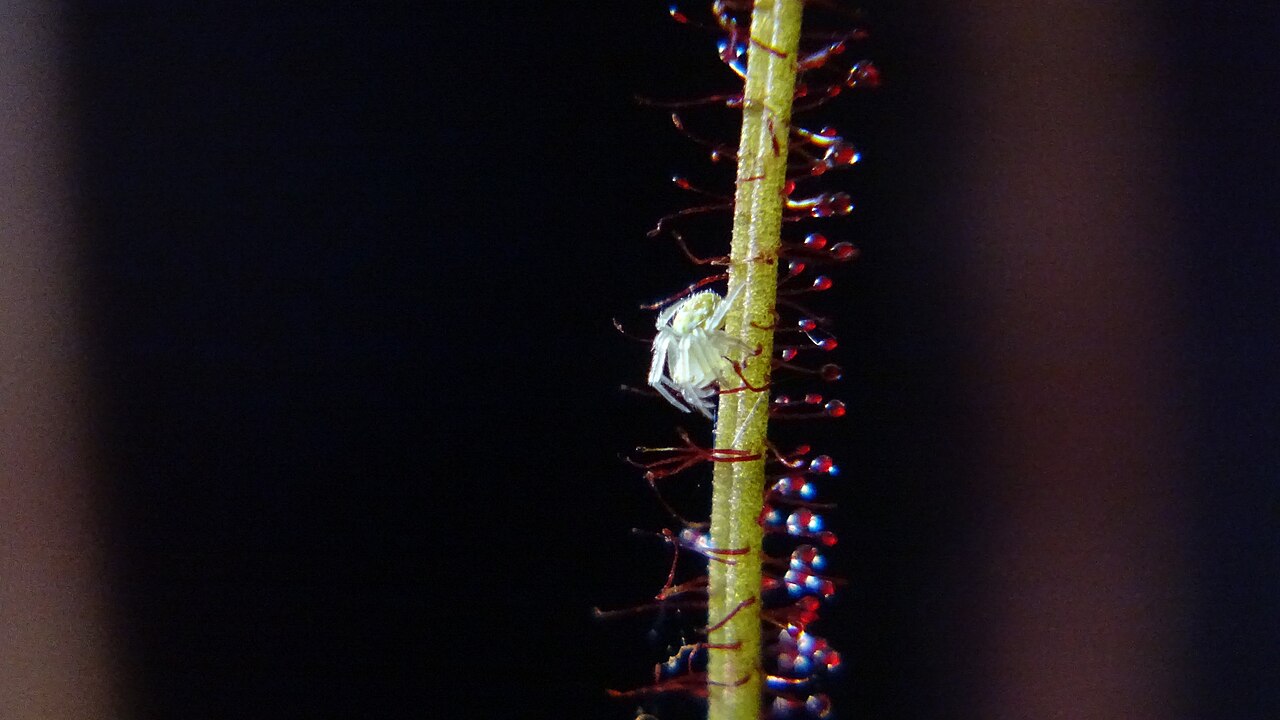
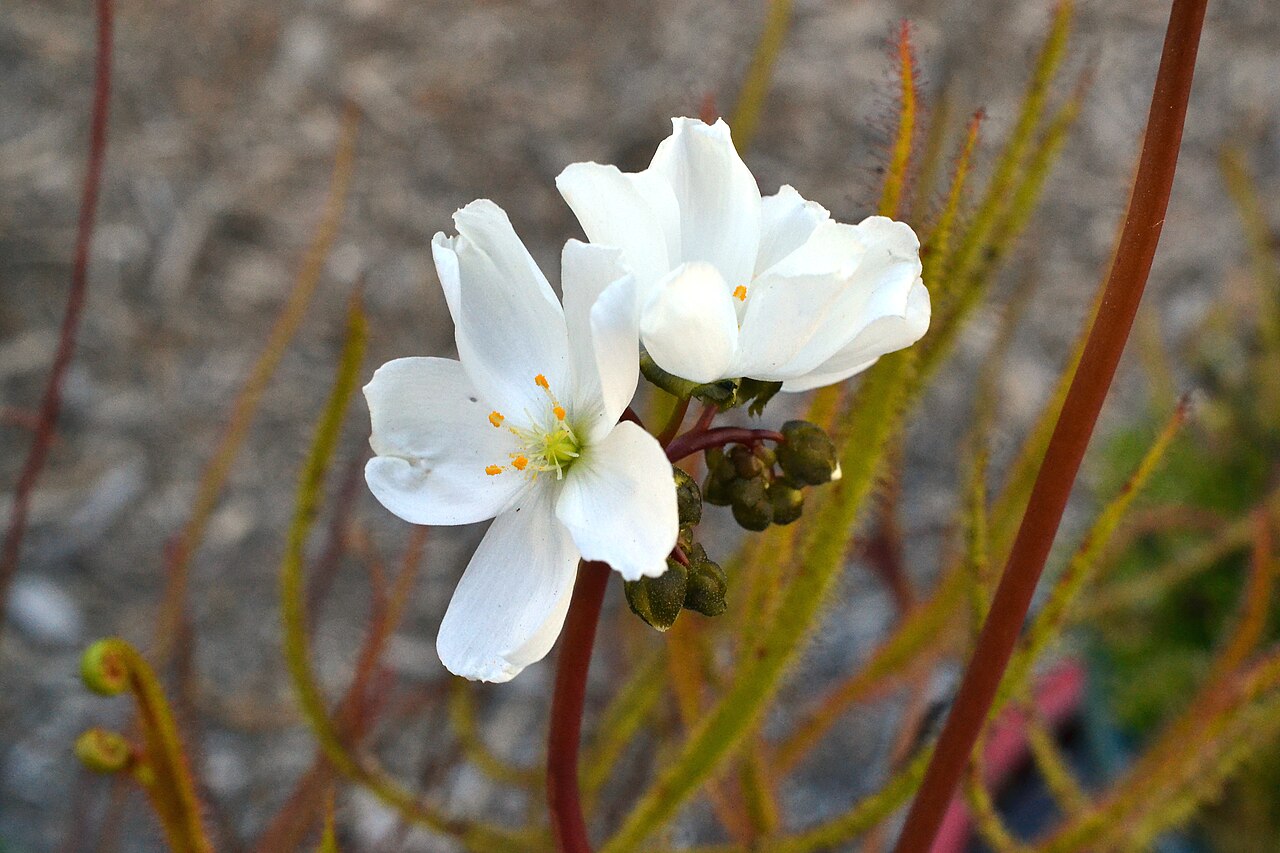
A perennial without an obvious stem, forming a tuft of erect, thread-like leaves up to about 25 cm long. There is no separate petiole and blade: the leaf carries stalked glands along almost its whole length, and in this species — the most important character — they are red to purplish red. Young leaves unroll from the centre like a fern crozier. The scape rises from the middle and carries a one-sided raceme of a few to about ten flowers roughly one and a half centimetres across, with five pink to purplish-pink petals; they open one at a time, only in sunshine. In winter the plant withdraws into a hibernaculum, a small, tight bud of folded leaves sitting on the sand.
Similar species
In North America only one species really resembles it: Drosera tracyi of the Gulf coastal plain, long treated as a variety of this species. It is larger, with leaves up to half a metre, and has green rather than red tentacles; its flowers are paler pink. Where the two approach each other, in north-west Florida, intermediate plants occur, and identification by eye alone is not always reliable there. Confusion with the other east-coast sundews, D. intermedia, D. rotundifolia and D. capillaris, is hardly possible: all have a distinct petiole with a broadened blade.
The trap and how it works
An active flypaper trap, as in all sundews. Every gland carries a droplet of sticky mucilage; an insect that flies or crawls into it is held. In this species the movement of the leaf itself is limited — a thread cannot fold round its prey as a round blade can — but the tentacles do bend towards the victim and so bring it into contact with more and more glands. The length of the leaf is what makes the trap effective: a large insect brushing along half a thread touches dozens of droplets at once. Surprisingly large prey is taken, up to small moths and damselflies, besides the usual midges and small flies.
Habitat and ecology
Acid, extremely nutrient-poor wet sand and thin peat over sand: the gently shelving shores of ponds and acid pools on the coastal plain, where the water level fluctuates strongly through the year, and wet open hollows in pine barrens (W6, W4). The plant typically occupies the belt that is flooded in spring and dries out in summer. It does not tolerate shade and benefits from fire and other disturbance that keeps shrubs back; it can also establish along ditches and in dug-out sand pits (H1).
Distribution and elevation
Eastern North America along the Atlantic coastal plain: the far south-west of Nova Scotia in Canada, and in the United States Massachusetts, Rhode Island, Connecticut, New York (Long Island), New Jersey, Delaware, Maryland and North Carolina; there are further reports for Pennsylvania and West Virginia and from north-west Florida. The gap between Nova Scotia and Cape Cod is usually explained as a relic of a former, now drowned coastal plain linking the two. Elevation data are not given here; these are lowland plains close to the sea.
- Recorded (quarter-degree cells)
Forms and variation
Two forms have long been recognised as varieties: the ordinary northern plant and, in north-west Florida, a smaller plant without a hibernaculum known as var. floridana. The third former variety, tracyi, is now treated as a species in its own right. Some authors regard the Florida plants as a stabilised intermediate between D. filiformis and D. tracyi; their status is not settled. They are not treated as a separate taxon in this guide.
Where and when to see it
July and August are best, when the leaves are full grown and the plants are in flower. Go on a sunny morning: the flowers open only in sun and close again in the afternoon. Search the edges of coastal-plain ponds, on the bare sandy shore belt; in late afternoon, with low light from behind, the red threads show up from far away. In Nova Scotia the few sites are strictly protected and the shores may not be entered; elsewhere too the shore zones are easily damaged by trampling.
Conservation status
The species is listed as Least Concern (LC) on the global IUCN Red List and is not in CITES. The regional picture is more varied. In Canada, where it grows only in south-west Nova Scotia, it is legally listed as endangered, and in several US states at the edge of its range it is rare. The threats are development of the coastal plain, peat extraction, drainage, and the closing-in of shores by shrubs once fire or water-level fluctuation ceases.
Scientific name
Drosera filiformis | Rafinesque, 1808
Described by Constantine Rafinesque in 1808, in Medical Repository, New York, series 2, volume 5, p. 360. The precise type locality could not be established. The species occurs from south-western Nova Scotia through New England to Florida, along the coastal plain of eastern North America. From the Latin filum ("thread") and -formis ("shaped like") — "thread-shaped", referring to the long, erect, thread-like leaves that unroll in a spiral.
World Checklist of Vascular Plants (WCVP), via Plants of the World Online (POWO), Royal Botanic Gardens, Kew.