All species › Caryophyllales › Sundew family › Drosera spatulata
Drosera spatulata
The spoon-leaved sundew is the sundew of the long shoreline of the western Pacific. Drosera spatulata ranges from Japan and southern China through Taiwan, South-East Asia, Micronesia and New Guinea to eastern Australia, Tasmania and New Zealand — one of the widest ranges of any sundew. It is a small, flat, red rosette found above all where the ground is wet and open, and in many districts road verges and ditches mean it even benefits from people.
Identification
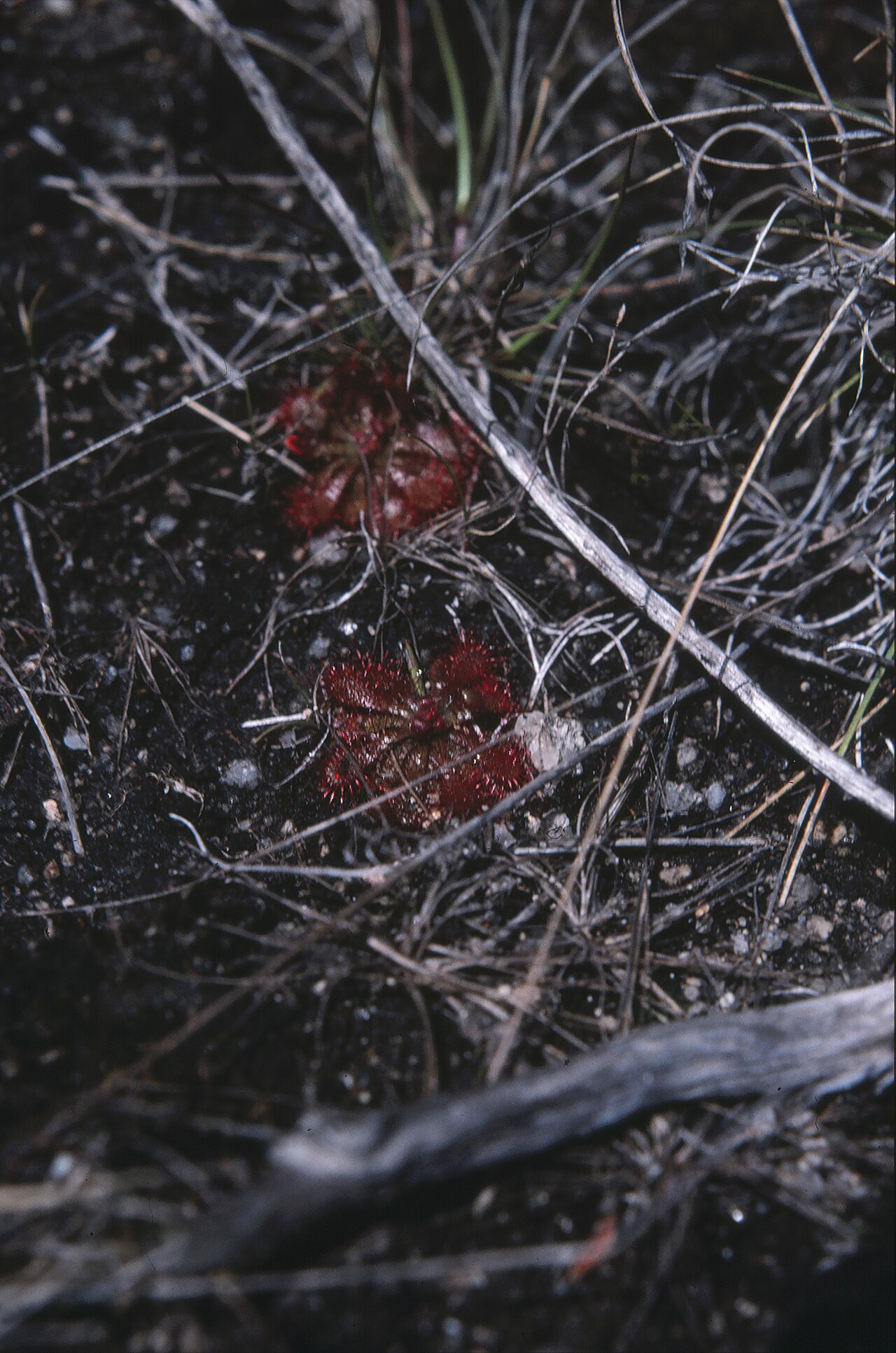
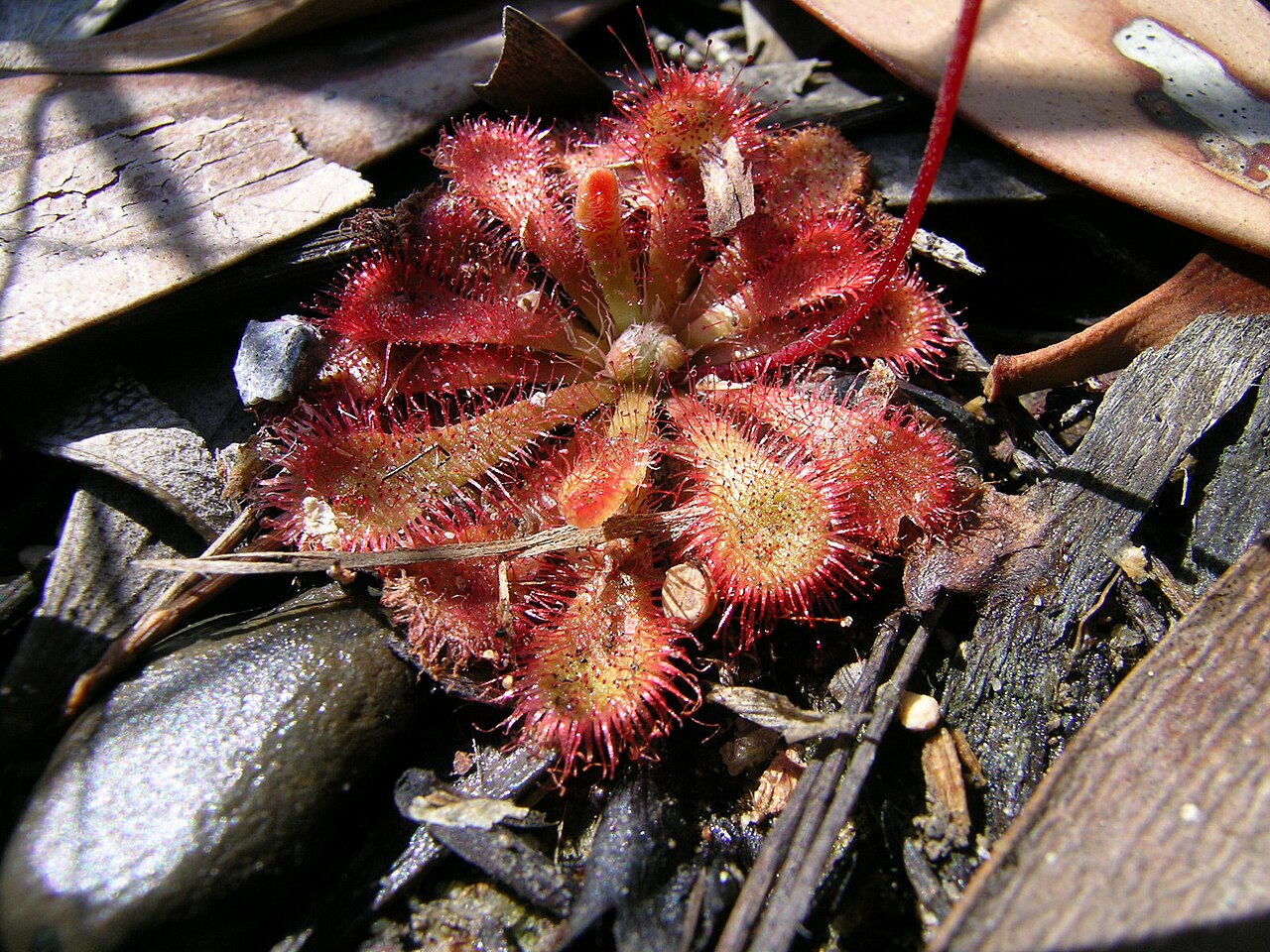
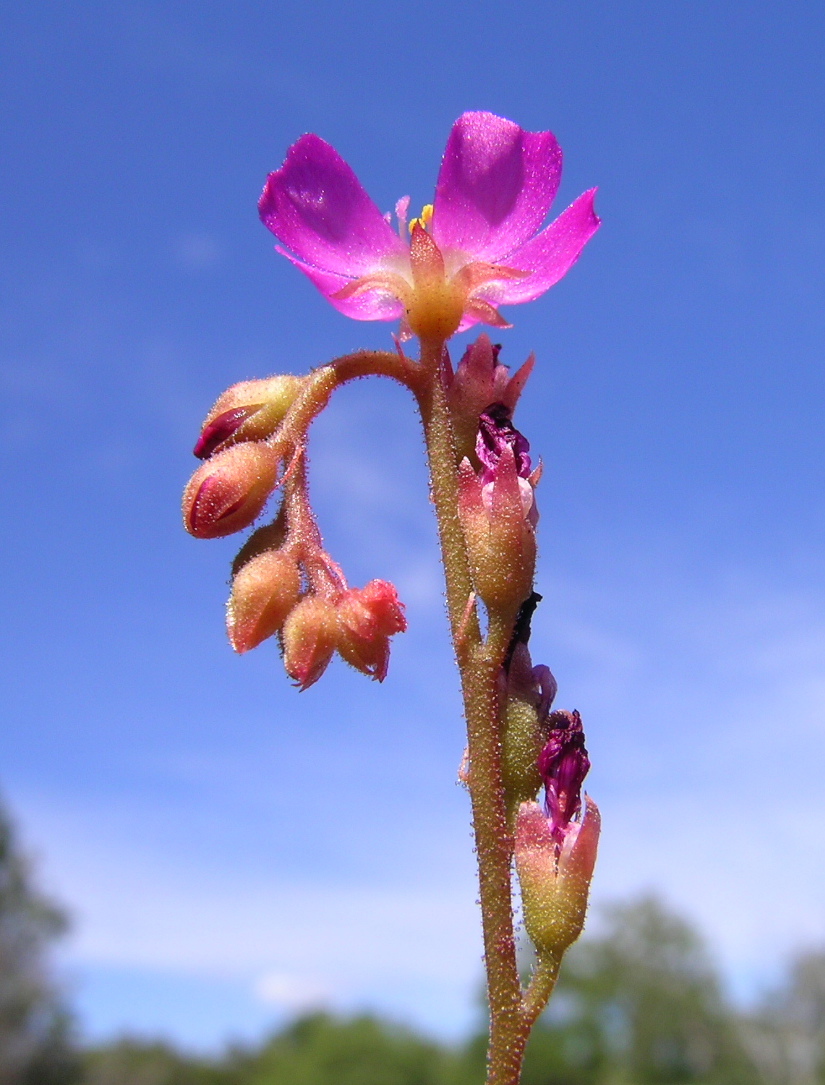
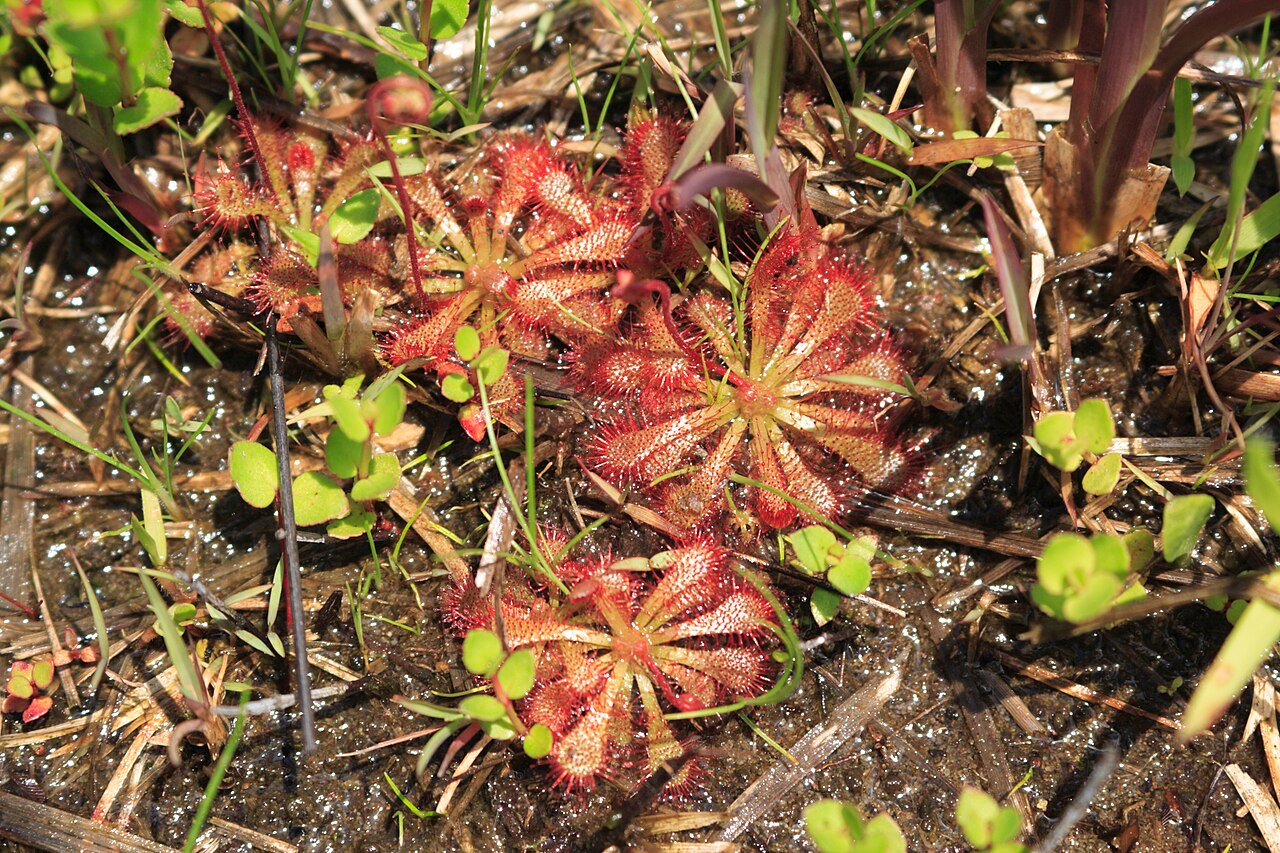
A flat rosette, usually about 4 cm across but between 2 and 6 cm depending on origin. The leaves lie flat on the ground or are held slightly raised. Each leaf consists of a narrow petiole passing gradually into a spatulate or spoon-shaped blade about 5 by 4 mm; the blade is wider than the stalk but longer than broad. In sun the whole rosette turns deep red, in shade it stays green with red tentacles. In early summer one or more upright scapes up to about 8 cm appear, each with some six small white or pink flowers that open in succession, only one or two at a time.
Similar species
In Australia and New Zealand it most resembles Drosera pygmaea, but that is much smaller (rosette under 2 cm), has round, almost peltate blades and four-parted rather than five-parted flowers. Drosera burmannii, which can grow alongside it in tropical Queensland and South-East Asia, has wedge-shaped leaves with conspicuously long marginal tentacles and a rosette pressed more tightly to the ground. In Japan it sometimes grows with Drosera rotundifolia, with which it forms the natural hybrid known as Drosera tokaiensis; that has broader, rounder blades and can be hard to separate in the field.
The trap and how it works
An active flypaper trap. The tentacles on the blade each carry a drop of sticky mucilage; a gnat or springtail landing there sticks fast, and over minutes to hours the tentacles bend towards the prey, after which the leaf closes somewhat around the catch. Digestive enzymes dissolve the soft parts and the glands take the nutrients back up. Because the rosette lies flat on the ground, the catch is mostly small crawling and low-flying insects.
Habitat and ecology
Wet, open, nutrient-poor ground with plenty of light: sandy and peaty heath, swamp margins, seepages on sandstone and the wet edges of peat swamps (W4, R1). Remarkably often it grows on man-made sites such as wet road verges, cut banks and ditches (H2), where competition from taller plants is temporarily absent. In Victoria it is often found with Drosera binata. It does not tolerate being overgrown; once shrubs and grasses close over the site it disappears.
Distribution and elevation
From Japan and southern China through Taiwan, the Philippines, Borneo and the rest of South-East Asia, Micronesia and New Guinea to eastern Australia (Queensland, New South Wales, Victoria), Tasmania and New Zealand. The species was described by Labillardière in 1804 from Tasmanian material. It is uncommon in Victoria and much more frequent in coastal New South Wales and Queensland. Reliable altitudinal limits for the whole range are lacking; the elevation field is left empty.
- Recorded (quarter-degree cells)
Forms and variation
This is a markedly variable species, and its forms are often referred to by locality in the literature and among growers. Two varieties have been formally described: var. gympiensis (2005, from south-eastern Queensland) and var. bakoensis (2009, from Bako National Park on Borneo). Different chromosome numbers occur within the species, and its relationships to allied forms in East Asia are not fully resolved. The Japanese Drosera tokaiensis is regarded as a stabilised hybrid of D. spatulata and D. rotundifolia. The name is often misspelt 'spathulata', an error going back to a publication of 1824.
Where and when to see it
Search in spring and early summer on wet, open ground along paths through coastal heath and along damp road verges; the red rosettes then stand out sharply against pale sand. Look low and preferably in sunshine: the droplets catch the light and give away even rosettes a couple of centimetres across. Where you see Drosera binata or Drosera pygmaea, it is worth looking for this species too. Do not step on rock seepages; the thin film of moss and algae in which the plants root is easily dislodged.
Conservation status
The species has not been assessed for the global IUCN Red List and is not listed in CITES. Given its huge range and its ability to colonise newly created wet, open ground quickly, there is little cause for global concern. Locally it is another matter: in Victoria it is uncommon and declining with the loss and drying of wet heath. Elsewhere too, drainage, urban growth along coasts and the closing-over of open ground are what threaten populations.
Scientific name
Drosera spatulata | Labillardière, 1804
Drosera spatulata was described by Jacques-Julien Houton de Labillardière, published in "Novae Hollandiae Plantarum Specimen", volume 1: 79, plate 106, figure 1 (1804/1805). The type material originates from Tasmania, likely collected by Labillardière himself during his voyage with the French expedition to Australia/Tasmania in the late 18th century. The exact collection date and precise locality could not be established with certainty. The name is descriptive Latin: "spatulata" means "spatula-shaped", referring to the shape of the leaves, which resemble a spatula or spoon.
World Checklist of Vascular Plants (WCVP), via Plants of the World Online (POWO), Royal Botanic Gardens, Kew.