All species › Caryophyllales › Sundew family › Drosera aliciae
Drosera aliciae
One of the best-known sundews of the Cape, and at the same time one of the hardest to delimit. Drosera aliciae forms flat, tightly closed rosettes that turn deep red in the sun, and is scattered through the wet places of the fynbos from the Cape Peninsula into the Eastern Cape. Anyone who finds a seep in the Cape mountains carpeted with small red rosettes has a good chance that this is the species — or one of its close relatives.
Identification
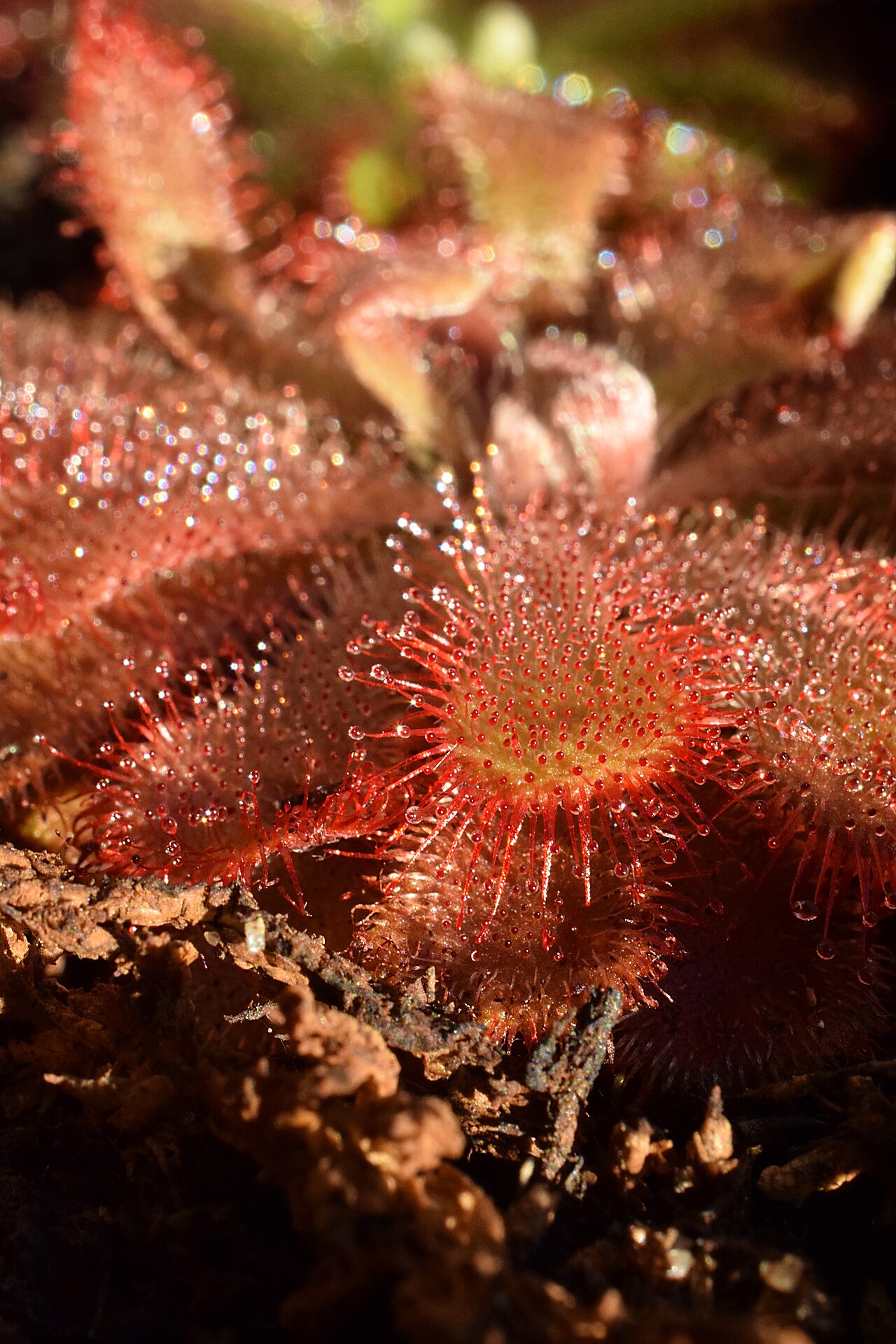
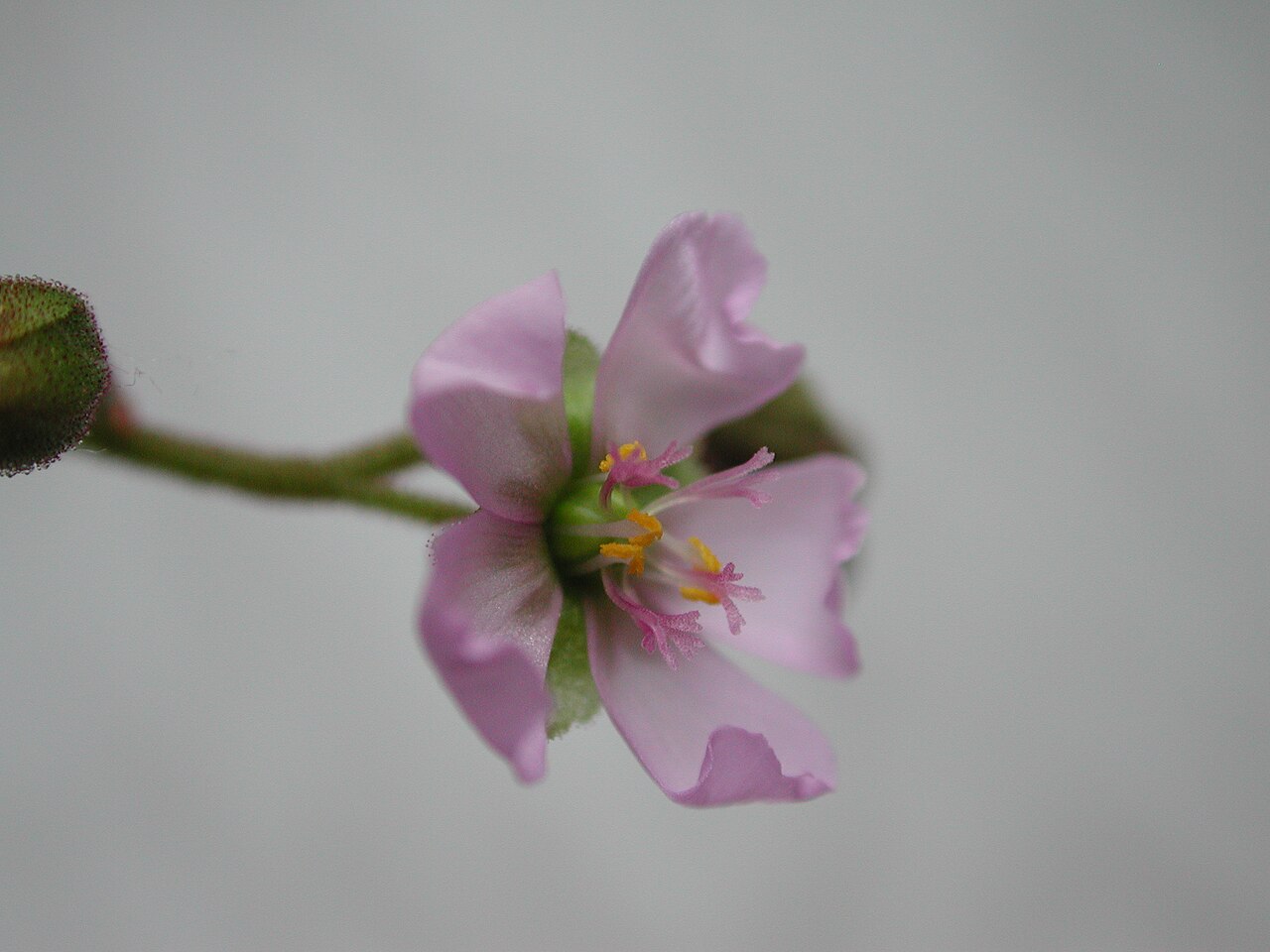
A small rosette pressed flat to the ground, up to about 5 cm across. The leaves are spatulate to wedge-shaped, tapering gradually to the base, and carry long red tentacles on the upper surface and along the margin; the underside and margins are conspicuously densely hairy, and there are distinct stipules at the leaf base — an important character. The scape is wiry and glandular, curved at first and then erect, and may rise some 30 cm above the rosette. Several deep pink flowers open in succession at its tip, each for only a few hours and only in sunshine.
Similar species
The Cape holds a whole series of rosetted sundews that resemble each other. Drosera trinervia is smaller, often has white flowers and lacks the conspicuous stipules; the three leaf veins are sometimes visible. Drosera cuneifolia has broader leaves truncate at the tip and is confined to the Table Mountain massif. Drosera slackii is larger, with a petiole that widens in the middle. Drosera natalensis from eastern South Africa differs in its hairier stipules and a larger gap between leaf base and the first tentacles. In the field, the combination of stipules, hairy underside and deep pink flowers is the best guide.
The trap and how it works
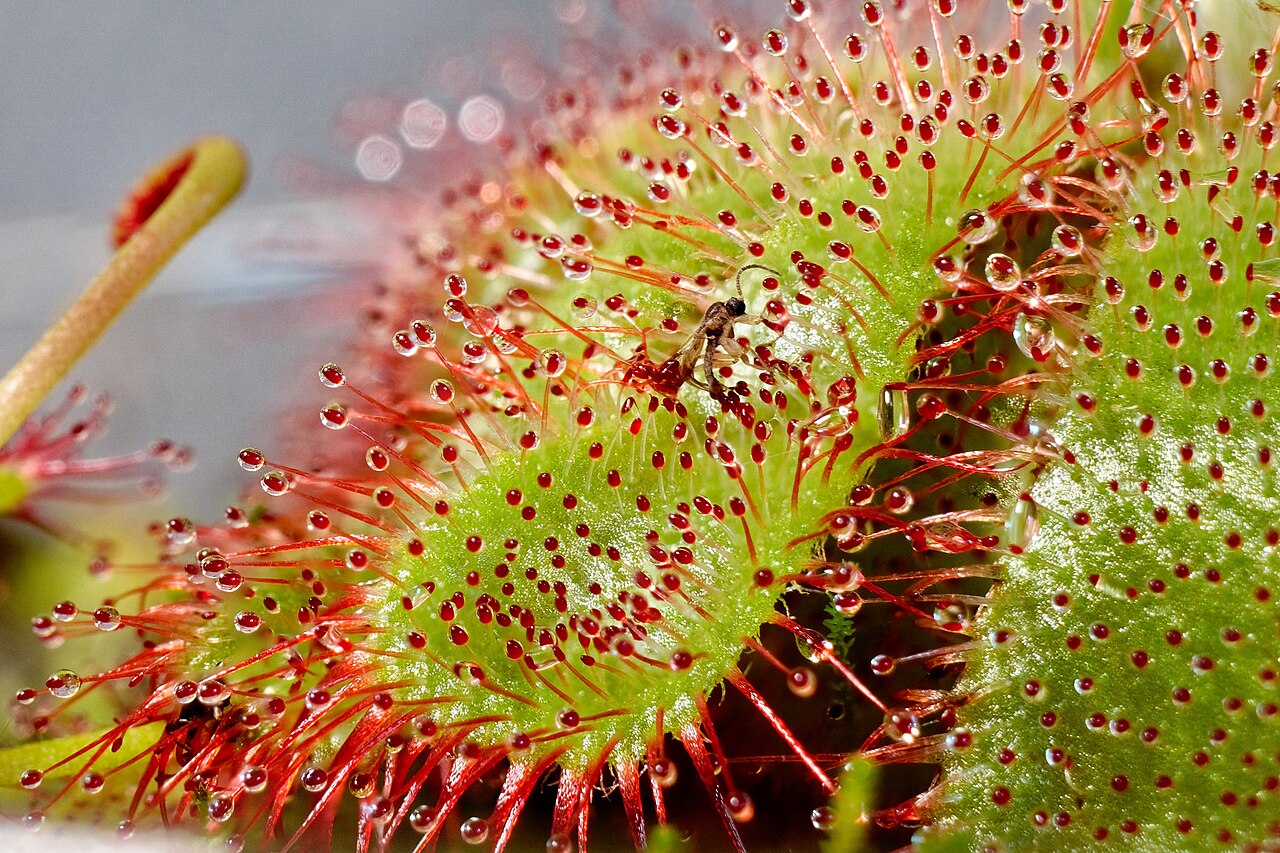
An active flypaper trap. Each tentacle ends in a gland holding a droplet of sticky mucilage. An insect landing on it sticks fast; the surrounding tentacles then bend slowly towards the prey, bringing it into contact with as many glands as possible. The glands then secrete digestive enzymes and absorb the released nutrients. In strong light the tentacles turn deep red through anthocyanin, which makes the rosettes conspicuous and may also help attract insects. The catch consists mainly of small flies and gnats around the seeps.
Habitat and ecology
Permanently moist, nutrient-poor places in the fynbos: seeps on mountain slopes, wet stream margins and peaty sandstone soils (R1, W4, B5). The species prefers open, sunny ground among low restios and sedges, and disappears where vegetation grows too tall and dense. It can be abundant precisely in the mountains on the boundary between the winter-rainfall zone and the zone with year-round rain and frequent mist.
Distribution and elevation
Endemic to South Africa: the Cape Provinces, from the Cape Peninsula east into the Eastern Cape. It is a typical element of the Cape flora but reaches further east than many of its relatives. No reliable published altitudinal limits for the species as a whole were found, so the elevation field is left empty.
- Recorded (quarter-degree cells)
Forms and variation
Delimitation is not simple. Drosera aliciae was described by Raymond-Hamet in 1905, and during the twentieth century several closely related Cape sundews were split off or merged back in. Drosera curviscapa is treated by some authors as a variety or synonym of D. aliciae and by others as a separate species; it is larger with firmer leaves. D. esterhuyseniae and D. slackii have also been placed under D. aliciae in some lists, while Kew now accepts them as distinct. This guide follows that narrower concept.
Where and when to see it
Flowering falls in the southern early summer, around November to January. The flowers open only in sunshine and close by mid-afternoon, so plan a visit on a bright morning. Search along paths through wet fynbos, where water seeps out of the slope; the red rosettes stand out against the sand. Do not step into the seeps: they are small, and the rosettes often grow close together.
Conservation status
The species has not been assessed for the global IUCN Red List and is not listed in CITES. For a Cape sundew its range is fairly large and it occurs in many protected mountain areas, so there is no direct evidence of serious threat. Locally the usual problems of the Cape fynbos apply: the drying of seeps, invasion by alien trees such as pines and wattles, and a fire regime that returns too often or too rarely. Taxonomic uncertainty around the species complex also makes older distribution records hard to interpret.
Scientific name
Drosera aliciae | Hamet, 1905
Described by Raymond Hamet, in Journal de Botanique (ed. L. Morot), Paris, volume 19, p. 114 (1905). In the same species complex, Drosera curviscapa Salter (1939) was later described, now considered a synonym. The precise type locality could not be established with certainty. From the Latin genitive "aliciae" ("of Alicia/Alice") — almost certainly named after a woman called Alice, but her identity could not be established with certainty.
World Checklist of Vascular Plants (WCVP), via Plants of the World Online (POWO), Royal Botanic Gardens, Kew.