All species › Caryophyllales › Sundew family › Drosera cistiflora
Drosera cistiflora
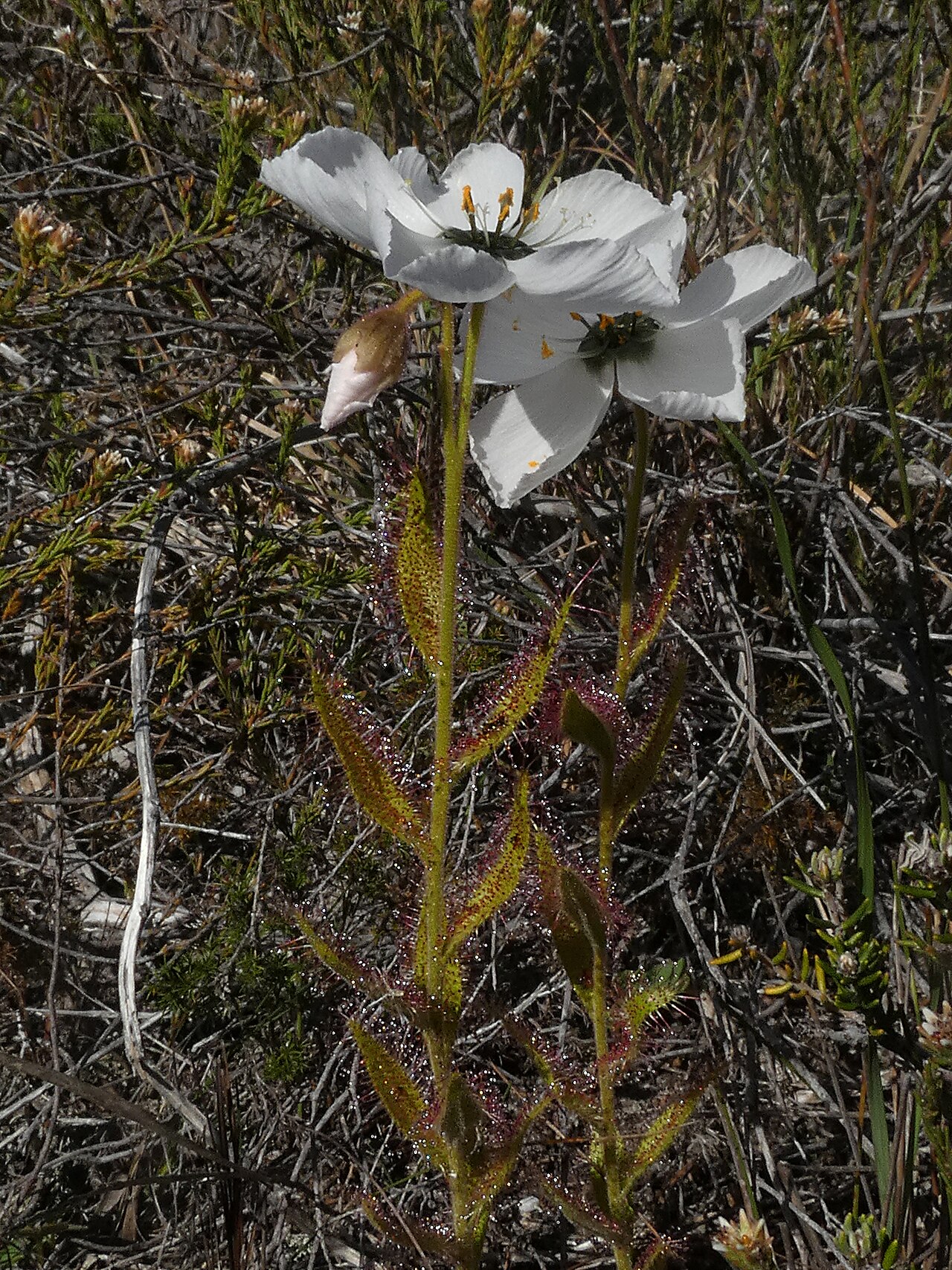
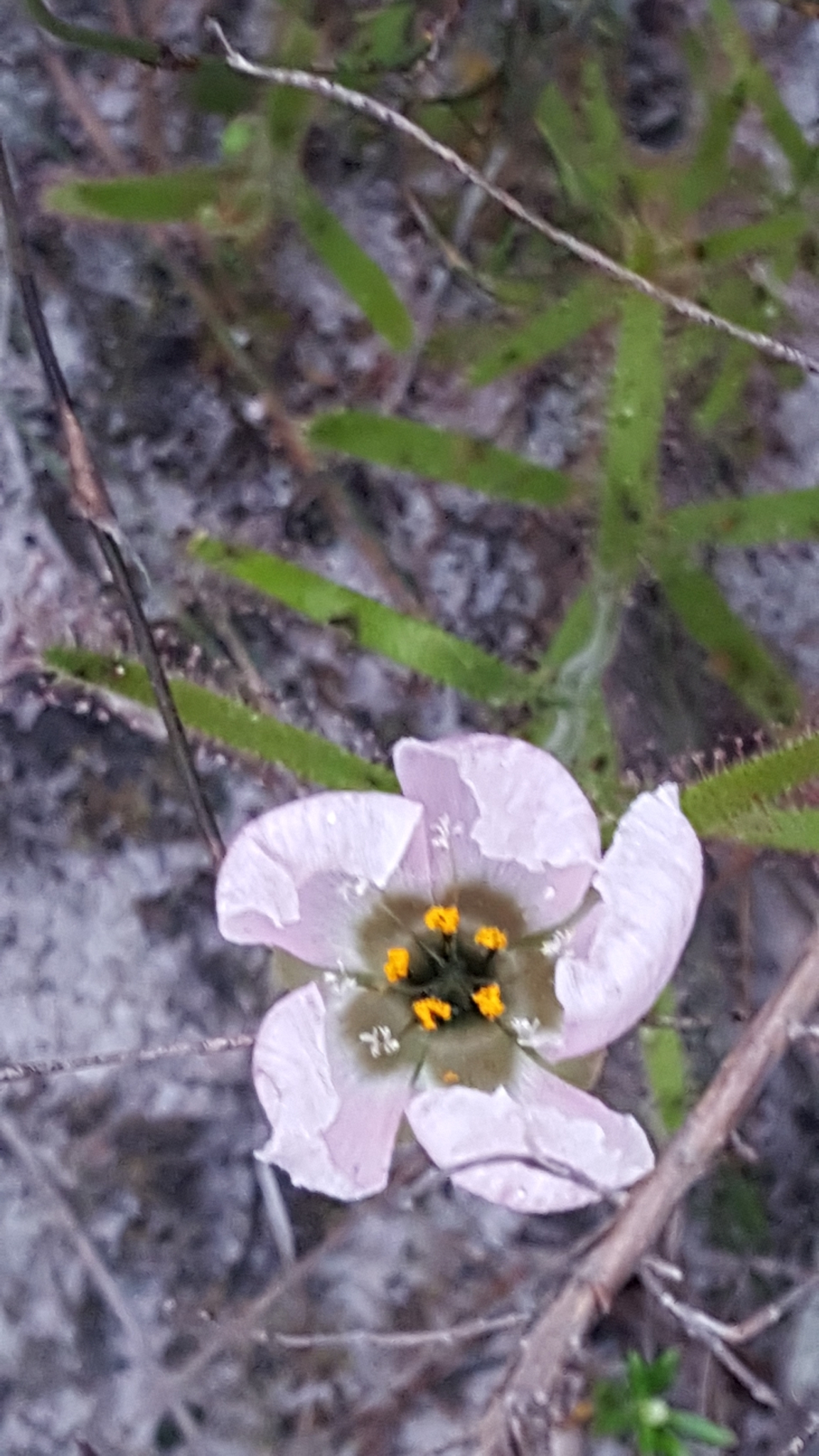
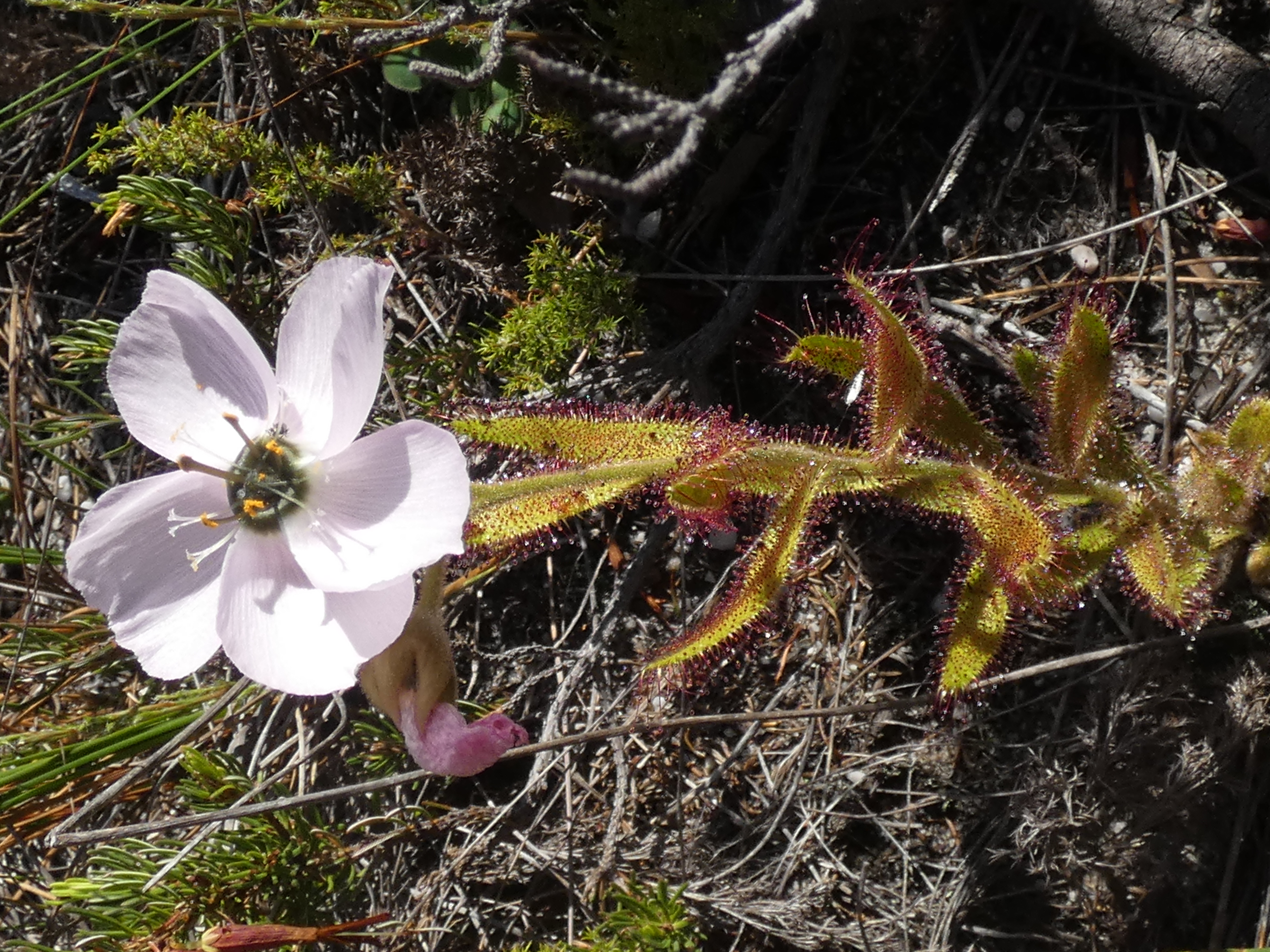
The sundew with the largest flowers in Africa, and one of the largest in the whole genus. Drosera cistiflora owes its name to the resemblance to rock-rose flowers (Cistus): bowls three to five centimetres across, in a bewildering range of colours. In the Cape spring, after the winter rain, they stand in renosterveld and fynbos like small flames among the grass.
Identification
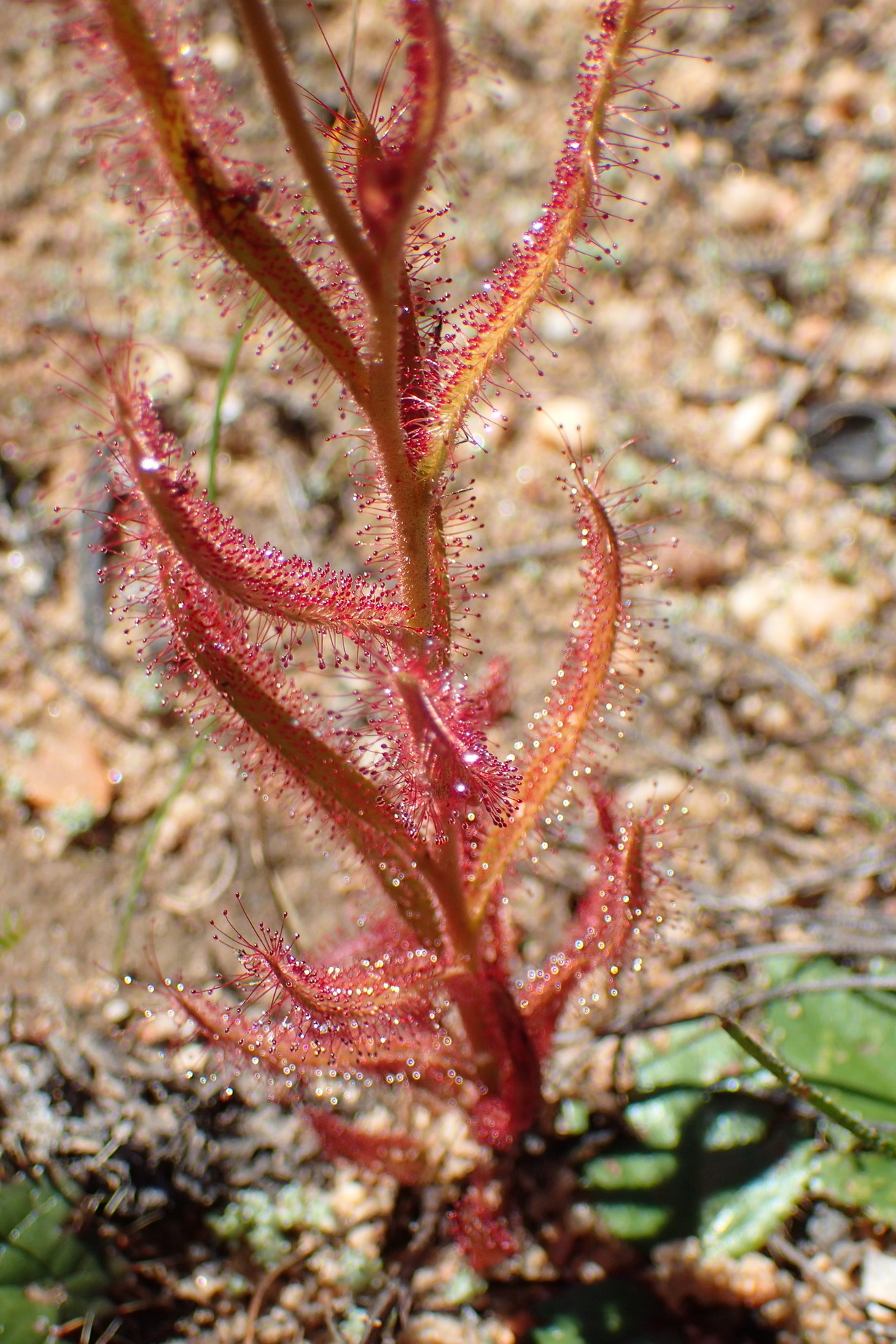
The plant begins the growing season as a flat or semi-erect basal rosette of narrowly oval leaves, and then sends up an erect, unbranched stem 10 to 40 cm tall. Along that stem stand narrowly lanceolate, upward-pointing leaves 20 to 40 mm long and about 4 mm wide, all bearing sticky tentacles. One or a few large flowers appear at the top. Colour is no identification character here: white, yellow, cream, salmon, pink, mauve, purple and dark red all occur, often with a dark centre. The styles are fringed. Underground are one or two long, swollen roots with a dense felt of root hairs, which carry the plant through the dry summer.
Similar species
Within the so-called D. cistiflora complex several species are very alike. Drosera pauciflora has similarly large flowers but forms no erect leafy stem: the flower stands on a bare stalk directly from the rosette. Drosera variegata has a shorter stem with only two or three leaves. From the other Cape rosetted sundews, such as D. trinervia and D. aliciae, the species differs at once in its leafy stem and much larger flowers.
The trap and how it works
An active flypaper trap, on both the rosette leaves and the stem leaves. The tentacles secrete sticky mucilage in which small insects become caught; the surrounding tentacles then bend towards the prey and the glands secrete digestive enzymes. Because the leaves are set along a rising stem, the plant also catches insects flying through the low vegetation, not only what lands on the ground. The large flowers stand well above the trapping leaves, reducing the chance that pollinators are caught.
Habitat and ecology
Well-drained sandy soils, moist in winter, in renosterveld and fynbos, often in open clearings, on alluvial deposits along streams, on wet sand flats and in seeps on hillsides (W7, B5, D1). The species grows in winter and retreats into its underground roots in the dry summer. After fire, while the vegetation is still low, it often flowers especially freely. The altitudinal range is wide: from 20 to 1250 m.
Distribution and elevation
Endemic to South Africa, in the winter-rainfall region of the Cape Provinces: from Namaqualand in the Northern Cape south and east to near Port Elizabeth (Gqeberha) in the Eastern Cape. Within that area it is locally common.
- Recorded (quarter-degree cells)
Forms and variation
The species is highly variable, which has produced a long list of synonyms, among them D. helianthemum, D. speciosa, D. zeyheri and D. pauciflora var. minor. Colour forms are often local: red forms occur around Darling and in Namaqualand, pink, white or yellow ones elsewhere. The complex has been restudied in recent decades and some forms have been described as separate species; anyone meeting an aberrant population should consult the recent literature. Cultivar names are not used in this guide.
Where and when to see it
Go in August or September, on a sunny day around midday: the flowers open for only a few hours and only in good light. The year after a veld fire is often best, when the vegetation is low and the plants flower en masse. Much renosterveld has been converted to farmland; your best chance lies in nature reserves and along gravel roads where remnants of the original vegetation survive.
Conservation status
Not assessed for the global IUCN Red List and not listed in CITES. On the national Red List of South African Plants (SANBI) it is listed as Least Concern. Even so, much of the renosterveld, its main habitat, was ploughed for wheat and vineyards over the last century, and many populations have been pushed back to verges and remnant fragments. Digging of plants for trade and the absence of fire in small reserves can also cause local damage.
Scientific name
Drosera cistiflora | Linnaeus, 1760
Described by Carl Linnaeus in 1760, in "Plantae Rariores Africanae" (also cited as Amoenitates Academicae, volume 6, p. 85). Southern Africa, the Cape region in general; lectotype Herb. Linn. no. 398.6 (LINN). Thunberg added a more detailed locality description in 1797: "on sandy hills and fields near the city [Cape Town], in Swartland" — however, this is Thunberg's own supplementary note, not necessarily Linnaeus's original type locality. From the Latin Cistus (rock-rose) and flora ("flower") — "with flowers like a rock-rose", hence the English common name "poppy-flowered/rockrose-flowered sundew".
World Checklist of Vascular Plants (WCVP), via Plants of the World Online (POWO), Royal Botanic Gardens, Kew.