All species › Caryophyllales › Sundew family › Drosera fragrans
Drosera fragrans
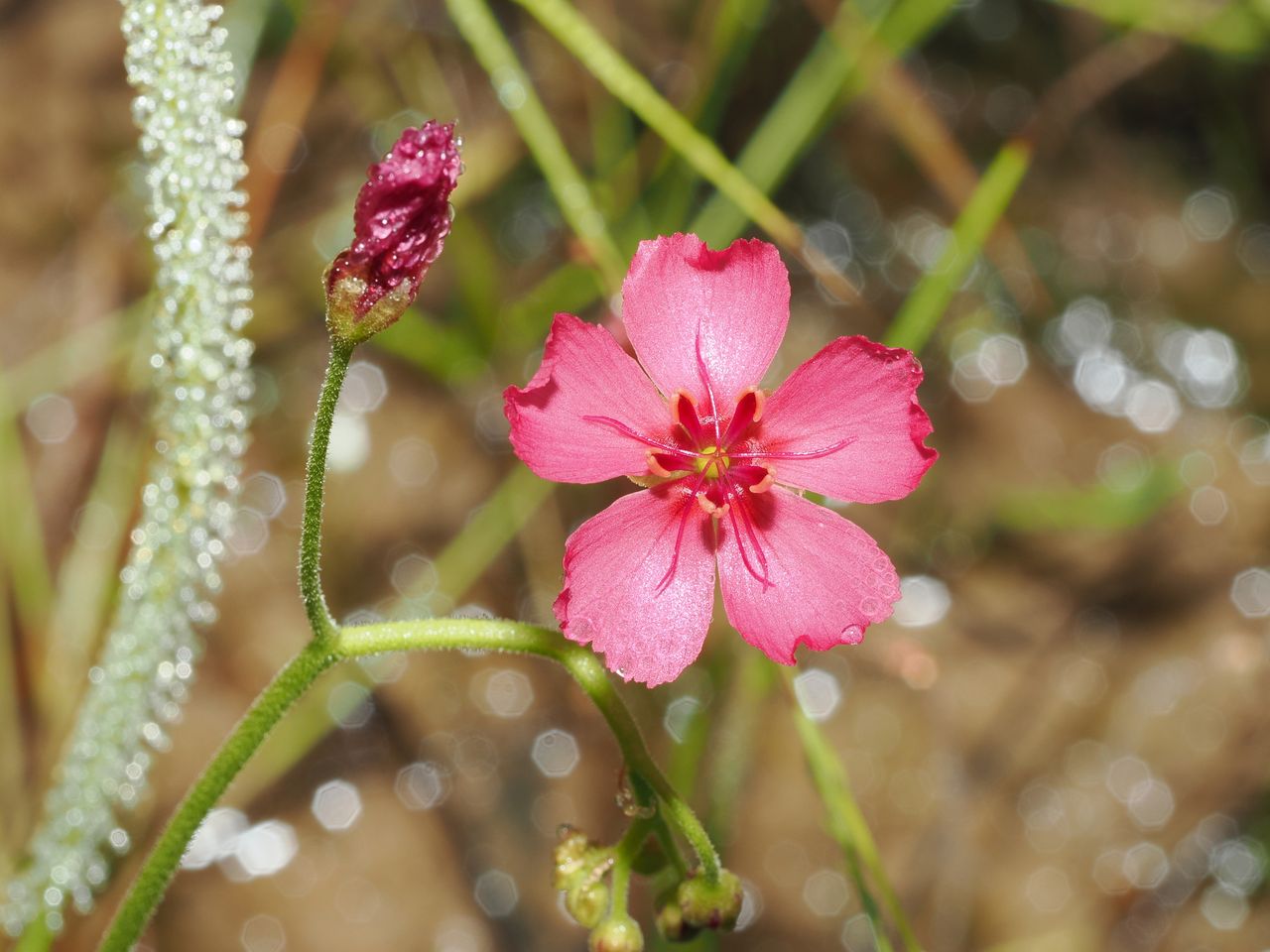
Drosera fragrans is a sundew you smell before you see: its flowers give off a sweet scent that observers compare to honeydew melon. The species was described only recently by Allen Lowrie, as part of his great survey of the carnivorous plants of Australia. Unlike many other sundews of the tropical north it does not belong to the D. petiolaris complex but to the D. indica group (section Arachnopus).
Identification
An annual sundew of the D. indica group: plants with an erect to scrambling stem and long, narrow leaves bearing glandular tentacles, living for a single growing season. The most striking feature is the scent of the flowers, sweet and fruity, which is absent or much weaker in related species of the group. Reliable measurements and flower colour from the original description were not available for this guide; those fields are left empty.
Similar species
The confusion lies within the D. indica group, which in northern Australia contains a series of very similar annual species, such as D. finlaysoniana, D. hartmeyerorum, D. serpens, D. aquatica and D. glabriscapa. They differ in hairiness, anther structure and seed shape. Flower scent is a useful field character in D. fragrans, but requires flowering plants and a good nose. Species of the D. petiolaris complex are easily distinguished by their rosette of long stalks with a small round blade.
The trap and how it works
An active flypaper trap along the length of the leaf. The tentacles mainly catch flying insects that blunder into the leaves or land on them. There are indications that the flower scent influences which insects visit the plant's surroundings, and thus possibly the make-up of the prey; this has not, however, been studied in detail.
Habitat and ecology
Open, sunny places in tropical savanna that become wet in the rainy season (W7), in savanna woodland (B6). As an annual it survives the dry season solely as seed.
Distribution and elevation
Endemic to northern Australia: northern Western Australia and the Northern Territory. The range description 'tropical northern Australia' fits. Precise limits and altitudinal limits are not published in the sources consulted; the elevation field is left empty.
- Recorded (quarter-degree cells)
Forms and variation
No varieties are recognised. The species is one of many split since 2000 from the broad concept of D. indica, and belongs to section Arachnopus. Older records of 'D. indica' from northern Western Australia and the Northern Territory may therefore refer to this species.
Where and when to see it
Search in the wet season in open, wet places in savanna and smell the flowers: the sweet melon scent is the quickest way to tell this species from its relatives. Also photograph the flower and stem and note the locality; that is often needed for a firm identification within the D. indica group.
Conservation status
On the IUCN Red List the species is Least Concern (LC); it is not listed in CITES. The range lies mostly in little-developed savanna country. Local threats are changes in fire regime, grazing and invasive grasses, which close over the open wet places on which the species as an annual depends.
Scientific name
Drosera fragrans | Lowrie, 2013
Described by Allen Lowrie, in "Carnivorous Plants of Australia Magnum Opus", volume 3, p. 1271 — sources differ slightly on the year (2013 or 2014). The precise type locality could not be established. The species occurs in northern Western Australia and the Northern Territory. Named after the strong, sweet fragrance of the leaves and stem, likened to honeydew melon — the scent is thought to play a role in attracting prey.
World Checklist of Vascular Plants (WCVP), via Plants of the World Online (POWO), Royal Botanic Gardens, Kew.