All species › Caryophyllales › Sundew family › Drosera pulchella
Drosera pulchella
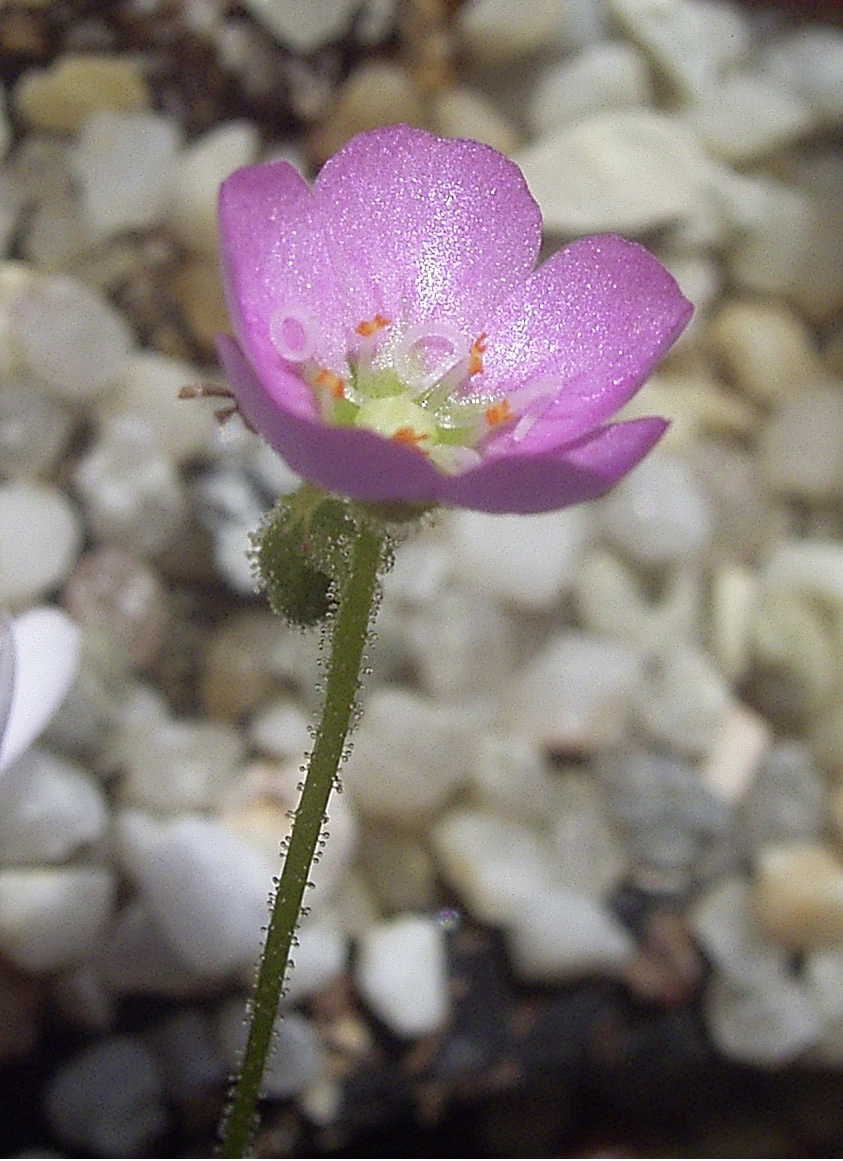
One of the best-known and most variable pygmy sundews of south-west Australia, and unlike most of its relatives a plant of wet ground. Drosera pulchella — 'the pretty one' — grows in swamps, along creeks and lakes and in shaded wet spots in forest, and flowers with blooms almost as big as the whole plant, in a colour range from white through pink to orange.


Identification
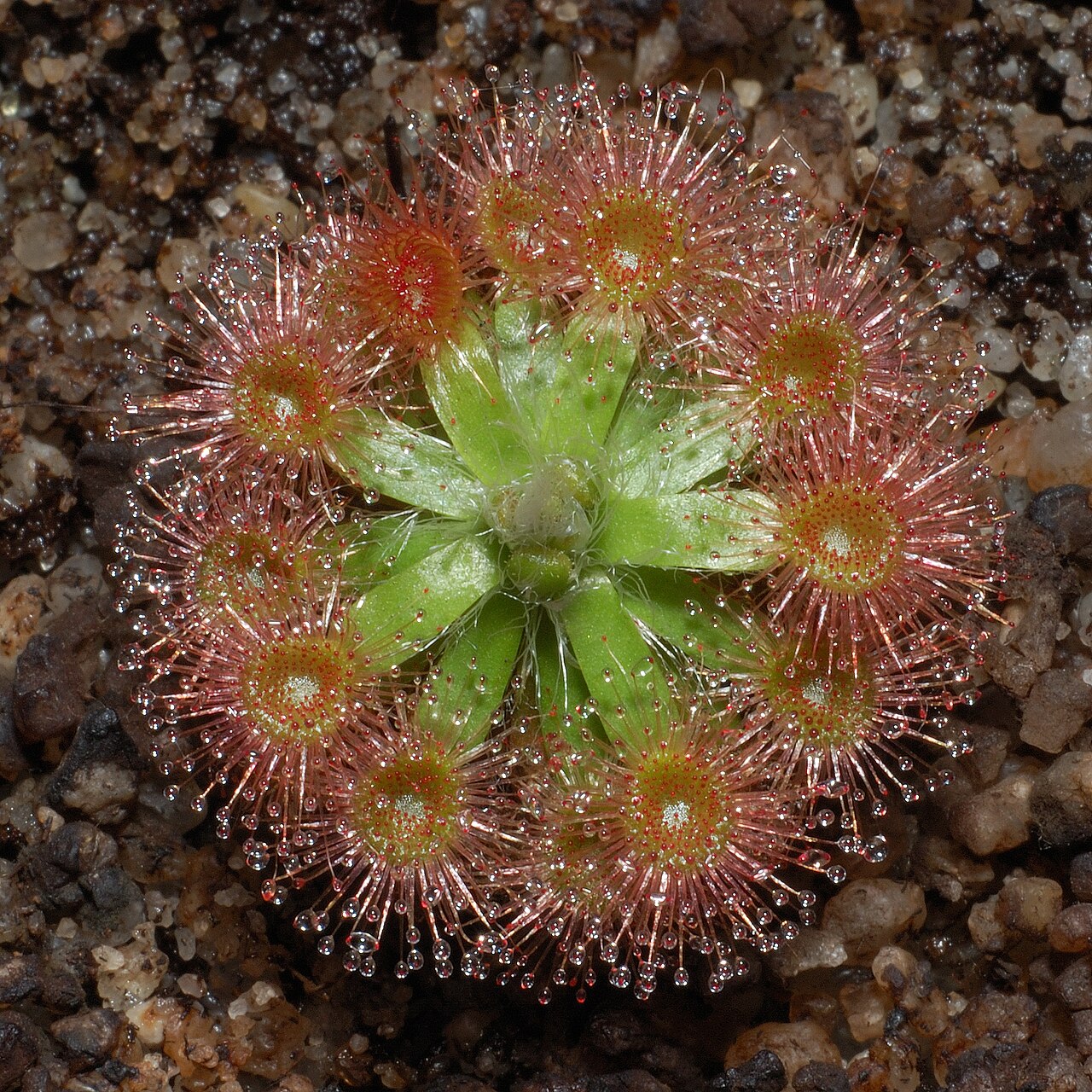
A rosette usually 15 to 20 mm across, according to FloraBase up to 3 cm across and up to 4 cm tall with the flowers. The leaves surround a central bud and end in a round blade set with tentacles. In the field the species often forms dense clusters resembling a tuft of moss — the result of reproduction by gemmae. The flowers are strikingly large for the plant, and the colour varies: pink, white and orange are most often recorded, yellow and red also occur. Flowering from November to January.
Similar species
Among the pygmy sundews, the combination of wet habitat, dense colonies and large, often pink or orange flowers is typical. Orange-flowered relatives such as Drosera platystigma and D. hyperostigma grow on drier laterite and sand and have a black centre to the flower. Because D. pulchella is so variable, a single plant without flowers cannot be identified with certainty; look at the whole population and at the habitat.
The trap and how it works
An active flypaper trap in miniature. Each leaf blade, often no larger than a pinhead to a few millimetres, carries stalked glands on its margin and upper surface, each holding a glistening sticky droplet; the marginal tentacles are usually the longest. A small animal that touches the droplets sticks fast, after which the tentacles bend towards the centre of the blade and press the prey against the digestive glands. The glands secrete enzymes and absorb nitrogen, phosphorus and minerals from whatever dissolves. Given the scale, the catch consists of the very smallest: springtails, mites, aphids, thrips and minute midges moving over or just above the sandy ground.
Habitat and ecology
Places that stay moist year-round or at least wet for a long time: swamps, creek banks, lake margins and wet spots in forest (W4, W7). The soil is white or black peaty sand, extremely poor in nutrients. The species tolerates more shade than most other pygmy sundews.
Distribution and elevation
Endemic to south-west Western Australia. FloraBase lists a broad spread of bioregions: Avon Wheatbelt, Esperance Plains, Geraldton Sandplains, Jarrah Forest, Mallee, Swan Coastal Plain and Warren. Altitudinal limits are not published.
- Recorded (quarter-degree cells)
Forms and variation
Johann Georg Christian Lehmann described the species in 1844. No formal subspecies or varieties are recognised, but variation in flower colour is great, and populations of different colours have become known over the years as informal 'forms'. The plant is mostly perennial, sometimes annual. Reproduction is mainly by gemmae: specially formed leaflets in the centre of the rosette that detach and, when touched, can be flung up to several metres. Seed set is reportedly inefficient.
Where and when to see it
Search in late spring and early summer, November to January, when the flowers are open. The plant grows in wet places — in peaty sand along a creek or at the edge of a swamp — and often in large numbers together. Look also in the half-shade of shrubs, where other pygmies are absent. Do not step into the wet margins: they are the habitat itself, and the dense colonies are quickly damaged by trampling.
Conservation status
Assessed as Least Concern (LC) on the IUCN Red List; not listed in CITES, and rated not threatened in FloraBase. The species has a large range. Because it is tied to wet places, it is sensitive to falling groundwater and to the drying climate of south-west Australia, which has received markedly less winter rain in recent decades.
Scientific name
Drosera pulchella | Lehmann, 1844
Drosera pulchella was described by the German botanist Johann Georg Christian Lehmann, in his work "Pugillus", volume 8, page 38, in 1844. The species is native to south-western Western Australia. The exact collection site, collector and collection date of the type specimen could not be established with certainty. The epithet pulchella is a Latin diminutive of pulcher, "beautiful", and thus means "rather pretty" or "pretty little". It is a descriptive name referring to the delicate appearance of this small pygmy sundew, not a toponym or a person's name.
World Checklist of Vascular Plants (WCVP), via Plants of the World Online (POWO), Royal Botanic Gardens, Kew.