All species › Caryophyllales › Tropical pitcher plant family › Nepenthes bongso
Nepenthes bongso
One of the first pitcher plants described from Sumatra, and still one of the most frequently seen species of the island's high mountains. The Dutch naturalist Pieter Willem Korthals published Nepenthes bongso in 1839 in his monograph Over het geslacht Nepenthes. The name refers to Putri Bungsu, the 'youngest daughter', who in Minangkabau tradition is the guardian spirit of the volcano Marapi. It is a typical cloud-forest plant: slender, climbing, with pitchers that in the misty forest edge often hang higher than you expect.

Identification
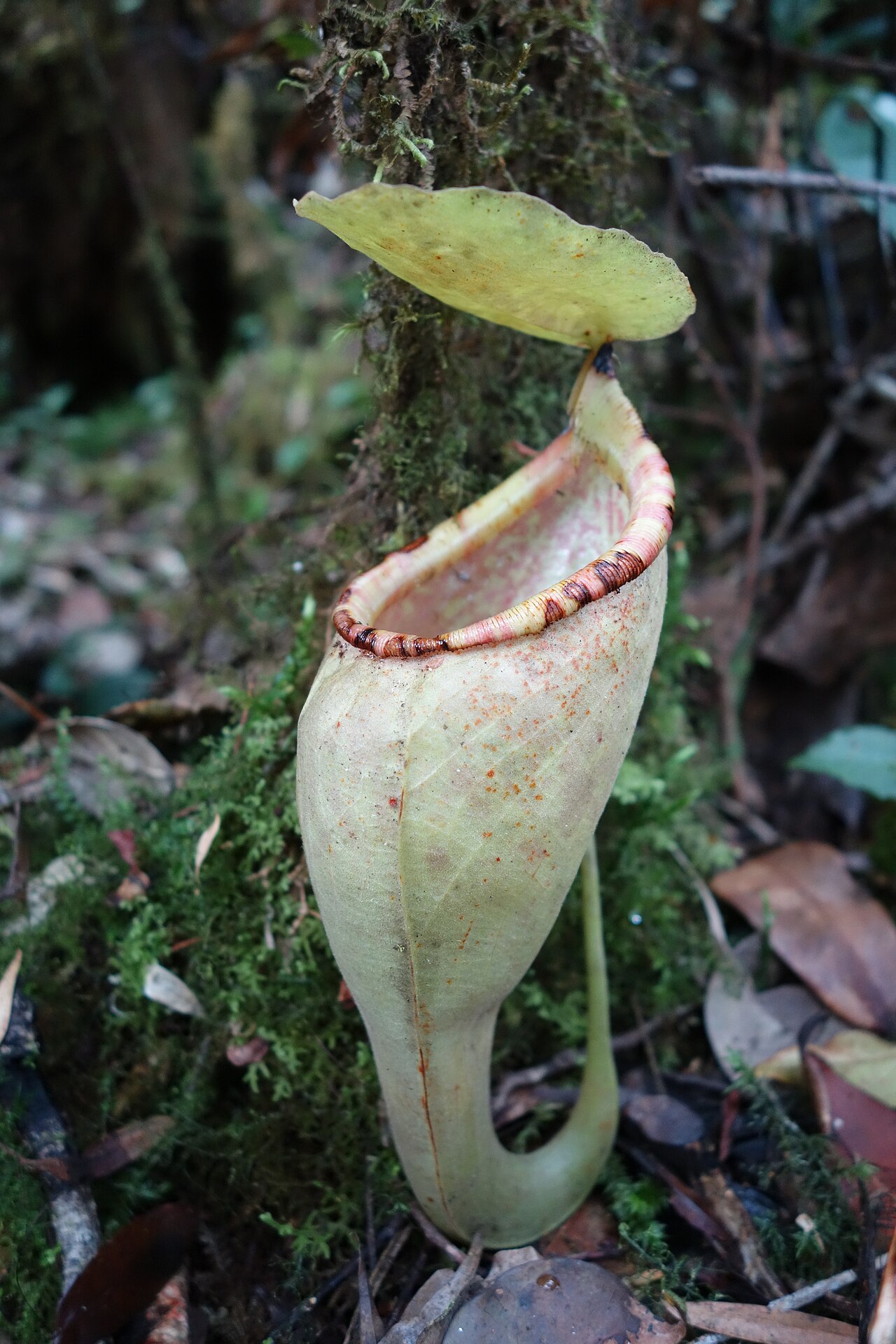
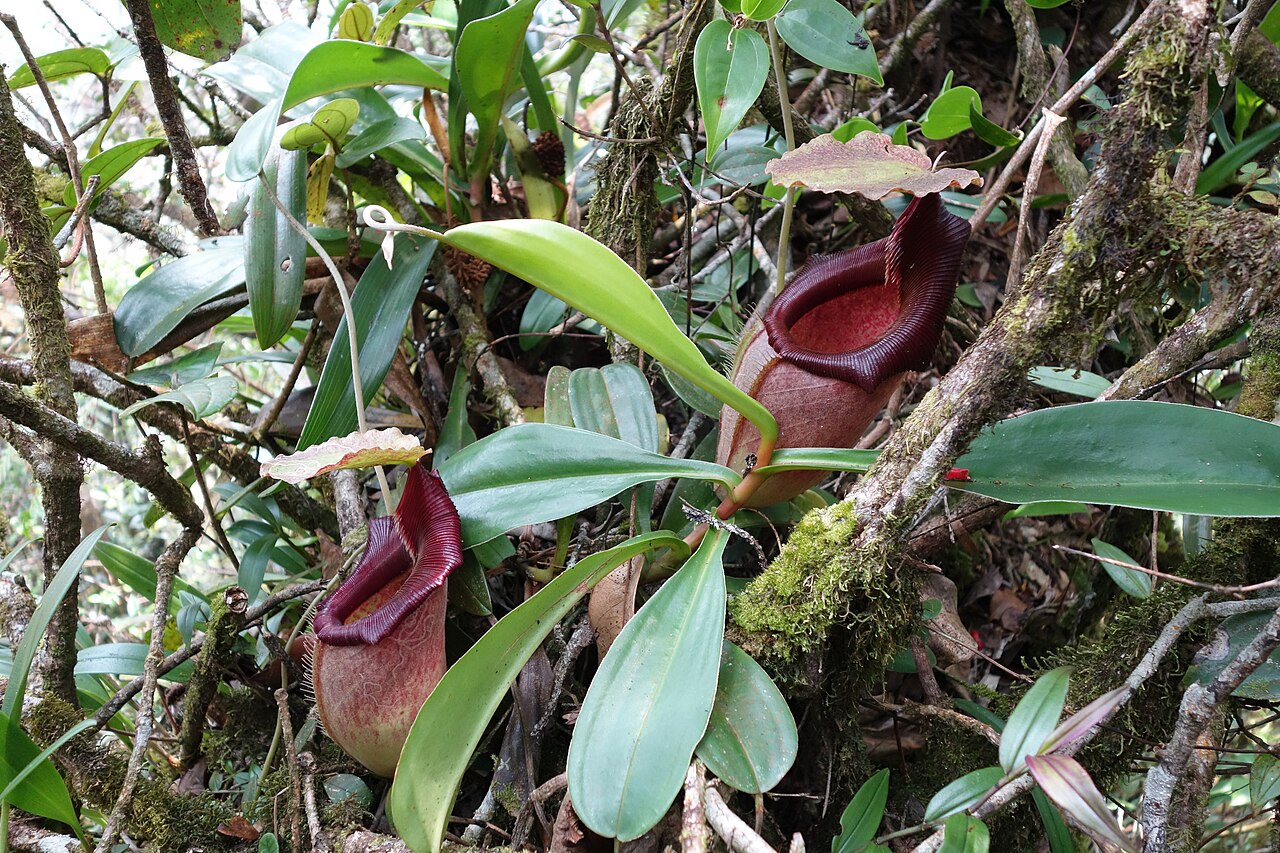
A climber with a stem to about five metres long and no more than eight millimetres thick, round to angular, with internodes to 15 cm. The leaves are leathery and sessile, obovate to spathulate, to 20 cm long and 5 cm wide, with margins running almost parallel near the base; the tendril is up to 30 cm long. Lower pitchers are ellipsoid to cylindrical, to 20 cm tall and 7 cm wide, with two fringed wings down the front and a broad peristome to 2 cm, set with narrow, distinct teeth. Upper pitchers are markedly larger and differently shaped: tubular below and funnel-shaped towards the mouth, to 35 cm tall and 8 cm wide, with a much narrower peristome and a round lid. What defines the whole plant is that slender, tall upper pitcher, more than three times as long as wide. Colour ranges from green to deep reddish brown, often with dark blotches and a red or striped peristome.
Similar species
In the Sumatran highlands several species with slender funnel pitchers grow together. Nepenthes talangensis and N. dubia have much shorter, stockier upper pitchers (length-to-width ratio around two rather than over three) and a different lid: broadly ovate in N. talangensis, narrowly cuneate and strongly reflexed in N. dubia. N. densiflora, long taken for a hybrid of N. bongso with N. pectinata, has a denser, compact inflorescence and broader, rounder lids. N. ovata shares a crest or appendage under the lid with N. bongso but has much more inflated lower pitchers. The name N. carunculata is treated by most authors as a synonym of N. bongso.
The trap and how it works
A pitfall trap in two versions. The lower pitchers stand in moss and litter and mainly catch walking animals: ants, beetles, woodlice and other small arthropods, guided along the fringed wings towards the mouth. The long upper pitchers hang free in the vegetation and mainly catch flying insects. The lure is nectar, secreted by glands on the peristome and on the underside of the lid; the ribbed peristome turns slippery when wet, so an insect landing or walking on it loses its footing. Below the mouth lies a smooth, waxy zone up which no animal can climb back, and in the lower part of the pitcher stands a fluid with digestive enzymes that breaks the prey down into absorbable nitrogen and phosphorus compounds.
Habitat and ecology
Montane cloud forest (B1): damp, cool forest between about 1000 and 2700 m, where moss lies thick on branches and trunks and cloud drifts between the trees almost daily. The species grows both on the ground, in the moss layer of clearings and ridges, and epiphytically in the crowns of low trees. It benefits from openings along paths and ridges where more light reaches in, but also tolerates fairly closed forest. As with all cloud-forest pitcher plants the soil is acid and poor, and litter decomposes slowly in the cool; the pitchers make up the nutrient shortfall.
Distribution and elevation
Endemic to Sumatra, where the species is scattered through the Barisan Mountains, the volcanic backbone of the island, across several provinces. The name ties the species to the volcano Marapi in West Sumatra; Clarke (2001) records it from mountains in several provinces along the chain. The altitudinal range is wide, from about 1000 to 2700 m, so that on many mountains the species can be found in both lower and upper cloud forest. The world checklist gives Sumatra as its only area.
- Recorded (one-degree cells)
Forms and variation
No formal varieties are recognised any longer. A plant with an exceptionally broad, flared peristome was described in 1994 as N. carunculata var. robusta, but since N. carunculata itself has been sunk into N. bongso, that form too is counted as ordinary variation. Colour varies widely, from green pitchers with few spots to almost wholly dark red ones. Natural hybrids are known with N. gymnamphora, N. singalana and N. talangensis, which grow on the same mountains. A cross with N. pectinata reported by Danser in 1928 turns out to be N. densiflora.
Where and when to see it
The volcanoes around Bukittinggi in West Sumatra, including Marapi after which the species is named, are the obvious places and are reached by existing climbing trails. Start searching once the forest turns mossy, around 1500 m, and look especially along open ridges. Watch for the slender upper pitchers hanging from tendrils in the scrub at chest height or above; the lower pitchers often sit half sunk in moss. Because several species share the same slopes, and hybrids are not rare, it pays to note lid shape and the length-to-width ratio of the pitcher. Stay on the trails: ridge-top moss is fragile.
Conservation status
Assessed on the Red List as Least Concern: the species has a large range along the Barisan chain, a wide altitudinal span and many populations in hard-to-reach mountain forest, partly in protected areas. As a member of Nepenthes it is listed in CITES Appendix II, so international trade in wild plants requires a permit. Local threats are plant collecting, forest fires and clearance of the lower slopes for agriculture, especially where roads open up the mountain forest.
Scientific name
Nepenthes bongso | Korthals, 1840
Nepenthes bongso was described in 1839 by Pieter Willem Korthals in his monograph "Over het geslacht Nepenthes" ("On the genus Nepenthes"). The precise type locality could not be established with certainty; the species is endemic to Sumatra, with a distribution between 1,000 and 2,700 m elevation. The specific epithet refers to the Indonesian legend of Putri Bungsu (literally "youngest daughter"), the spirit guardian of Mount Marapi.
World Checklist of Vascular Plants (WCVP), via Plants of the World Online (POWO), Royal Botanic Gardens, Kew.