All species › Caryophyllales › Tropical pitcher plant family › Nepenthes macrophylla
Nepenthes macrophylla
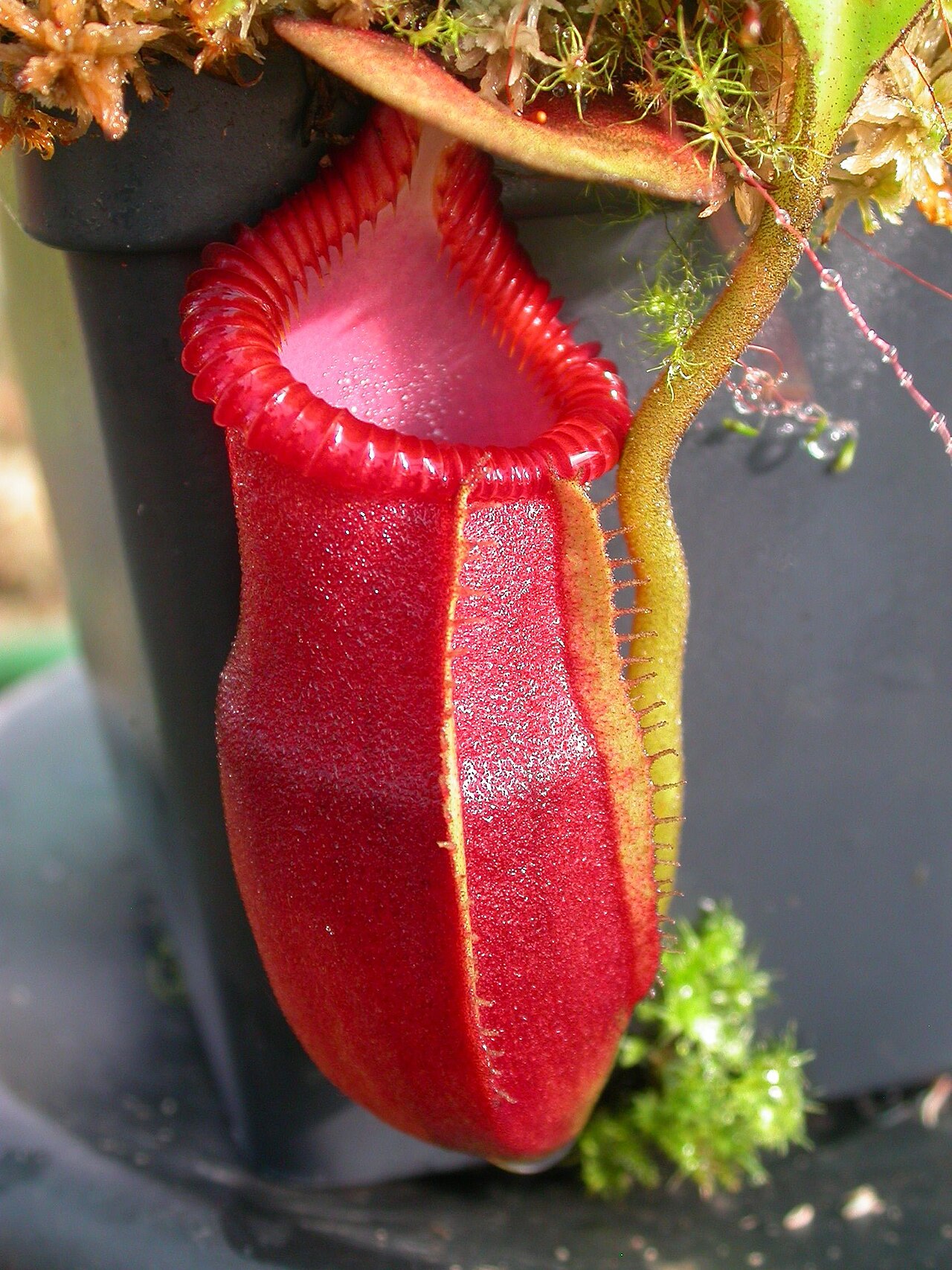
High on one of the great mountains of Sabah, in the mossy forest above 2200 m, hang pitchers more than thirty centimetres tall with a peristome like a ribbed collar. Nepenthes macrophylla is one of the rarest species in Borneo: it is known only from the summit of Trus Madi. The name means ‘large-leaved’, and rightly so — the lamina can reach sixty centimetres. But the reason the species is known in biology is a mammal: the mountain treeshrew, which perches on the pitcher, licks sugar from the lid and defecates into the pitcher.
Identification
A climbing plant with exceptionally large, oblong leaves, to 60 cm long and 20 cm wide. The pitchers are up to 35 cm tall and 15 cm wide; two fringed wings up to 10 mm wide run down the front. The most striking part is the peristome: cylindrical and much expanded, to 15 mm, with prominent downward-pointing teeth on the inner edge that project over the mouth. The lid stands well back. Lower and upper pitchers differ only a little: the upper ones are somewhat more cylindrical, the wings narrower, and the hip — where the pitcher is widest and changes shape — always lies in the upper half.
Similar species
The species was long confused with Nepenthes edwardsiana of Kinabalu, of which it was first described as a subspecies; N. villosa has also been linked with it. N. edwardsiana has slimmer, more cylindrical pitchers and a peristome with tall, step-like ribs, while N. macrophylla has broader pitchers and much larger leaves. On Trus Madi itself grows N. lowii, with a completely different, constricted pitcher and a reduced peristome; the hybrid of the two, Nepenthes × trusmadiensis, has pitchers to 35 cm and is better known on the mountain than the species itself.
The trap and how it works
The pitcher catches insects in the usual way, but its shape also seems tuned to another visitor. The reflexed lid secretes a sugary exudate on its underside, and the broad, sturdy collar of the peristome provides a seat. The mountain treeshrew (Tupaia montana) sits there, licks the exudate and drops faeces into the pitcher, supplying the plant with nitrogen. A study from 2010 showed that the shape and size of the pitcher mouth match exactly the dimensions of a typical mountain treeshrew. The teeth on the inner edge of the peristome make it particularly hard for insects walking over the rim to climb back out.
Habitat and ecology
Mossy montane forest along ridge tops, where the vegetation is dominated by Leptospermum and rhododendrons (B1). Temperatures swing widely: up to around 30 °C by day and down to about 5 °C at night, with constantly high humidity. The ground is soaked with rain and cloud water, and the plants grow in the moss and among the roots of the dwarf trees, or climb into the low canopy. The species occurs between about 2200 m and the summit at 2642 m.
Distribution and elevation
Endemic to Sabah, Malaysian Borneo, and known only from the highest parts of Trus Madi, between about 2200 m and the summit at 2642 m. That gives it one of the smallest ranges of any Bornean pitcher plant. Precise sites are not given here, because of the species' status and the risk of collecting.
- Recorded (one-degree cells)
Forms and variation
No varieties are recognised. The species has shifted taxonomically, though: it was first included in N. villosa and then in N. edwardsiana, described by Marabini in 1987 as a subspecies of the latter, and raised to species rank by Jebb and Cheek in 1997. The best-known natural hybrid is N. × trusmadiensis with N. lowii, discovered in 1983, with pitchers that are among the largest in Borneo, although the plant itself is not large.
Where and when to see it
Trus Madi is a hard climb of several days, possible only with a permit from the Sabah forestry department and with a local guide. Pitcher plants are best seen in the mossy forest on the highest ridges, early in the day in clear weather. Keep strictly to the path and do not touch the plants: the moss and roots along the ridge are fragile, and damage by visitors is one of the known threats. Take nothing away, not even seed.
Conservation status
The Red List assesses the species as Critically Endangered. Its range is tiny, and Trus Madi does not enjoy the same strict protection as Kinabalu. The threats named are over-collection of plants and seed and damage to the habitat by visitors. As a member of the genus it is listed in CITES Appendix II, so international trade in wild plants requires a permit; for this species the trade rests almost entirely on tissue culture.
Scientific name
Nepenthes macrophylla | (Marabini) Jebb & Cheek, 1997
Nepenthes macrophylla was originally described in 1987 by Marabini as a subspecies of N. edwardsiana, and elevated to full species status in 1997 by Matthew Jebb and Martin Cheek in their revision "A skeletal revision of Nepenthes (Nepenthaceae)" (Blumea). Mount Trusmadi, Sabah, Malaysian Borneo, where the species is known with certainty only from the summit area, at 2,200 m up to the summit at 2,642 m, growing in mossy montane forest along ridge tops. The name is Latin for "large-leaved", referring to the leaves, which may be twice as long as those of the closely related N. edwardsiana or N. villosa.
World Checklist of Vascular Plants (WCVP), via Plants of the World Online (POWO), Royal Botanic Gardens, Kew.