All species › Caryophyllales › Tropical pitcher plant family › Nepenthes tentaculata
Nepenthes tentaculata
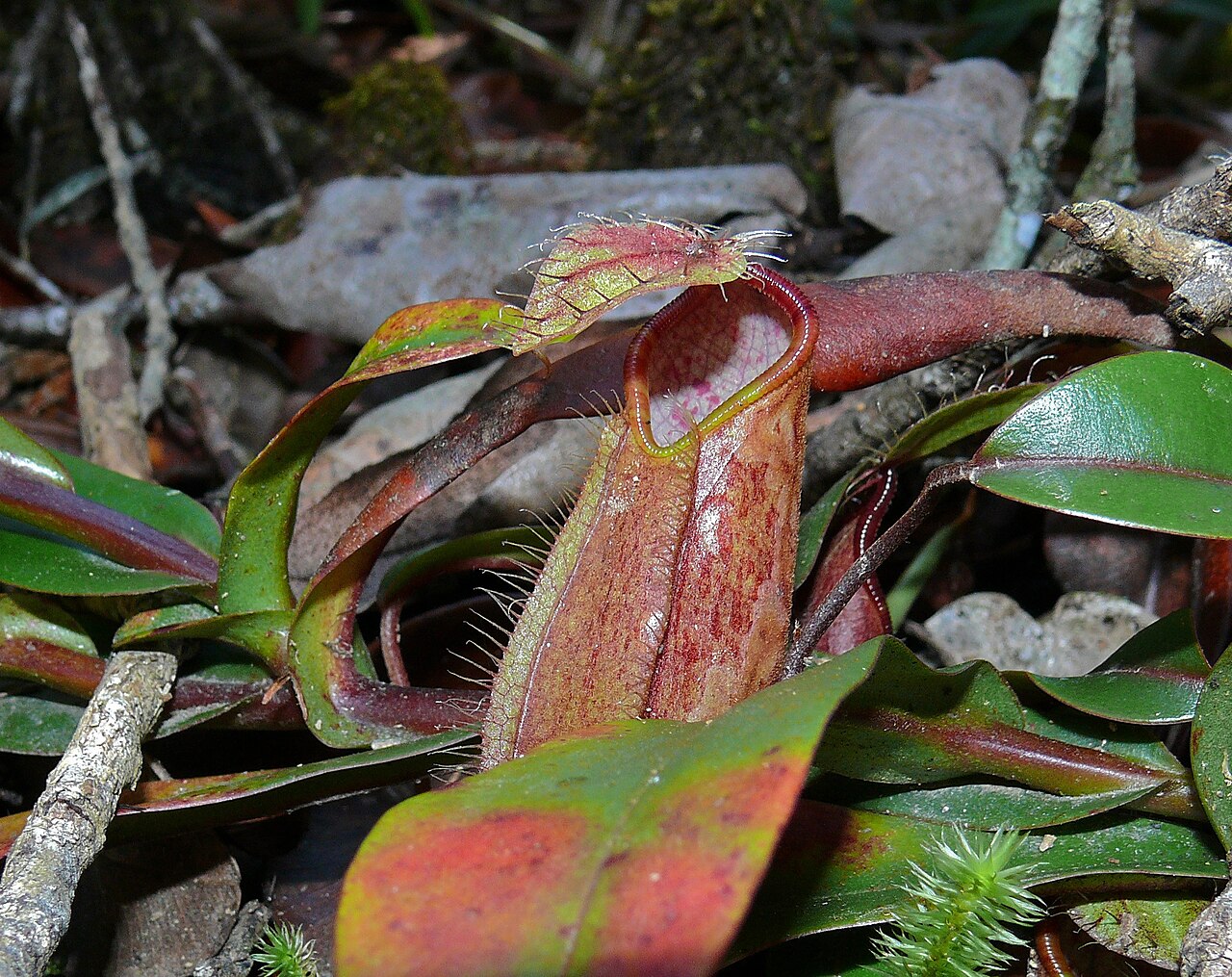
A small, common montane pitcher plant of Borneo and Sulawesi, named for the 'tentacles' on its lid: filiform, multicellular appendages standing mainly along the edge of the upper surface. Nepenthes tentaculata was described by Hooker in 1873 from plants Thomas Lobb had collected twenty years earlier. It is one of the few species found on both islands, and it is the pivot of the 'Hamata group', a circle of related montane species that includes N. hamata of Sulawesi.
Identification
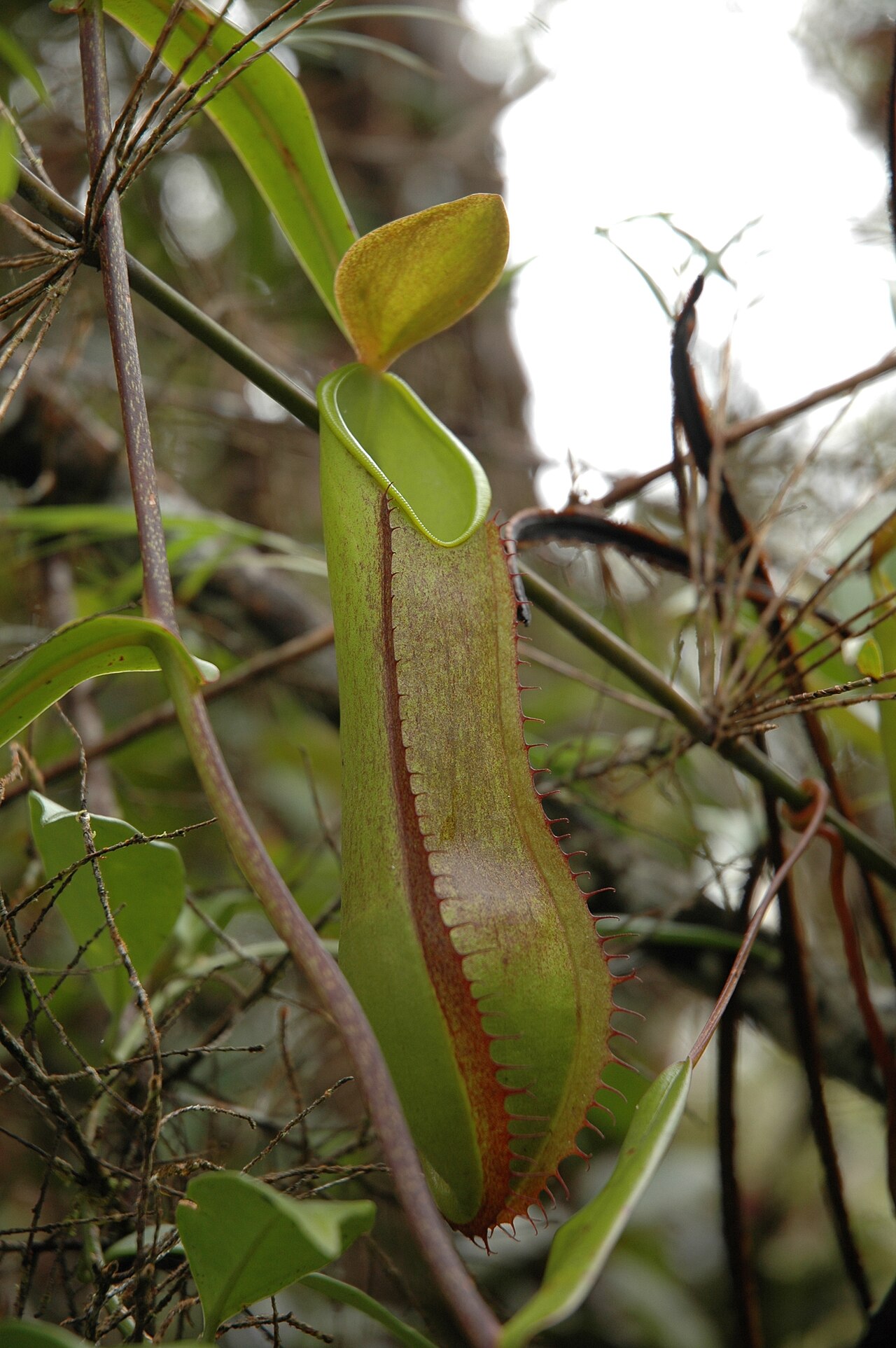
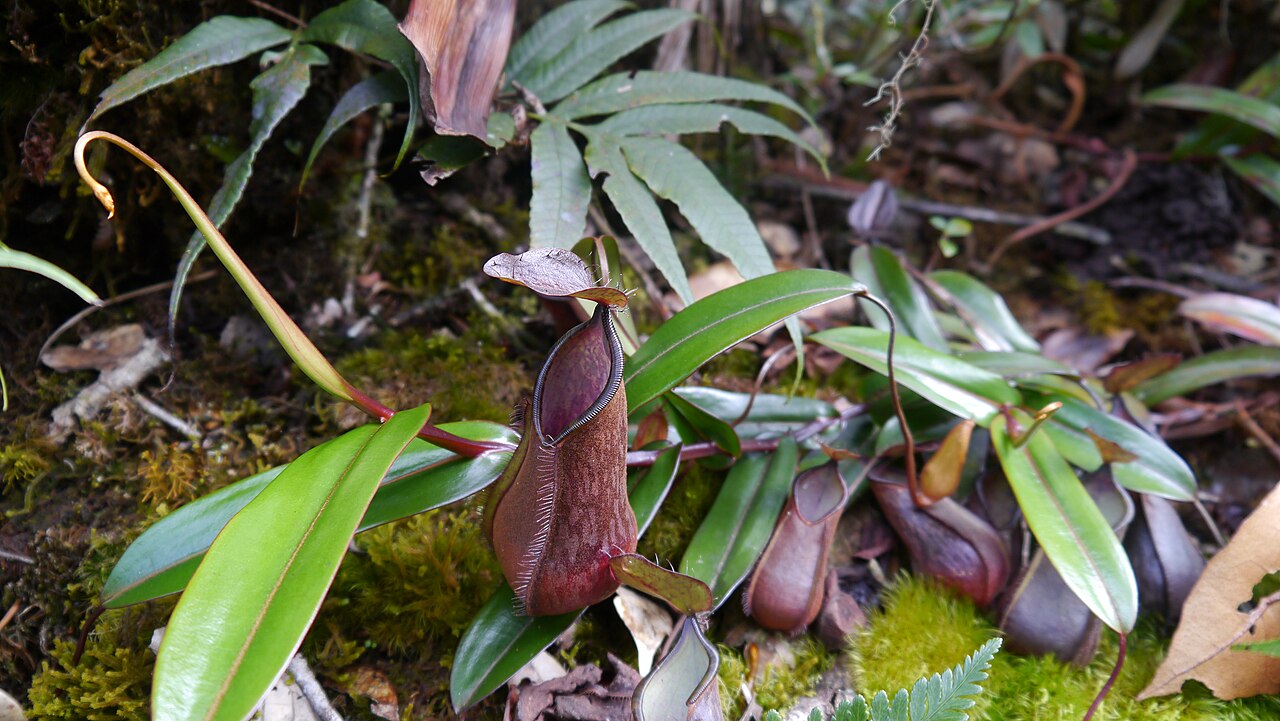
A climber with stems to 3 m long and 5 mm thick, with internodes to 10 cm, round to triangular in section. The leaves are stalkless, lanceolate to elliptic, to 15 cm long and 3 cm wide, with a rounded to acute tip and a cordate, clasping base; the tendril reaches 15 cm. Lower pitchers are ovoid in the lower third and cylindrical above, rarely over 15 cm tall (exceptionally to 30 cm and 8 cm wide), with fringed wings and an ovate mouth; the peristome is almost cylindrical, to 5 mm wide, with small ribs and tiny teeth. Upper pitchers are more cylindrical, with ribs instead of wings and a peristome of 1 to 5 mm. The lid is ovate and in most forms bears filiform appendages on its upper surface. The whole plant is hairless.
Similar species
Most easily confused with Nepenthes muluensis, which has nearly identical lower pitchers but with a rounder mouth, usually narrower leaves and striking upper pitchers with a white lid, a round mouth and greatly reduced or no wings. N. murudensis of Mount Murud is regarded as a giant form of N. tentaculata: more robust, without filiform hairs on the lid and with a dense indumentum on the inflorescence and parts of the plant. In northern Sarawak some N. tentaculata populations produce pitchers over 20 cm that closely resemble it.
The trap and how it works
A small pitfall of the ordinary kind. The filiform appendages on the upper surface of the lid are the most striking character, but their function has not been explained; they stand outside the mouth and have no obvious role in capture there. The peristome is narrow and finely ribbed; about 57 per cent of its cross-section lies on the inside of the mouth. Lower pitchers sit in the moss on the ground and catch walking animals; upper pitchers hang in the low vegetation. For so common a species remarkably little has been published on its prey.
Habitat and ecology
Mossy cloud forest (B1), and also ridge-top vegetation on summits, usually between 1200 and 2550 m, sometimes from 400 m. The plant grows on the ground, often in clumps of Sphagnum moss, and spreads by underground stems rather than climbing up as an epiphyte. It therefore often grows in groups, forming dense mats of small pitchers among the moss. It grows alongside many other montane species, which explains the large number of hybrids.
Distribution and elevation
Borneo (Sabah, Sarawak, Brunei and Kalimantan) and Sulawesi, Indonesia. It is thus one of the few Nepenthes species found on both Borneo and Sulawesi, and so not endemic to one island. Altitude: 400 to 2550 m, mostly above 1200 m. The area in our species list (Borneo and Sulawesi) agrees with the world checklist.
- Recorded (quarter-degree cells)
Forms and variation
Two infraspecific taxa have been described, which are not generally recognised. A visible difference between forms is the presence or absence of the filiform lid appendages, which are wholly lacking in some forms. More natural hybrids are known than for almost any other montane species, including crosses with N. burbidgeae, N. fusca, N. glabrata, N. hamata, N. maxima, N. muluensis (described as N. ×sarawakiensis), N. nigra, N. pitopangii, N. rajah, N. reinwardtiana and N. stenophylla.
Where and when to see it
One of the easiest montane species to find. On almost any Bornean mountain above 1200 m with mossy forest, including Kinabalu and the mountains in Sarawak's national parks, it grows in the moss along the trails. Look low near the ground for groups of small green to red pitchers, and check the upper surface of the lid close up for the filiform hairs. Because it crosses with so many species, it is wise to consider a hybrid first when a plant looks unusual.
Conservation status
The Red List assesses the species as Least Concern (2018 assessment). The range covers two large islands and many mountain areas, much of them protected, and the species is locally abundant. Earlier assessments, in 1995 and by Clarke in 1997, likewise saw no threat. Like the whole genus, it is listed in CITES Appendix II.
Scientific name
Nepenthes tentaculata | J.D. Hooker, 1873
Described by Joseph Dalton Hooker in 1873, in Prodromus Systematis Naturalis Regni Vegetabilis, volume 17, p. 90-105 (monograph "Nepenthaceae"), based on material collected by Thomas Lobb in 1853 on Borneo. No specific mountain or region is named in the protologue. Only "Borneo" is stated in the protologue, without a specific mountain or region. The species is now known from Borneo and Sulawesi, at 400-2550 m elevation (most records between 1200-2550 m). From the Latin tentacula ("tentacles") — refers to the multicellular appendages on the upper surface of the pitcher lid.
World Checklist of Vascular Plants (WCVP), via Plants of the World Online (POWO), Royal Botanic Gardens, Kew.