All species › Caryophyllales › Tropical pitcher plant family › Nepenthes northiana
Nepenthes northiana
One of the most plundered pitcher plants of Borneo. Nepenthes northiana grows only on limestone crags in the hills around the small town of Bau, in western Sarawak, and is named after the English botanical painter Marianne North, who painted it in 1876 from plants that a Borneo Company employee had fetched for her from the jungle. Hooker described it in 1881. The large, rounded pitchers, greenish white with red blotches and with a broad, wavy peristome, made it a coveted glasshouse plant as early as the nineteenth century.
Identification
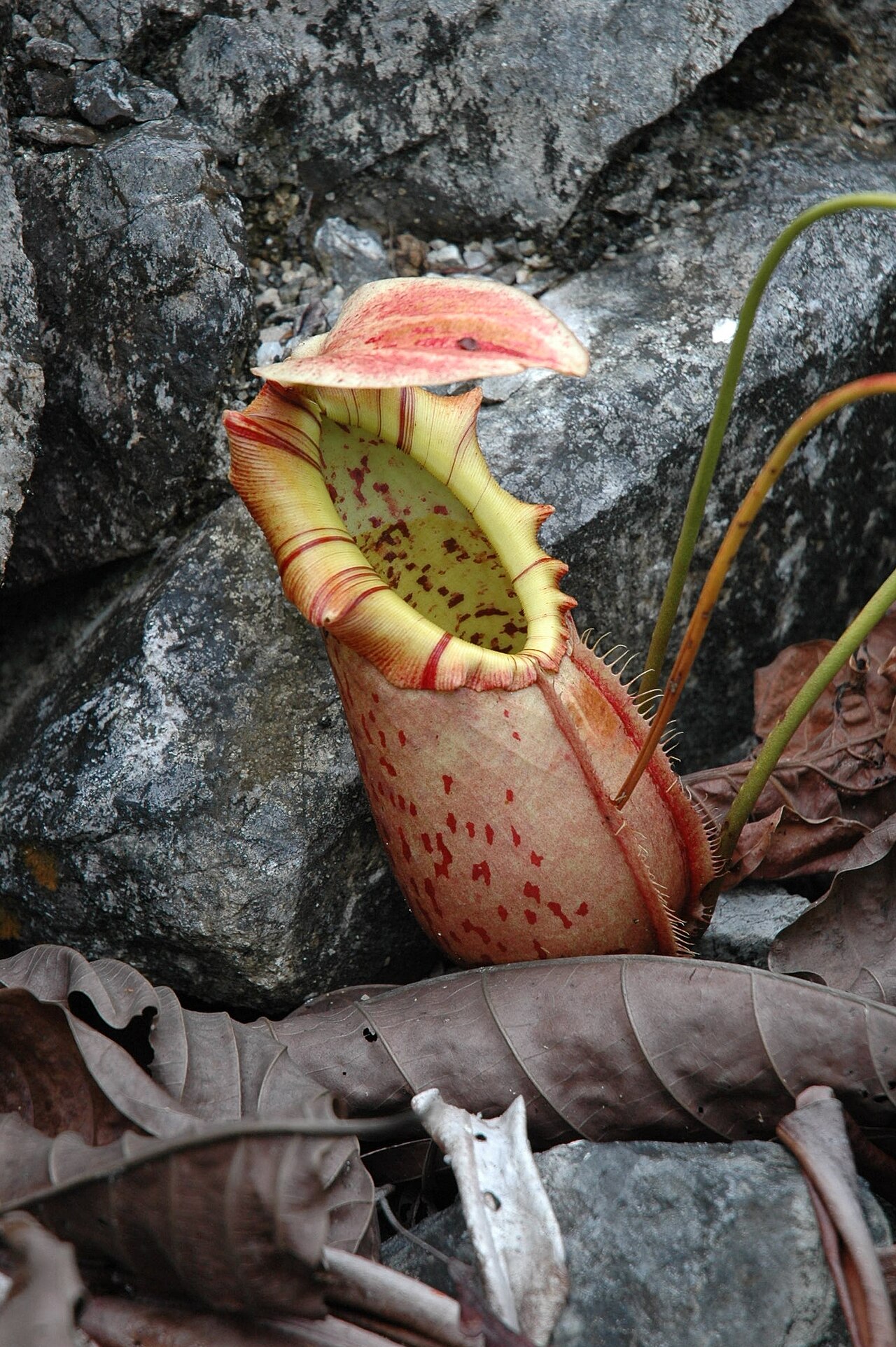
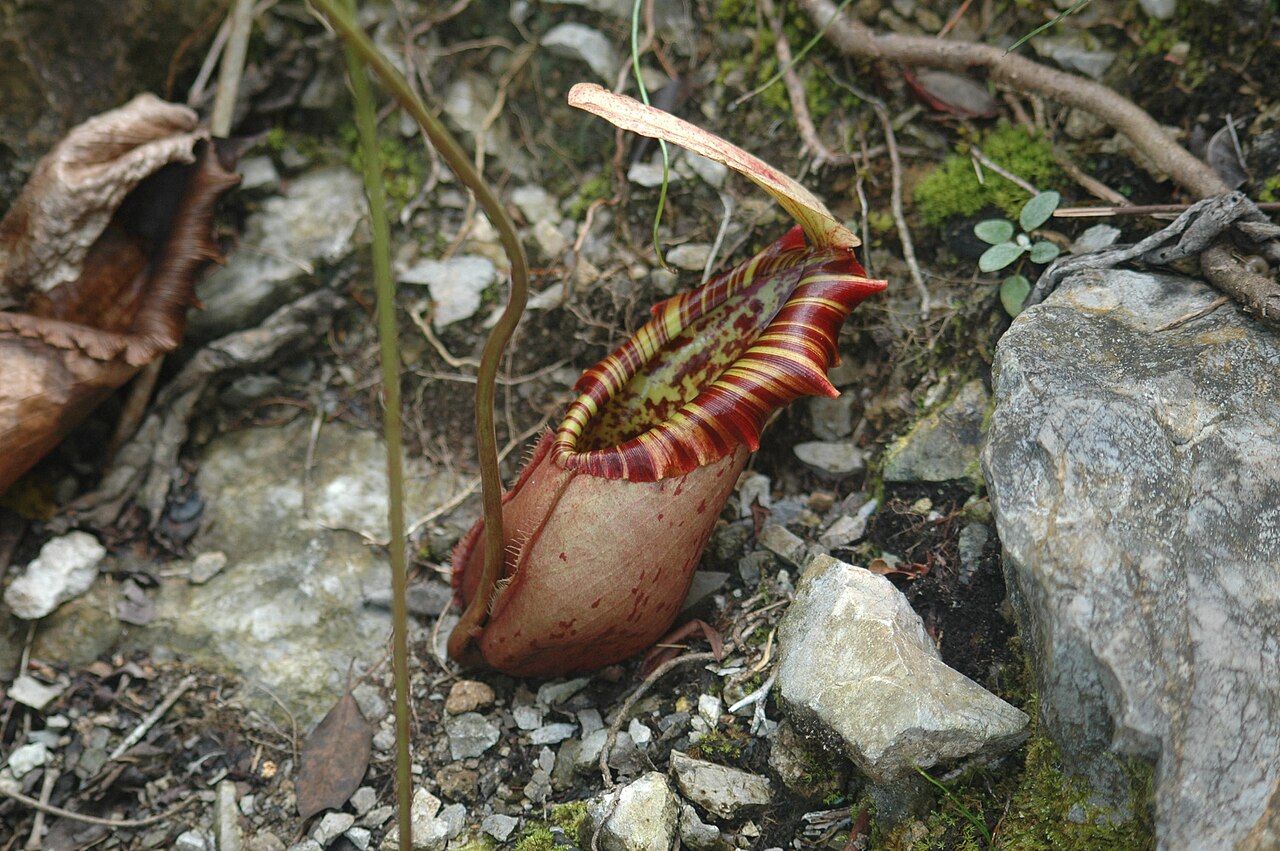
A vigorous climber with stems to 10 m long and 15 mm thick, with internodes to 25 cm, round to triangular in section. The leaves are papery, stalkless to nearly stalked, oblong to obovate, to 40 cm long and 10 cm wide, with four longitudinal veins on each side of the midrib. The leaf base half-clasps the stem and runs down it as two wings. The tendrils reach 100 cm. The leaf underside carries thirty to sixty nectar glands. Lower pitchers are ovoid, sometimes slightly cylindrical above, to 40 cm tall and 15 cm wide, with fringed wings to 15 mm; the peristome is greatly widened at the sides, to 25 mm, often wavy, with short teeth on the inner edge. The lid is ovate to oblong with an acute tip. Upper pitchers are funnel-shaped throughout, with a narrower peristome. The plant is virtually hairless.
Similar species
Its closest relative is Nepenthes mapuluensis of East Kalimantan, with narrower, more linear leaves, darker pitchers and narrower upper pitchers; both grow on limestone, but far apart. N. macrovulgaris lacks the decurrent leaf base and has a different stem section. N. hurrelliana and N. veitchii also have a broad peristome, but smaller, less boldly coloured pitchers and a different habit. Around Bau the combination of limestone, large rounded pitchers and a wavy, striped peristome is distinctive enough.
The trap and how it works
A large pitfall that can hold nearly a litre of fluid. The broad, wavy peristome forms a spacious slippery platform with nectar, and the waxy zone on the inner wall is reduced, so the peristome does the real catching. The leaf also carries dozens of nectar glands on its underside, which draw ants and other insects to the plant. Lower pitchers catch walking animals on the rock ledges, funnel-shaped upper pitchers catch flying insects. The seeds are remarkable: short-winged, with a large embryo and unusually woody, which limits wind dispersal and suits a species tied to a few crags.
Habitat and ecology
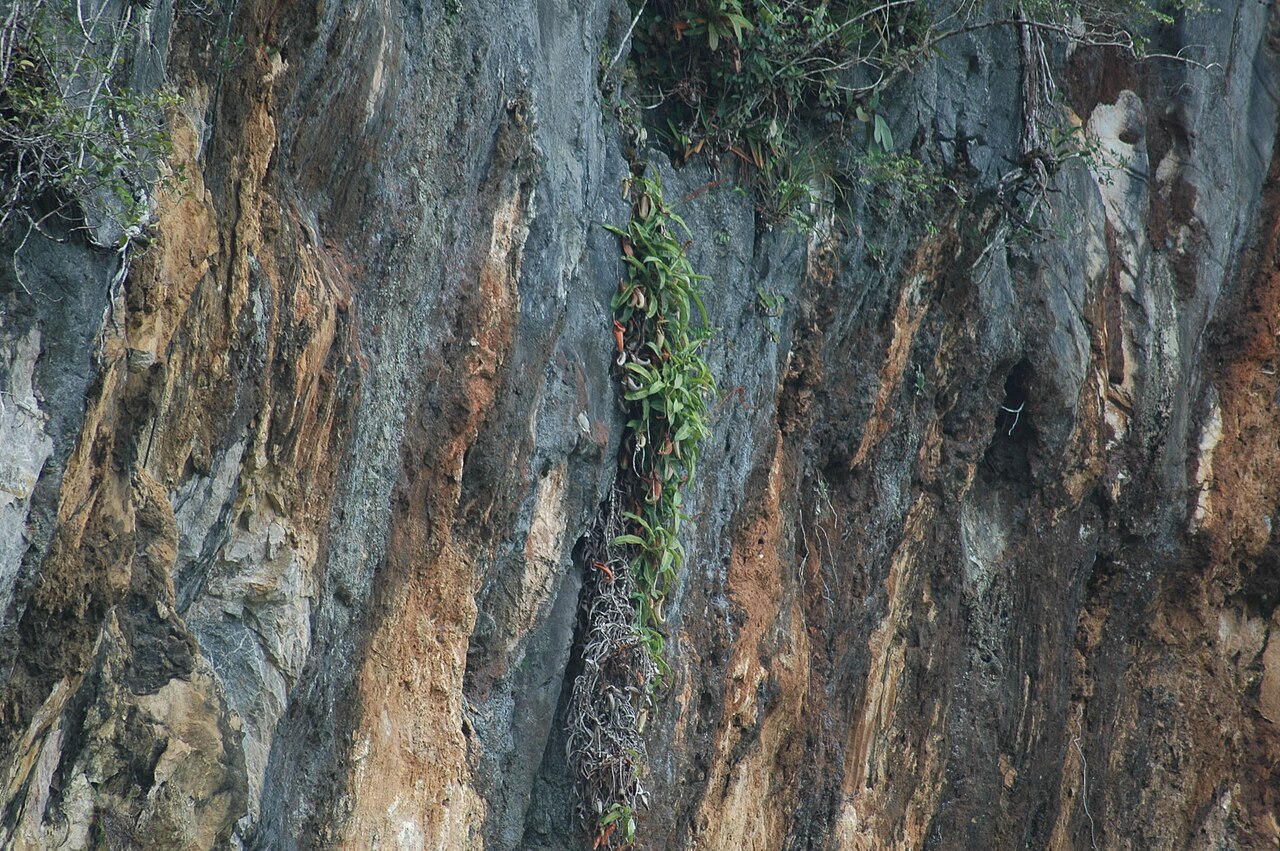
Exclusively limestone (R2), from sea level to about 500 m. The plant grows on open, near-vertical limestone cliffs with permanent water seepage (R1), and sometimes in secondary vegetation on small hills. The cliffs are hot in the sun but always moist from the seepage; the plant roots in crevices and on ledges where some humus has collected. That it grows on limestone, an unusual soil for pitcher plants, was long a subject of speculation; in cultivation it turns out not to need lime.
Distribution and elevation
Endemic to Borneo, and there confined to the hills around Bau in Kuching Division, western Sarawak, Malaysia. Altitude: 0 to 500 m. A plant from the Baram River, once described as N. decurrens, is included in this species. The area in our species list (Bau, Sarawak) agrees with the literature.
- Recorded (one-degree cells)
Forms and variation
In 1909 a var. pulchra was described, with purplish-red pitchers and a red-and-yellow striped peristome as against the usual yellowish pitchers with brown or red blotches; the name is not valid and is not recognised. Three natural hybrids are known: N. ×cincta with N. albomarginata, rare at a few limestone sites around Bau; N. ×bauensis with N. gracilis, from a single swampy lowland site; and a cross with N. mirabilis discovered in 2007.
Where and when to see it
The limestone hills around Bau, an hour's drive from Kuching, are the only area. The Fairy Cave and Wind Cave lie in the same landscape and give an impression of the limestone walls; the plants themselves mostly grow high on steep, inaccessible faces and can be seen with binoculars from the foot. Do not climb the faces: it is dangerous and damages the plants. Look for large greenish-white pitchers with red blotches hanging on long tendrils over the rock edge.
Conservation status
The Red List assesses the species as Vulnerable (2000 assessment). Because of its beauty and trade value it was once collected almost to extinction; Phillipps and Lamb said as much in 1996. Limestone quarries have damaged some hills. In the short term the species is fairly safe, since most plants grow on unreachable cliffs. It is listed in CITES Appendix II; collectors' demand is now largely met from cultivation.
Scientific name
Nepenthes northiana | J.D. Hooker, 1881
Nepenthes northiana was described in 1881 by Joseph Dalton Hooker, in The Gardeners' Chronicle, new series, 16(414): 717, with a supplementary descriptive sheet. The type material was collected in 1876 near Jambusan, Sarawak, Borneo, on the branches of a tree at about 300 m elevation, on the limestone mountains near Bau, and is held at the Royal Botanic Gardens, Kew. The limestone mountains near Bau, close to Jambusan, Sarawak, Borneo, at approximately 300 m elevation. The specific epithet honours Marianne North, the English botanical illustrator who first depicted the species.
World Checklist of Vascular Plants (WCVP), via Plants of the World Online (POWO), Royal Botanic Gardens, Kew.