All species › Caryophyllales › Tropical pitcher plant family › Nepenthes veitchii
Nepenthes veitchii
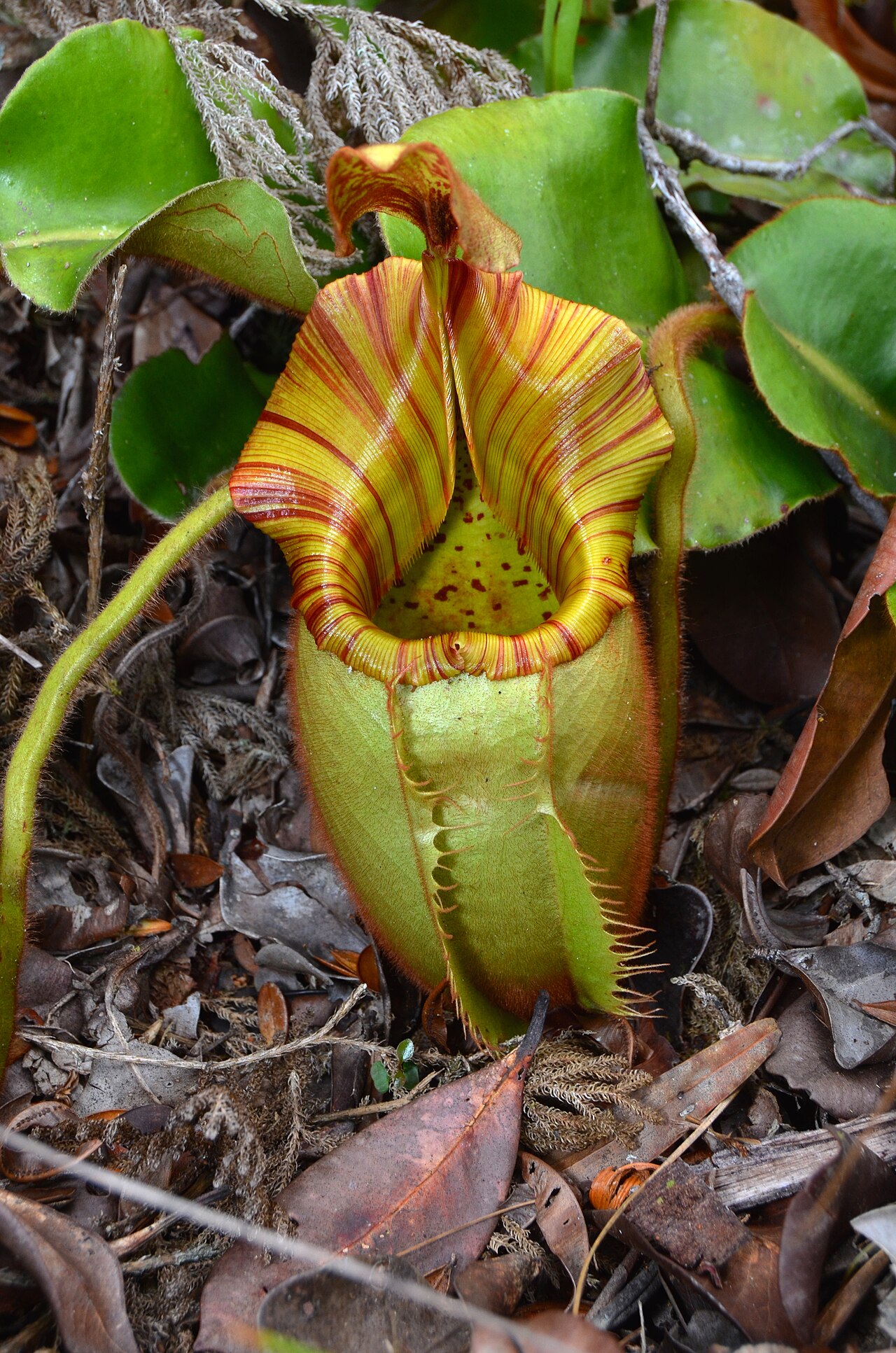
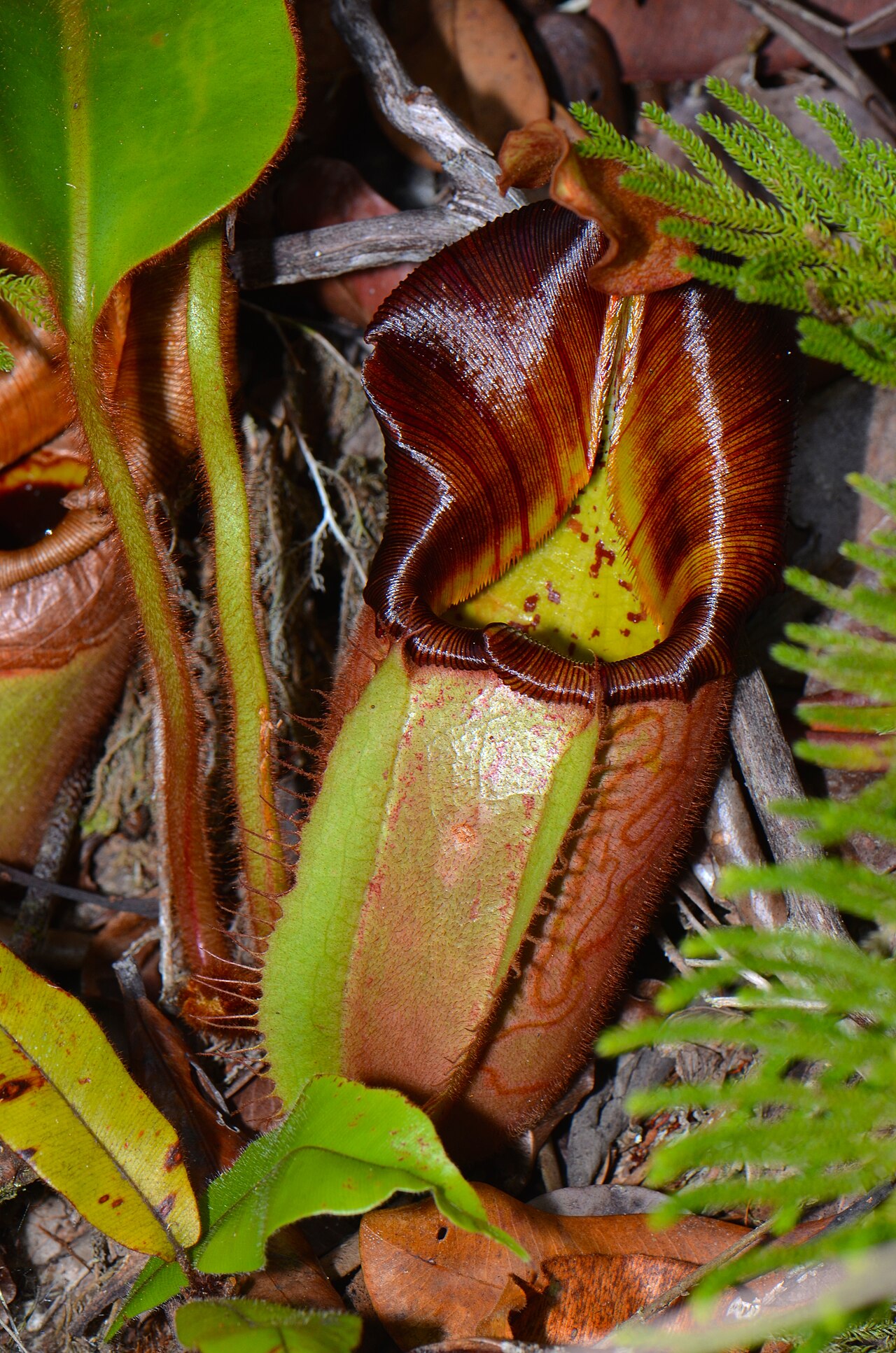
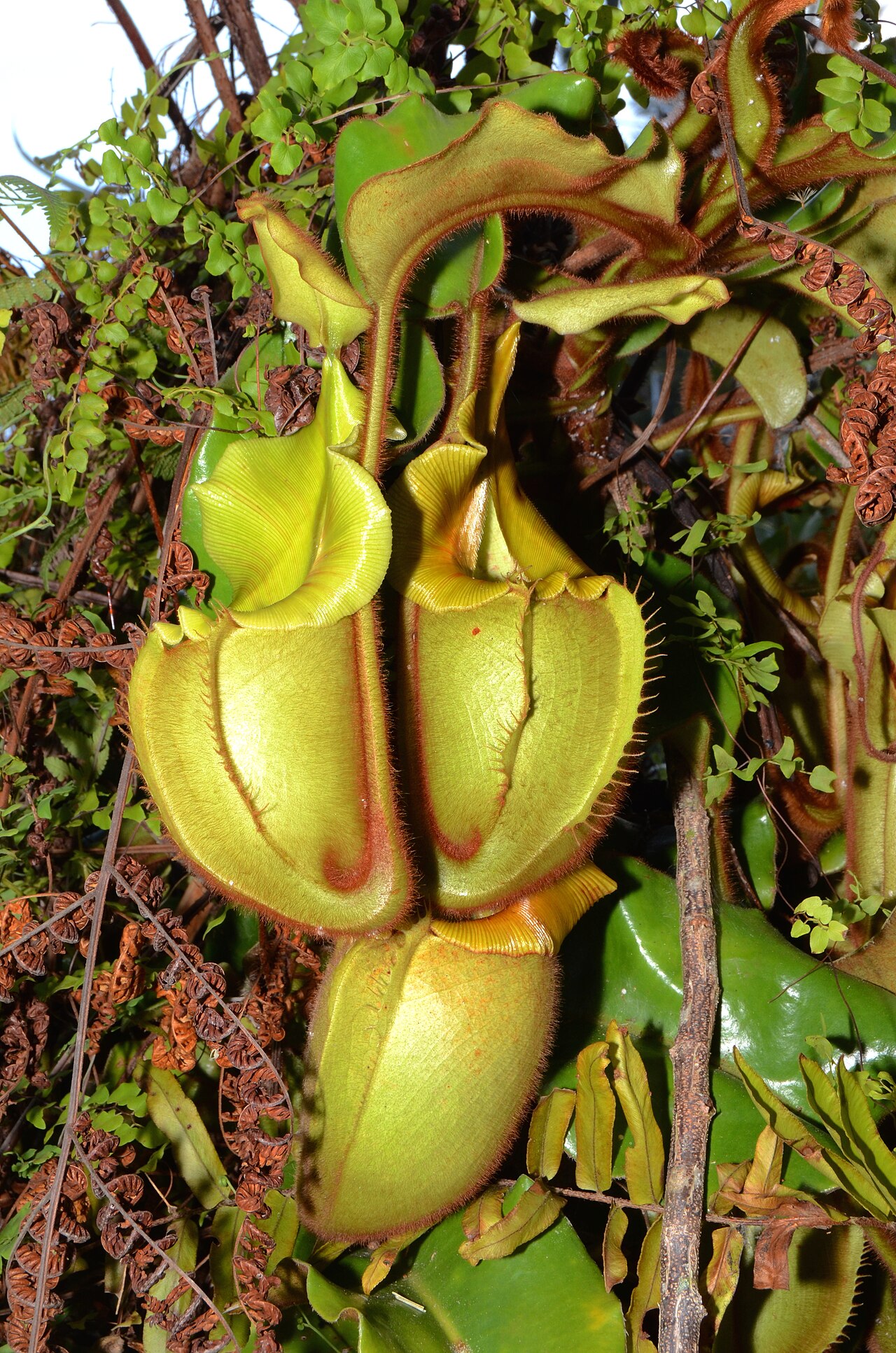
A pitcher plant that grows on a tree trunk as if glued to it. Nepenthes veitchii has an unusual habit: its leaves stand in two ranks and clasp the host tree's trunk with their bases, so the plant lies flat against the bark like a fan. Add to that pitchers with one of the broadest peristomes in the genus, a golden-yellow to orange collar that can reach 8 cm wide at the back and stands almost vertical. The species is named after the English nursery family Veitch.
Identification
A climber, epiphytic or terrestrial, rarely a shrub, from half a metre to six and exceptionally ten metres, with an often wavy, round stem 4 to 10 mm thick. The leaves are leathery and stalked, obovate to oblanceolate, 14 to 25 cm long and 4 to 10 cm wide, with a channelled petiole to 5 cm sheathing the stem. The whole plant is covered in dense, spreading, copper-coloured hairs to 3 mm. Lower pitchers are broadly cylindrical, broadest near the middle, 15 to 28 cm tall and 4 to 10 cm wide, with fringed wings of 4 to 5 mm. The mouth is horizontal in front and abruptly concave behind; the peristome is flattened, 4 to 15 mm wide at the front and 10 to 80 mm near the lid. The lid is narrowly ovate to elliptic, 3 to 9 cm long. Upper pitchers are larger, to 30 by 8.5 cm, with wings of 5 to 10 mm.
Similar species
No other Bornean species combines a two-ranked habit pressed against the trunk with such a broad, near-vertical peristome and a dense coppery indumentum. Nepenthes truncata of the Philippines has a similarly broad peristome but much larger leaves with a truncate base. Later authors regard N. robcantleyi, also Philippine, as its closest relative. On Borneo itself hybrids can confuse: N. veitchii crosses with N. fusca, N. stenophylla and N. lowii, among others, and these crosses often have an intermediate peristome and indumentum.
The trap and how it works
The peristome is the trap. It is a broad, flattened, ribbed platform, greatly widened especially at the back and standing up along the pitcher's length; an old description compared it to fish gills, with narrow lamellae converging to the centre. Nectar on this broad surface lures insects, and once a water film covers the ribs they slide inwards. The narrow lid is held at an angle and leaves the mouth largely open. Lower pitchers, winged, catch animals crawling on the trunk; the larger upper pitchers catch flying insects. No prey data have been published.
Habitat and ecology
The species has two very different habitats: lowland dipterocarp forest, especially along rivers, from 55 to 500 m (B2), and mossy cloud forest on mountain ridges, from 750 to 1800 m (B1). In both it usually grows as an epiphyte on tree trunks, its leaf bases wrapped around the trunk. On the Bario plateau in Sarawak a form occurs that grows only on the ground and never climbs. Flora Malesiana gives separate altitudinal zones for these two habitats, which fits the distinction drawn in practice between lowland and highland forms.
Distribution and elevation
Endemic to Borneo: central Sarawak, Brunei and Sabah, and rare in Kalimantan. The altitudinal range according to Flora Malesiana is 55 to 500 m and 750 to 1800 m; other authors give 0 to 1600 m. The area in our species list (Borneo) is correct.
- Recorded (one-degree cells)
Forms and variation
No varieties are recognised; two names for infraspecific forms were published invalidly. In practice a lowland and a highland form are distinguished, differing in habit and colour; the terrestrial form of Bario is the most striking. Pitcher colour ranges from golden yellow to green, rarely with red blotches, and the peristome can be striped red and yellow or plain green, yellow or brown. Natural hybrids are known with N. albomarginata, N. chaniana, N. faizaliana, N. fusca, N. hurrelliana, N. lowii and N. stenophylla.
Where and when to see it
In the lowlands of Sarawak and Brunei, search riverbanks in dipterocarp forest: look for tree trunks with a fan of leaves pressed against them and lower pitchers hanging against the bark. In the mountains the species grows on mossy ridges; in the Sarawak highlands, as around Bario, it can be seen along trails. The broad yellow to orange peristome catches the eye from a distance. Do not touch the plants: the coppery hairs and pitchers are easily damaged.
Conservation status
The Red List assesses the species as Least Concern. The range is large, the species occurs in two altitudinal zones, and as an epiphyte it often grows out of reach. Lowland riverside populations do suffer from logging and the spread of oil-palm plantations, and plants with unusual peristome colours have been collected in the past. Like the whole genus, it is listed in CITES Appendix II.
Scientific name
Nepenthes veitchii | J.D. Hooker, 1859
Described by Joseph Dalton Hooker in 1859, in Transactions of the Linnean Society of London, volume 22, no. 4, p. 415-424. The precise type locality could not be established with certainty. Odoardo Beccari found the species on Mount Santubong in 1865, but this is a later observation, not necessarily the original type collection. The species is widespread in northwestern Borneo, at 0-1600 m elevation. Named after James Veitch, nurseryman of the well-known English Veitch Nurseries — hence the English common name "Veitch's pitcher-plant".
World Checklist of Vascular Plants (WCVP), via Plants of the World Online (POWO), Royal Botanic Gardens, Kew.