All species › Caryophyllales › Tropical pitcher plant family › Nepenthes ramos
Nepenthes ramos
A species with two lives in the literature. Nepenthes ramos was described in 2013 by Cheek and Jebb from herbarium material collected in 1919 by the Filipino collector Maximo Ramos in Surigao Province on Mindanao; as early as 1908 Macfarlane had named the same plants Nepenthes alata var. ecristata. Three years later German and Filipino botanists visited the species in the field, and what had seemed a shadowy herbarium species turned out to be a widespread and highly variable plant. They gave an extended new description and sank Nepenthes kurata into this species. It is a member of the alata group.

Identification
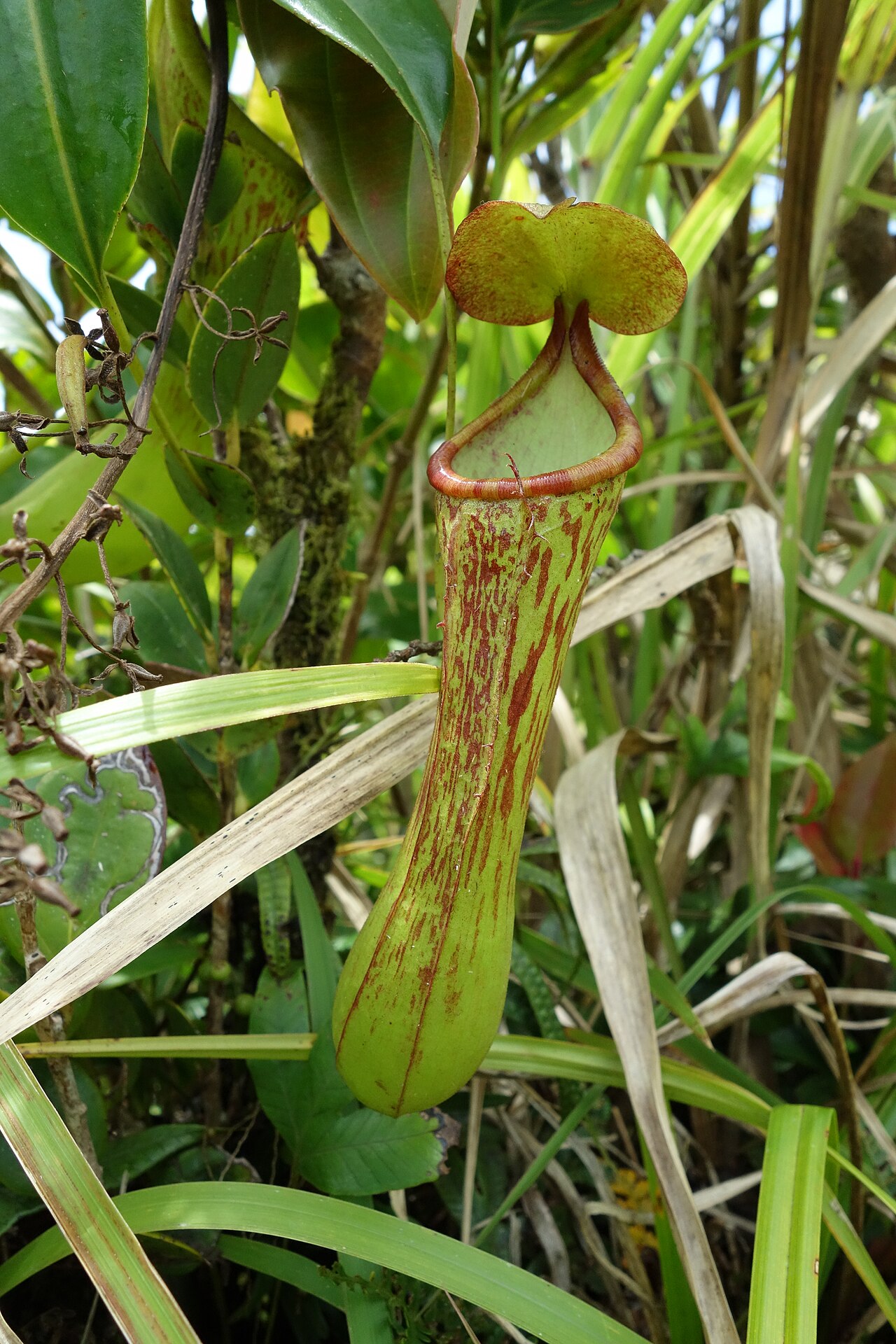
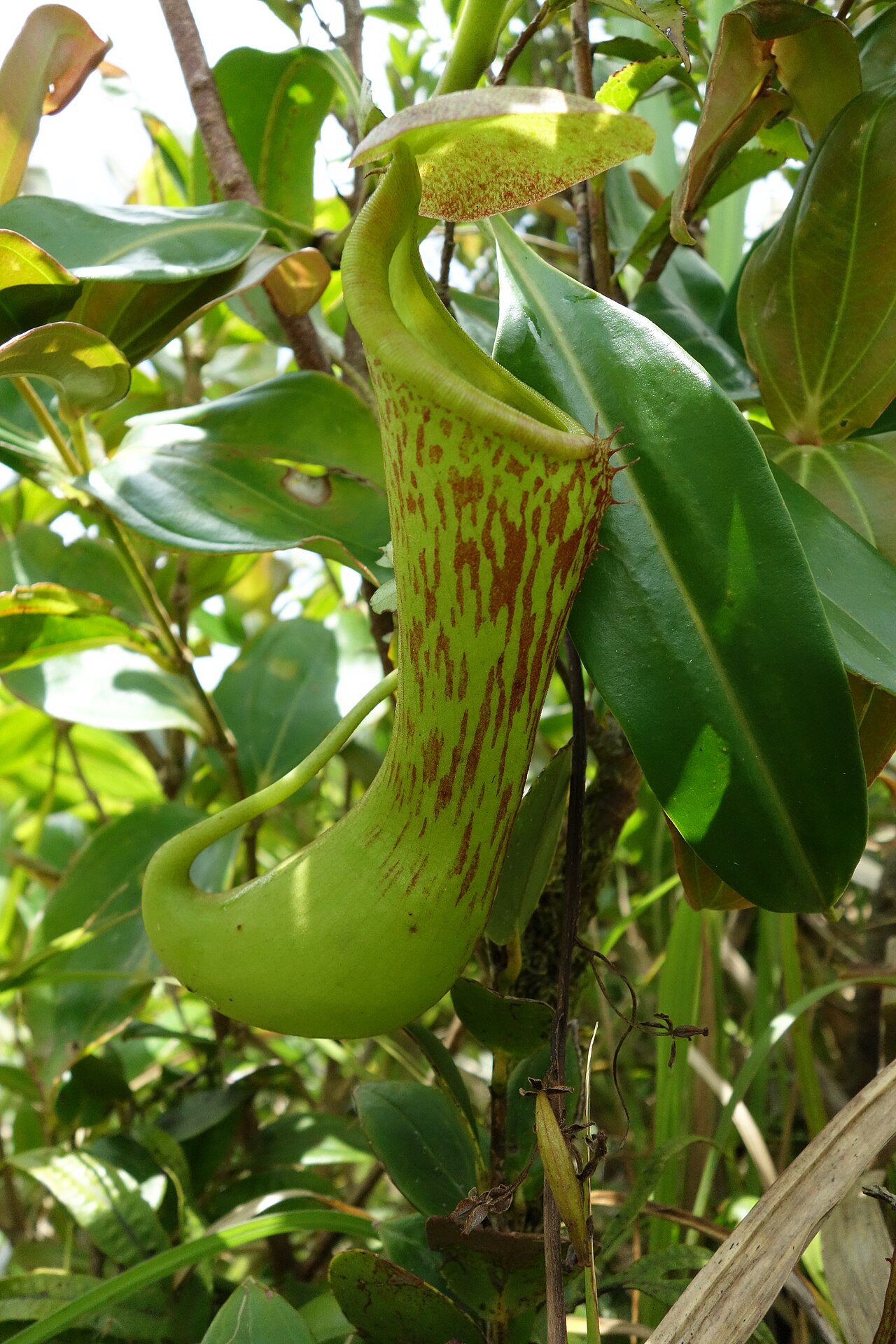
A climber with terete stems six to eight millimetres thick, which like the inner side of the midrib are densely hairy. The leaves are narrowly elliptic-oblong, 13.5 to 22 cm long and 3 to 3.7 cm wide, with two pairs of longitudinal veins and a winged, channelled petiole up to 10 cm long. The upper pitchers are characteristic: almost cylindrical, 14 to 20 cm tall, roughly as wide at base as at top and slightly constricted midway, without fringed wings in the original description. The peristome is narrow, about three millimetres at the front; the lid is ovate and rather large, 4.3 to 5.1 cm long, with a well-developed but never hooked appendage beneath. Field observations added that colour varies widely, from plain pale green through green with red-brown blotches to entirely red, and that many plants do show short fringes in the upper part of the pitcher. Lower pitchers were not recorded in the field.
Similar species
The closest relative and the hardest to separate is Nepenthes negros of the Visayas, whose upper pitchers are broadest at the base and narrow upward, with fringed wings and a hooked lid appendage; it has been suggested that it may fall within the variation of Nepenthes ramos. Nepenthes kurata, earlier described as a separate species on the basis of lid shape, wings and constriction, has been treated as a synonym since 2016, because those characters vary so much within ramos that the two cannot be told apart in the field. Other Mindanao species of the group, such as Nepenthes mindanaoensis, have upper pitchers clearly broadest at the base.
The trap and how it works
A pitfall trap of the ordinary pitcher-plant type. The upper pitchers hang from the tendrils and catch mainly flying and climbing insects; the slight constriction midway gives them a somewhat hourglass profile. The narrow peristome is slippery when wet, and the large lid, sometimes so broad that it visually enlarges the opening, carries an appendage with nectar glands beneath that lures animals above the mouth. The strong colour variation, from green to entirely red, could relate to attracting different prey, but that has not been studied. Nothing has been published on the prey of this species.
Habitat and ecology
Versatile. According to the field account the plants grow in a broad range of habitats: in open places on volcanic soil and also in dense forest (B5, B1). The original describers thought the species grows on ultramafic soil, like many pitcher plants of north-eastern Mindanao (R3). The plants usually root in the ground, but the researchers consider it likely that they can also grow on tree branches. The type collection was made at 670 m; no reliable altitudinal range for the species as a whole has been published, so the elevation field is left empty.
Distribution and elevation
Endemic to the Philippines. The type locality lies in Surigao Province in north-eastern Mindanao, but since the new description of 2016 the species is regarded as widespread on Mindanao and neighbouring islands; records come from Bukidnon and Davao Oriental among other provinces. Our own list names only Surigao, which is therefore too narrow. Since Nepenthes kurata, previously known from other mountains, now belongs to this species, the range is considerably larger than the original description suggested.
- Native
Forms and variation
No varieties are recognised, but the species is markedly variable in pitcher colour and shape: plain pale green, green with red-brown speckles or entirely red; with or without short fringes in the upper part of the pitcher; a more or less pronounced waist; and sometimes an unusually large lid. That very variation was the reason for sinking Nepenthes kurata into this species. The historical name Nepenthes alata var. ecristata is a synonym. No natural hybrids are described in the literature consulted.
Where and when to see it
Because the species grows in open ground as well as in forest, it pays on Mindanao to check the shape of the upper pitcher of every pitcher plant of the alata group: equally wide at base and top, with a slight waist midway, points to Nepenthes ramos. Open places along roads and trails on volcanic soil are easier to search than dense forest. Note the large colour differences between plants growing side by side; they are no reason to think of several species. Security varies across parts of Mindanao, so check beforehand.
Conservation status
The species has not (yet) been assessed for the Red List. The researchers who redescribed it in 2016 proposed Near Threatened: some habitats are threatened by surface mining and agriculture, while others lie in protected areas. As a member of Nepenthes it is listed in CITES Appendix II, so international trade in wild plants requires a permit. Its broad ecological tolerance makes it appear less vulnerable than many relatives known from a single site.
Scientific name
Nepenthes ramos | Jebb & Cheek, 2013
Nepenthes ramos was described in 2013 by Martin Cheek and Matthew Jebb, in "Nepenthes ramos (Nepenthaceae), a new species from Mindanao, Philippines" (Willdenowia 43(1): 107-111). The type material was already collected in 1919 at 670 m elevation in north-eastern Mindanao, Philippines; the species is known from only a handful of herbarium specimens. North-eastern Mindanao, Philippines, at 670 m elevation. The specific epithet honours the Philippine botanical collector Maximo Ramos, who collected the type material with J. Pascasio.
World Checklist of Vascular Plants (WCVP), via Plants of the World Online (POWO), Royal Botanic Gardens, Kew.