All species › Caryophyllales › Tropical pitcher plant family › Nepenthes rosea
Nepenthes rosea
Bend back a pitcher of this species and look inside, and you often see a plain pink inner wall — hence the name Nepenthes rosea. The species was described at the end of 2014 by Marcello Catalano and Trongtham Kruetreepradit, from a population in the hills of Krabi province in southern Thailand. It belongs to the group around Nepenthes thorelii, a tricky set of closely related Indochinese species, and has a peculiarity rarely seen in pitcher plants: sometimes a new leaf rosette grows out of the flowering stem.
Identification
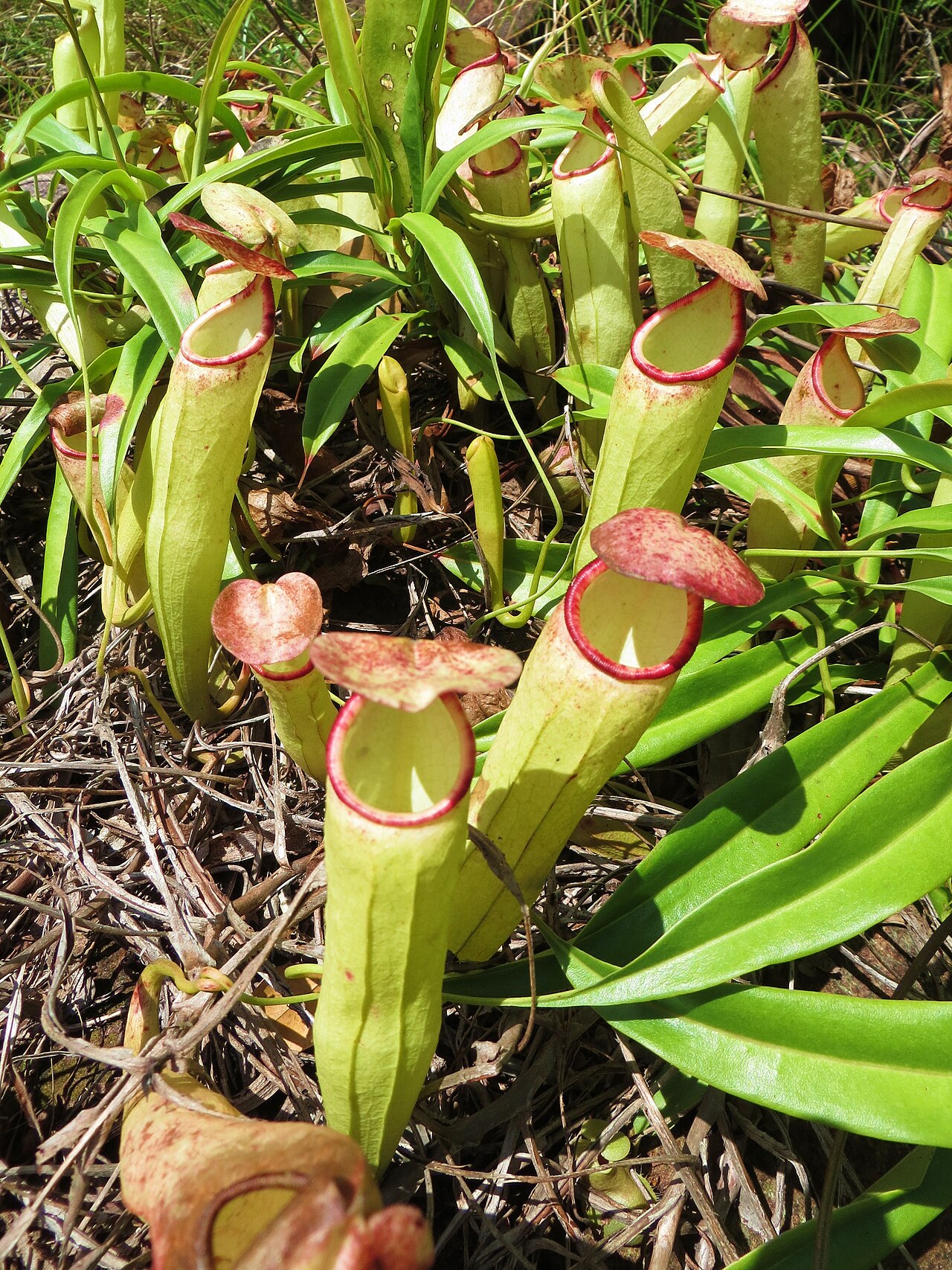
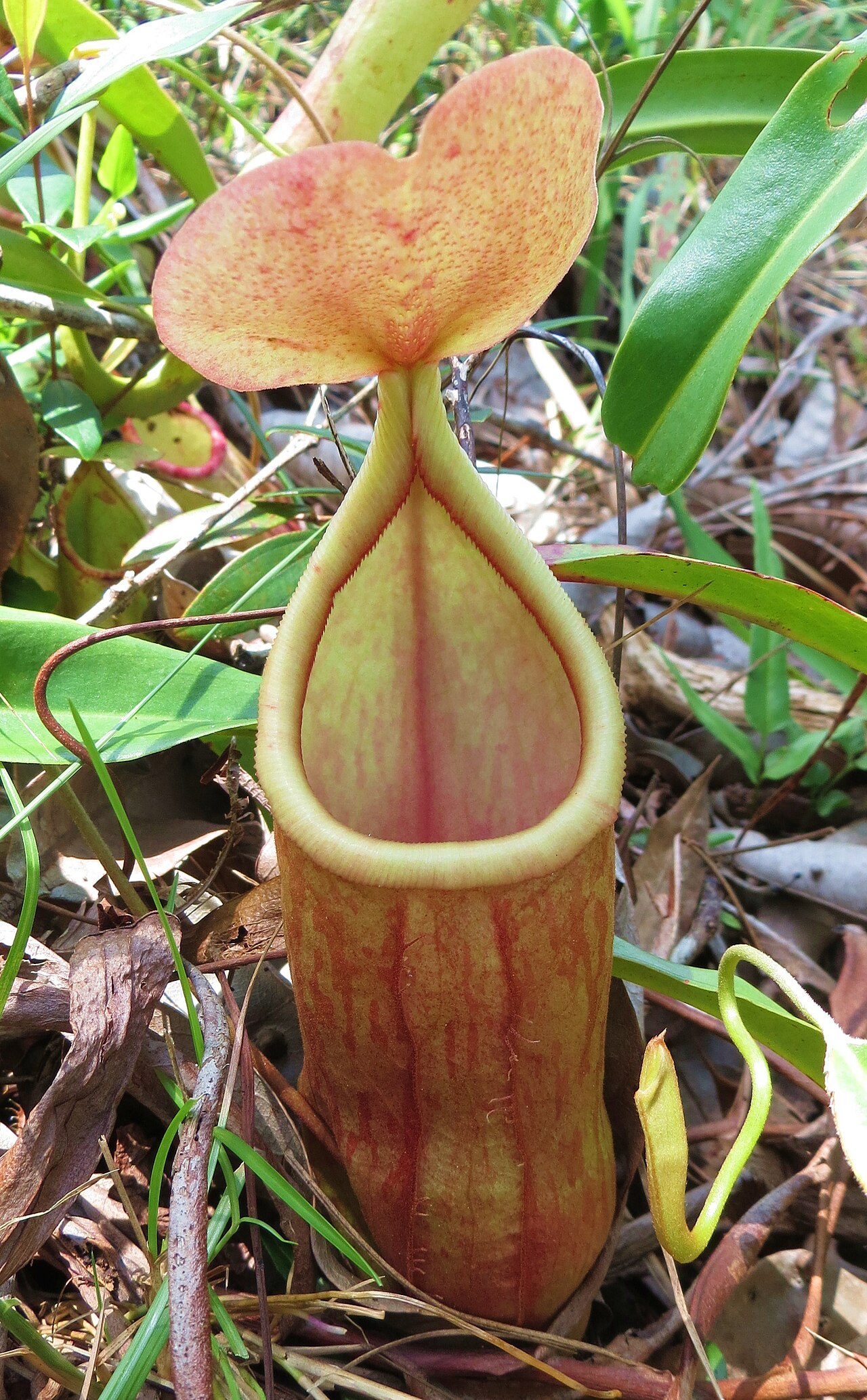
A climber to about 4 m, with strikingly thin stems, up to 4 mm across — thinner than in related species. The leaves are lanceolate, 10 to 24 cm long and 1.5 to 3.5 cm wide, light to dark green. Lower pitchers are 8 to 15 cm tall and 3 to 4.5 cm wide, green to light pink with dark pink stripes outside; the lid is 2.5 to 4.5 cm long and 3 to 4.5 cm wide. Upper pitchers are slimmer, 11 to 18 cm tall and 1.5 to 3.5 cm wide, and light green outside. The inner wall is often plain pink. Male inflorescences reach 40 to 50 cm with about 25 to 90 flowers; female ones 20 to 50 cm with 18 to 42 flowers.
Similar species
In the same area grows Nepenthes krabiensis, described in 2016 from the same wildlife sanctuary in Krabi and, according to its describers, closely related to N. rosea. N. krabiensis grows on higher summits, often in limestone crevices, and has lower pitchers that are green to orange with red stripes, and upper pitchers with red blotches inside. Within the N. thorelii group, N. rosea is distinguished according to its description mainly by the thin stem, the pink pitcher interior and the rosettes that sometimes grow from the flowering stem.
The trap and how it works
An ordinary pitfall trap, with lower pitchers standing on the ground and catching walking prey, and slender upper pitchers hanging from the climbing stems. The pink inner wall is striking, but whether that colour plays a part in luring prey has not been studied. As in other species nectar lies on the peristome and under the lid, and a film of water makes the peristome slippery. Digestive fluid sits at the bottom. In the open, sunny vegetation where the species grows, ants and other ground-dwellers are plentiful, and the lower pitchers are well suited to them.
Habitat and ecology
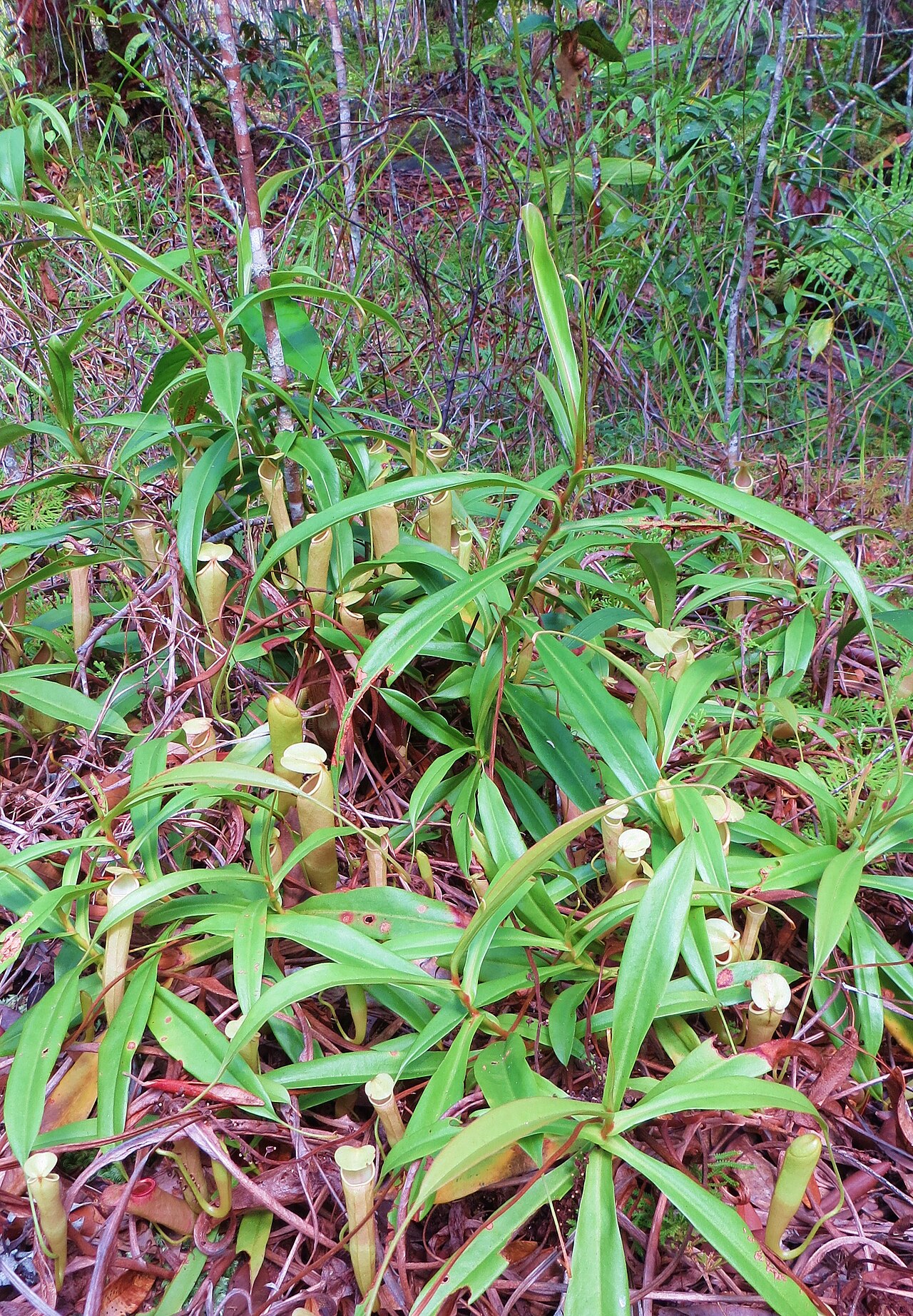
Sand and humus in varying proportions, on both steep and flat ground: clearings, scrub and open forest in the hills (B5, D1). The species grows between about 450 and 520 m; the type was collected at about 500 m. It is a seasonal landscape with a dry and a wet period, and related species of the N. thorelii group survive the dry season on a thick rootstock. The plants like light, growing along edges and in clearings, and climb up into the low shrubs there.
Distribution and elevation
Endemic to Thailand, in Krabi province on the peninsula, between about 450 and 520 m. The species is known from a limited area in the hills of Krabi, in a wildlife sanctuary where N. krabiensis also occurs. It is one of the southern outliers of the N. thorelii group, whose centre lies in Cambodia, Vietnam and eastern Thailand.
- Recorded (one-degree cells)
Forms and variation
No varieties or forms are distinguished. Colour does vary: lower pitchers range from plain green to light pink with dark pink stripes, and the pink interior is not equally clear in every plant. The describers saw rosettes growing from the flowering stem in about a third of the three hundred plants they examined in the wild — a form of vegetative propagation rarely described in the genus. No natural hybrids are mentioned in the sources consulted.
Where and when to see it
The hills of Krabi province are the area, at around 450 to 520 m. The country is wooded and hilly, with wildlife sanctuaries for which permission from the park authority may be needed. Search clearings and scrub on sandy, humus-rich ground. The end of the wet season, around October — also the month the type was collected — is a good time: the plants are full grown and the pitchers full. On flowering plants, check the flowering stem: a rosette on it is the unmistakable sign of this species.
Conservation status
The species is not evaluated for the Red List (Not Evaluated) in the source this guide uses. What is known: its range is small and confined to one province, but part of it lies in a wildlife sanctuary, and the describers examined around three hundred plants in the wild. The lowlands and hills of Krabi are under pressure from rubber and oil-palm plantations and from tourism. As a member of the genus it is listed in CITES Appendix II; international trade in wild plants requires a permit.
Scientific name
Nepenthes rosea | Catalano & Kruetreepradit, 2015
Nepenthes rosea was described in December 2014 by Marcello Catalano and Trongtham Kruetreepradit, in AIPC Magazine 36: 24-31. Krabi Province, Peninsular Thailand — the same province as N. krabiensis (golf 25) — at 450-520 m elevation, in clearings, scrubland and open forest on sandy and humus-rich substrates. The specific epithet references the flower's distinctive colouring: this species' pitchers often have uniformly pink interiors.
World Checklist of Vascular Plants (WCVP), via Plants of the World Online (POWO), Royal Botanic Gardens, Kew.