All species › Caryophyllales › Tropical pitcher plant family › Nepenthes rowaniae
Nepenthes rowaniae
Between 1881 and 1905 the Queensland Government Botanist Frederick Manson Bailey described eleven pitcher plants from northern Australia. In 1928 the Dutch monographer Danser swept them all together under the widespread Nepenthes mirabilis. A century later one of them proved to be a species after all: fieldwork on Cape York between 2001 and 2003 showed that Nepenthes rowaniae has stable characters that N. mirabilis never shows, and in 2005 Charles Clarke and Rob Kruger reinstated it. Bailey named the plant after Ellis Rowan, the Australian painter famous for her botanical watercolours.
Identification
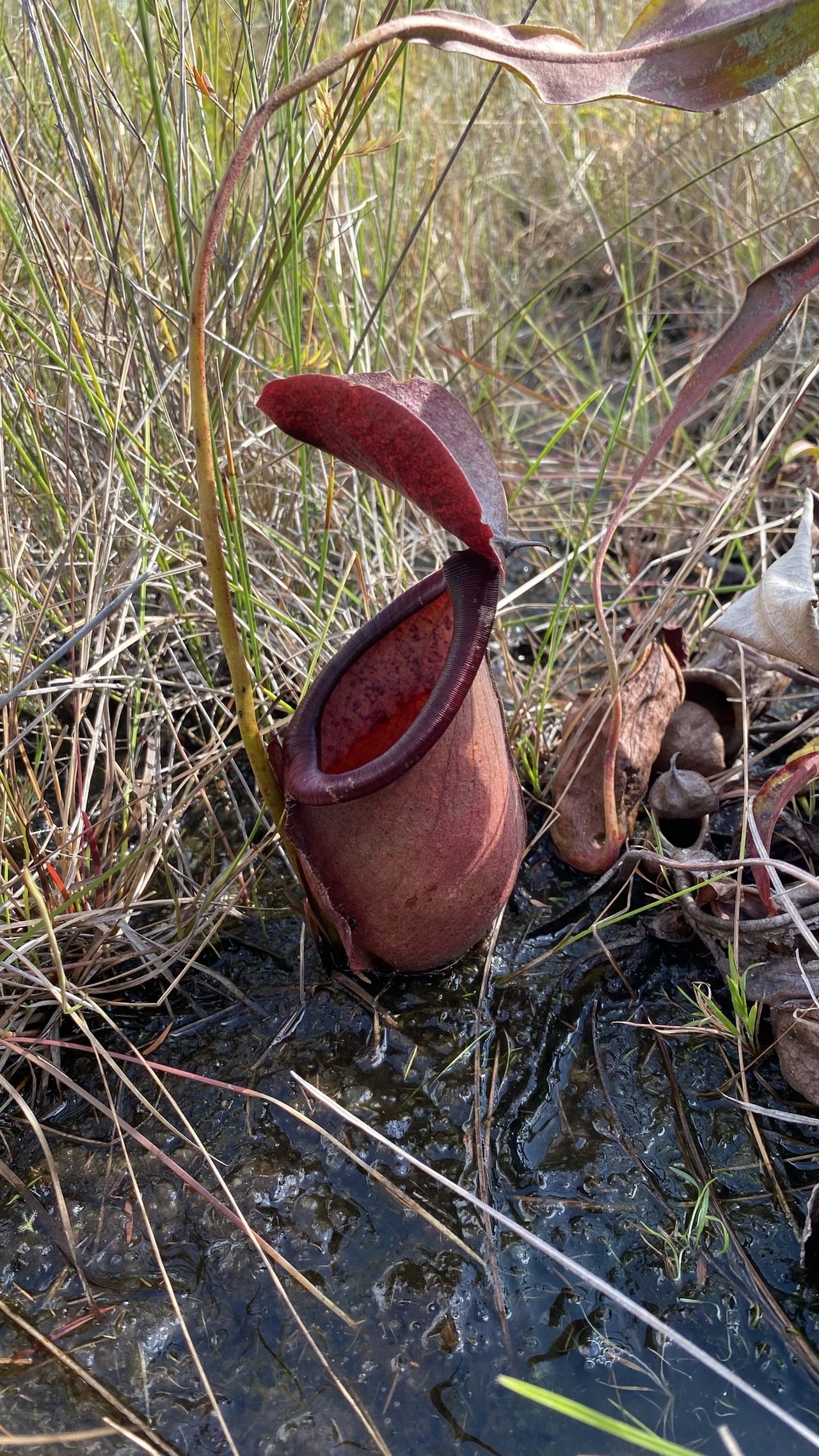
A climbing to scrambling plant with strikingly thick, stiffly leathery leaves. The best character is at the leaf tip: there the blade contracts and continues for some distance along the tendril as a narrow, pointed extension, so that the tendril appears attached not at the end but peltately to the underside of the leaf tip. The leaf base runs down the stem for at least half the internode length, often more. Lower pitchers are strongly swollen below, with the ‘hip’ — where the shape changes — directly beneath the peristome, so they are almost wholly bulbous. In upper pitchers the hip lies in the top quarter. The wings are often flattened at the front, forming a T in cross-section, and usually bear fringe filaments. No verifiable source with measurements was found for this guide, so the measurement fields are left empty.
Similar species
Nepenthes mirabilis, which grows in the same area, is the species it was confused with for a century. The distinction according to Clarke and Kruger: in N. mirabilis the leaf tip is acute to rounded and the tendril simply attached to it; the blade is usually thin and papery and runs down at most a third of the internode; the pitcher hip lies midway or lower. In N. rowaniae the blade is strongly leathery, the tendril peltately attached, the leaf base decurrent for at least half the internode and the hip placed high. N. tenax and N. parvula are small, upright plants with much narrower pitchers and are easy to tell apart.
The trap and how it works
A pitcher trap with a remarkably high density of glands. In the lower part of the pitcher Clarke and Kruger counted about 3600 glands per square centimetre, against 1600 to 2500 in N. mirabilis, which points to a strong digestive capacity. The almost globular lower pitchers stand on the ground and catch walking prey, guided by the broad, often flattened wings; the upper pitchers also catch flying insects. As in related species nectar sits on peristome and lid, and a film of water on the ribbed peristome makes the rim slippery. With its stiff, leathery leaves the plant stands up well to the fierce sun and dry periods of Cape York.
Habitat and ecology
Wet, open lowland in northern Cape York: swamps, wet heath and the margins of hollows that flood in the wet season (W6, W4). The site is poor and acid, with sandy or peaty soil. The climate is strongly seasonal: a hot wet season from about December to April, and a long dry season in which the surrounding savanna burns regularly. The leathery leaves and the growth habit suit these harsh conditions. No reliably published altitudinal limit was found for this guide; it is a lowland species.
Distribution and elevation
Endemic to Australia: Queensland, on the Cape York Peninsula. It is one of the four pitcher plant species of Cape York, together with N. mirabilis, N. tenax and N. parvula, and one of the three found only in Australia. Its exact distribution within the peninsula is not worked out in the sources consulted for this guide; it occurs in the northern part of Cape York, in the lowlands.
- Recorded (one-degree cells)
Forms and variation
No varieties or forms are recognised. Taxonomically the species is a returnee: Bailey described it in 1897, Danser sank it into N. mirabilis in 1928, and Clarke and Kruger reinstated it as a species in 2005. The spelling of the name varies: the original publication and much of the literature have N. rowanae, current name lists N. rowaniae. Two natural hybrids are known: with N. mirabilis and, more rarely, with N. tenax.
Where and when to see it
Northern Cape York is reachable overland only in the dry season, from about June to October; outside it floods make the roads impassable. Look at wet hollows, swamp margins and wet heath along the main route north; pitcher plants often grow close to the road. When in doubt against N. mirabilis, check the leaf tip and the thickness of the leaf: in N. rowaniae the leaf feels stiff and thick and the blade continues as a narrow point along the tendril. Much of the land on Cape York belongs to traditional owners; ask permission where needed.
Conservation status
The Red List assesses the species as Least Concern. Cape York is sparsely populated, large parts are protected or extensively managed, and the species is scattered across the north of the peninsula. Possible threats are a changed fire regime, feral pigs rooting in wet hollows and illegal collection. As a member of the genus it is listed in CITES Appendix II; international trade in wild plants requires a permit.
Scientific name
Nepenthes rowaniae | Bailey
Nepenthes rowaniae was described in 1897 by Frederick Manson Bailey, in the Queensland Agricultural Journal. Field observations between 2001 and 2003 provided the evidence that distinguished this taxon from the closely related N. mirabilis (golf 27), leading to its elevation to full species status in 2005. Cape York Peninsula, Australia — the same region as N. parvula (golf 29). The specific epithet honours Ellis Rowan, Australian naturalist and illustrator.
World Checklist of Vascular Plants (WCVP), via Plants of the World Online (POWO), Royal Botanic Gardens, Kew.