All species › Lamiales › Bladderwort family › Pinguicula antarctica
Pinguicula antarctica
The southernmost butterwort in the world. Pinguicula antarctica grows as far south as Isla de los Estados near Cape Horn, at fifty-four degrees south, in the saturated cushion bogs of Tierra del Fuego where the wind hardly ever drops. It is a minute plant with a flower under a centimetre across, and its season falls in the middle of the southern summer: January to March.
Identification
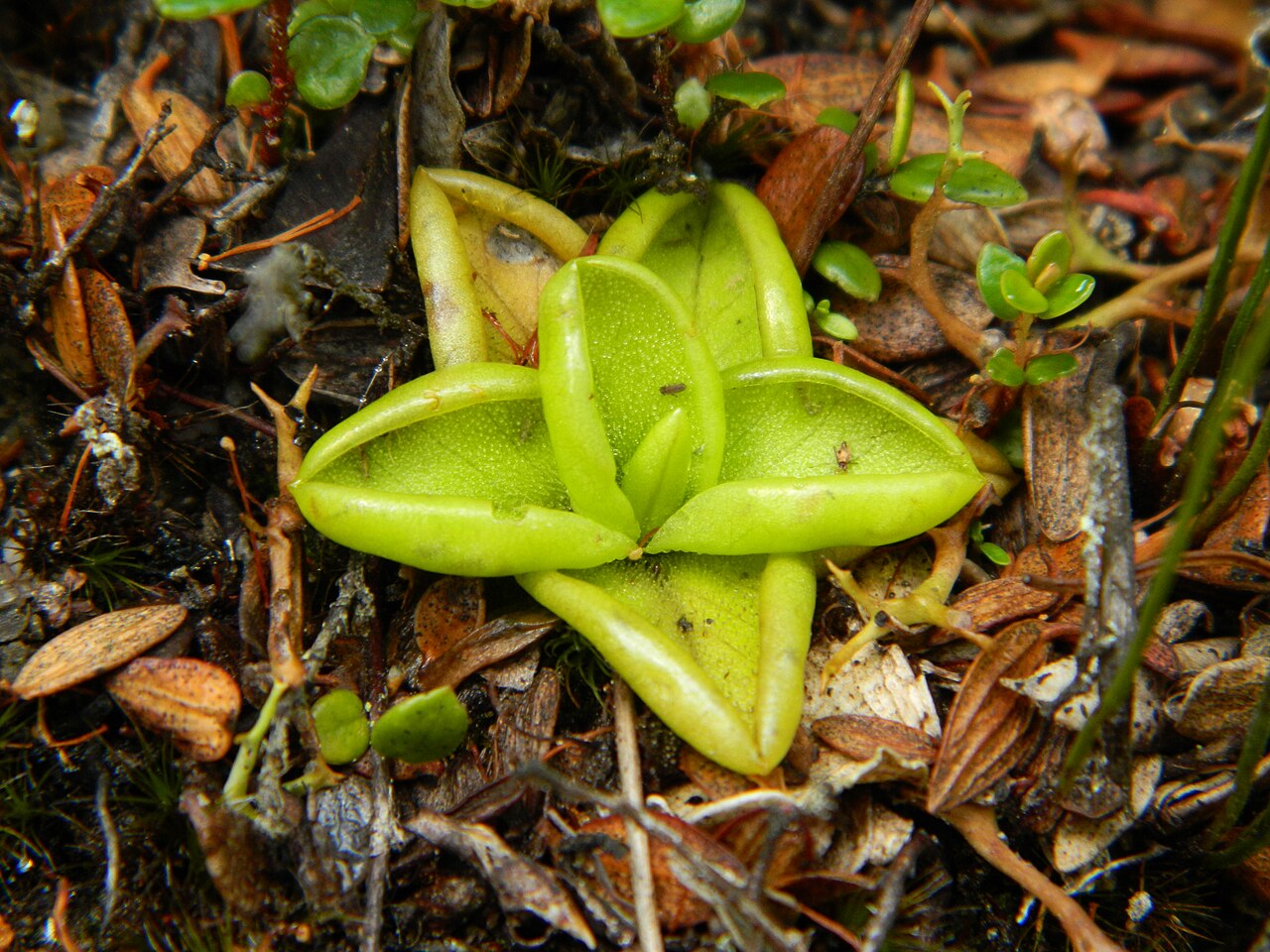
A small flat rosette of ovate-oblong leaves eleven to seventeen millimetres long with inrolled margins, green and sticky. One or a few scapes rise from the centre and stand, at two and a half to twelve centimetres — exceptionally twenty — surprisingly tall above the rosette for so small a plant; the upper part of the scape is sparsely set with glandular hairs. The flower is white, sometimes very pale violet and finely veined, two-lipped with a two-lobed upper and three-lobed lower lip, and only eight to ten millimetres long including the spur. The spur is saccate and, at one to one and a half millimetres, barely more than a bulge. Flowering is January to March.
Similar species
In Chile the species is most often confused with Pinguicula chilensis, which grows further north and has larger flowers of nine to thirteen millimetres with a distinct spur of two to three millimetres. Further north in the Andes comes P. australandina, with violet to lilac flowers and a conical spur. On the Cordillera de Nahuelbuta grows P. nahuelbutensis, with a far shorter scape of at most one and a half centimetres and a denser covering of glandular hairs. The rule of thumb: the further south and the shorter the spur, the more likely P. antarctica — but a spur under one and a half millimetres on a white flower is the best single character.
The trap and how it works
A flypaper trap in one of the wettest and windiest settings the genus occupies. The stalked glands carry a tenacious droplet that does not dry in the permanently high humidity; the sessile glands beneath release enzymes only once something is lying on the leaf. The inrolled margin keeps the digestive fluid with the prey. In the cushion bogs of the far south the supply is not large but it is constant: small flies, springtails and mites sheltering between the cushions of Donatia and Astelia. In these soils, which consist of little but acid, cold peat, virtually all usable nitrogen comes either from what the plant catches itself or from the rain.
Habitat and ecology
Saturated cushion bogs and Sphagnum mires of the subantarctic lowlands (W1), where Donatia fascicularis, Astelia pumila and bog moss set the tone; also wet bare rock (R1) and open, swampy woodland on peat (B4). Everywhere it is a permanently wet, acid, extremely nutrient-poor substrate under a cool maritime climate with rain in almost every month. There is hardly any tall vegetation to cast shade; the limiting factor here is not light or water but nutrients.
Distribution and elevation
From Isla de los Estados and the Strait of Magellan in the far south of Argentina and Chile northwards along the coast to the island of Chiloé, with an outlier in the Valdivian coastal range at about forty degrees south. The species is thus shared between two countries and not endemic, but it is confined to the cool, rain-soaked southwestern edge of South America. The distribution follows the peat rather than the altitude: from sea level up into the lower mountains. Our own species list names Tierra del Fuego, Chile and Argentina, which matches what the recent revision shows.
- Recorded (quarter-degree cells)
Forms and variation
No wild varieties are recognised. Variation lies mainly in the length of the scape, which runs from barely two and a half centimetres on the most exposed sites to twenty in sheltered mires, and in how far the flower is flushed violet — from pure white to pale lilac. Plants from the far south generally stay smaller. No natural hybrids are reported. The species concept in this group has, however, shifted in recent years: in the revision of the Chilean butterworts material formerly placed here was moved elsewhere, and the reverse.
Where and when to see it
This is a plant for wet feet. The cushion bogs of Tierra del Fuego and southern Chile are saturated right to the surface; walk the edges and look into the hollows between the Donatia and Astelia cushions, where the moss stays open. The rosettes are small and green on green, but the white flower on its relatively long scape can be seen from a few metres off. January and February are the best months. Bring waterproofs you can sit on, because from standing height nothing here is visible.
Conservation status
The species has not been assessed for the global IUCN Red List and is not in CITES, so there is no international category. What is known looks more reassuring than for many other butterworts: the range covers hundreds of kilometres of coast and islands in two countries, much of it in thinly populated country or inside protected areas. The main pressures are peat extraction, drainage for pasture, and in the north of the range forestry with exotic conifers, which alters the water regime of mires. There is no formal assessment, so no trend can be reported — only that this habitat type is more fragile than the map suggests.
Scientific name
Pinguicula antarctica | Vahl, 1804
Described by Martin Vahl in 1804, in Enumeratio Plantarum 1: 192. The type area lies in southern Chile and Argentine Patagonia, where the species grows in temperate rainforest and peat bogs. The species name antarctica refers to the southerly location of the species' range, near the southernmost tip of South America.
World Checklist of Vascular Plants (WCVP), via Plants of the World Online (POWO), Royal Botanic Gardens, Kew.