All species › Lamiales › Bladderwort family › Pinguicula chilensis
Pinguicula chilensis
A small butterwort of the wet high pastures of the southern Andes, described in 1849 for the Flora Chilena and ever since the subject of a lingering question of names. Pinguicula chilensis grows beside meltwater pools and springs between roughly one thousand and two thousand two hundred metres, in a landscape of volcanoes, glaciers and peaty meadows.
Identification
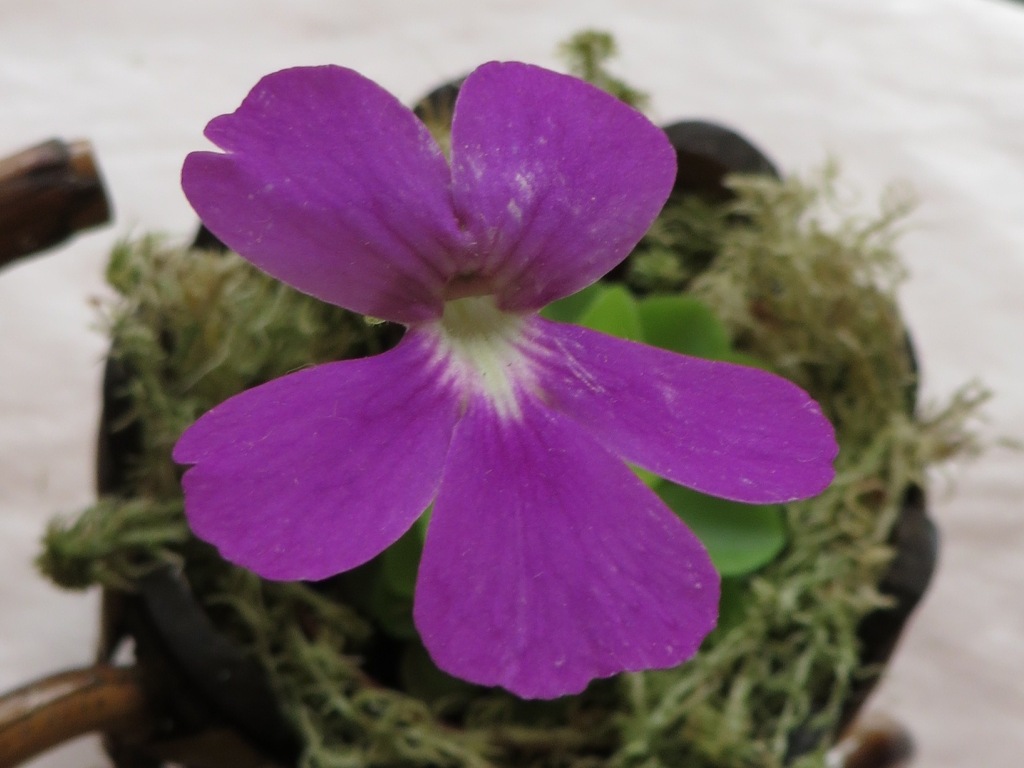
A flat rosette of three to ten leaves, each twelve to twenty-four millimetres long and eight to eleven wide, ovate-oblong with a blunt tip. The upper surface is densely set with sessile glands and feels greasy; at the leaf base stand long, awl-shaped hairs, a character obvious at once through a lens. Each scape carries one flower nine to thirteen millimetres across, blue or whitish, with violet veins running into the throat; the lower lip is three-lobed. The spur is short, about two to three millimetres. The plant flowers in the southern summer and then withdraws; in winter the site is usually under snow.
Similar species
South of this range stands Pinguicula antarctica, with smaller flowers of eight to ten millimetres and a saccate spur of at most one and a half millimetres — that difference in the spur is the most usable character. In the same high mountains, between thirty-six and forty-one degrees south, occurs P. australandina, with violet to lilac flowers with darker veins and a conical spur of two to three millimetres; here colour decides, since P. chilensis tends to blue or white. On the Cordillera de Nahuelbuta, nearer the coast, grows P. nahuelbutensis with a very short, densely hairy scape.
The trap and how it works
A flypaper trap working in a setting of short summers and long snow cover. The stalked glands hold the droplet, the sessile glands beneath act only once prey lands on the leaf and dissolve it on the spot. The leaf margin rolls slowly inwards so that the digestive fluid pools in a hollow. Because the growing season is short, much has to happen in few weeks: in the southern summer clouds of midges and gnats swarm above the meltwater pools, and that is exactly when the plant is in leaf and flower. By the end of the season an older leaf lies covered in dark insect remains.
Habitat and ecology
Damp to boggy high pastures at the edges of pools and lakes fed by meltwater from volcanoes and glaciers (W6), along the shores themselves (W7), and on open, short-turfed ground above the treeline (R5). The soil is peaty, acid and poor, permanently wet during the growing season and snow-covered in winter. Companions include Calceolaria biflora and violets growing in the same seepages. Tall vegetation is absent; the site stays open through the combination of altitude, wind and a long snow-lie.
Distribution and elevation
From Nahuel Huapi National Park on the Chile–Argentina border northwards to just beyond Laguna del Maule at thirty-six degrees south, in a band from about one thousand to two thousand two hundred metres. The species is therefore shared between two countries and not endemic. Our species list names only Chile; the Argentine part of the range, along the eastern side of the same cordillera, belongs just as much. Within that area the distribution is patchy: the plant follows the wet places, and those lie as islands in otherwise dry, stony high country.
- Recorded (one-degree cells)
Forms and variation
No wild varieties are recognised. Flower colour varies within the species from clear blue to nearly white, always with the same violet veining; that is variation, not a series of forms. More important for the reader is that the name itself is disputed: the recent revision of the Chilean butterworts raised the possibility that Clos's type material belongs to the plant now called P. antarctica, which would mean the name P. chilensis changes hands. The major reference works keep the species standing for now. No natural hybrids have been described.
Where and when to see it
Search along the water, in the southern summer. The best places are the flat, boggy margins of meltwater pools and the seepages below them, where the sward stays short and the ground gives under your boots. The rosettes are small and lie flat; the little blue-white flower on its scape is what you notice first. January and February are the likeliest months. Be aware how quickly these seepages are trampled out: walk around them and sit on a dry stone to look.
Conservation status
The species has not been assessed for the global IUCN Red List and is not in CITES, so there is no international category. What is known: the range covers a couple of hundred kilometres of Andes in two countries, with many sites inside national parks on both sides of the border. Pressure comes mainly from grazing of the high pastures, from abstraction and damming of mountain water for hydropower and irrigation, and from a rising snowline, which shrinks the moist zones in the mountains. On top of that the question of names makes it hard to pool old and new records — an assessment would first have to settle that.
Scientific name
Pinguicula chilensis | Clos, 1849
Described by Dominique Clos in 1849, in Gay, Historia Física y Política de Chile, Botanica 4: 365. The species occurs in southern South America, from the Nahuel Huapi area on the Argentina-Chile border northward to the Laguna del Maule at 36 degrees south latitude. The species name chilensis refers to Chile, one of the countries where the species occurs.
World Checklist of Vascular Plants (WCVP), via Plants of the World Online (POWO), Royal Botanic Gardens, Kew.