All species › Lamiales › Bladderwort family › Pinguicula macrophylla
Pinguicula macrophylla
One of the oldest names in the Mexican part of this genus: Pinguicula macrophylla was described by Kunth as early as 1817, from material Humboldt and Bonpland collected on their journey through New Spain. As the name promises it is a large-leaved species — a substantial rosette of the cool oak woodland in the highlands of central Mexico.
Identification
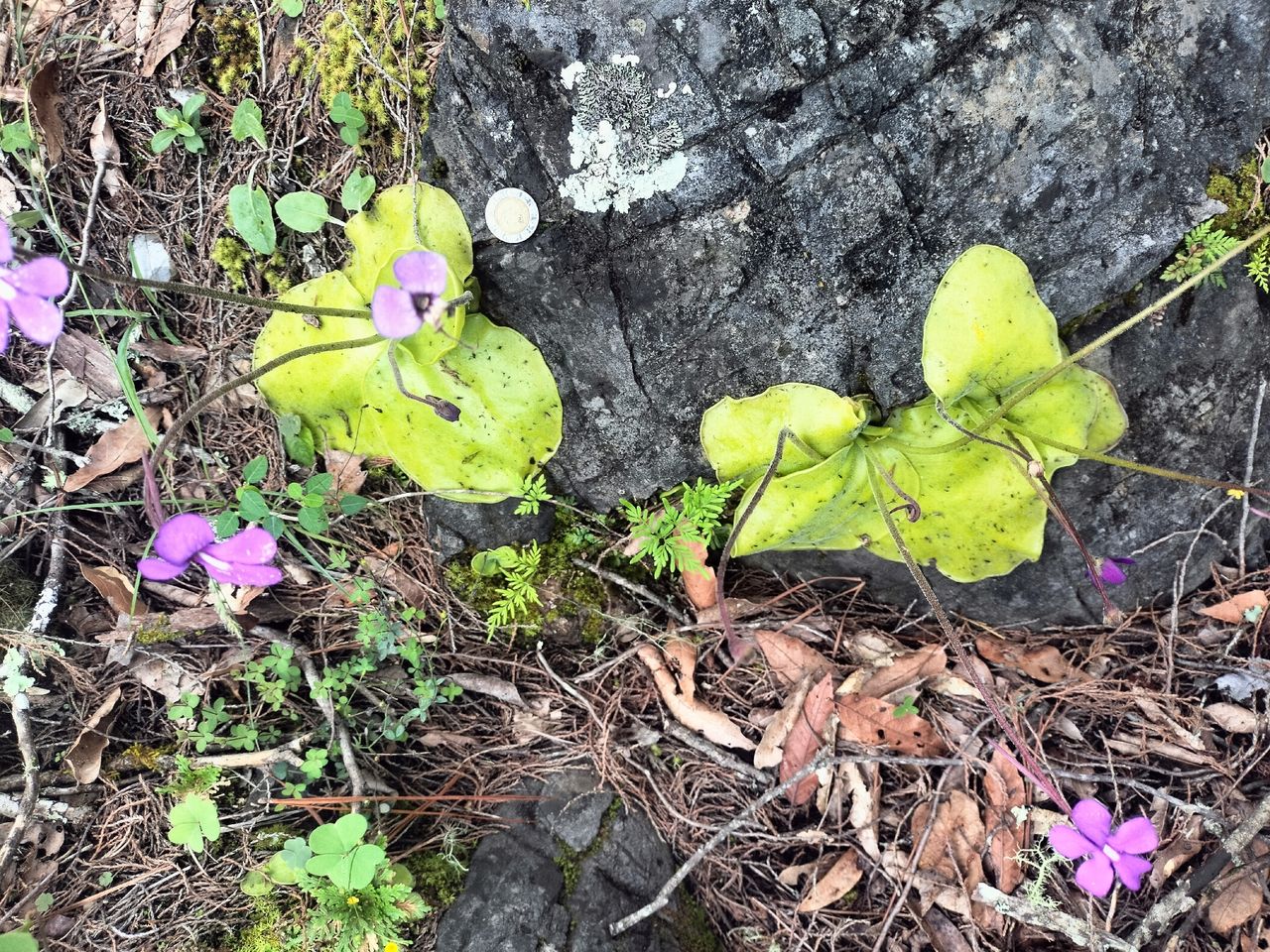
In the dry season the plant withdraws into a true underground bud with small lanceolate leaflets; above ground nothing is to be seen. With the rains the summer rosette appears: ovate to elliptic leaves 35 to 90 mm long and 25 to 70 mm wide, with a clearly set-off petiole, spread flat and densely glandular. One to three, sometimes five scapes 16 to 20 cm tall, exceptionally 23 cm, rise per plant. The flower is violet-purple and 35 to 55 mm long including the cylindrical, curved spur of 23 to 28 mm. Flowering falls in summer, together with or shortly after the emergence of the summer leaves.
Similar species
Pinguicula acuminata, with which the species has often been confused, has a much smaller pale flower with a spur of at most five millimetres, and flowers in early spring from the winter rosette rather than in summer. P. moranensis has a comparably large flower but a different leaf shape and a far wider distribution. P. oblongiloba stands close, likewise with large leaves on a distinct petiole; that species occurs further west. Because of the historical confusion, old records of P. macrophylla always deserve checking.
The trap and how it works
A flypaper trap on a broad leaf with a set-off stalk, so the blade lies fairly flat on the ground or on moss. The stalked glands hold the prey; the sessile glands between them supply digestive enzymes on contact, and the leaf margin rolls slowly towards the prey so the fluid stays in a shallow bowl. In a humid oak wood the supply of small flies is generous. Outside the rainy season, when only the underground bud remains, the plant catches nothing: the catching season coincides entirely with the rains.
Habitat and ecology
Cool highland in the oak belt, with species such as Quercus rugulosa and Q. hartwegii, where the plants grow in damp mossy spots among rocks and at the foot of trees (B5, R2). Associates include Agave celsii and small herbs of the woodland floor. The substrate is calcareous to neutral; the plant grows not on cliff rock but in the thin humus and moss cover over it. Elevation is roughly two thousand to twenty-eight hundred metres, with dry winters and a marked summer rainy season.
Distribution and elevation
Endemic to Mexico. The published sites lie in the central highlands, among them the area between Guanajuato and Santa Rosa, in San Luis Potosí and in Hidalgo near Real del Monte, although some authors consider that last record to rest on confusion with P. acuminata. Our species list says only 'Mexico', which is defensible here: the precise limits of the range are not sharp because of the historical confusion of names. What is clear is that it concerns the central mountains.
- Recorded (quarter-degree cells)
Forms and variation
No wild varieties are distinguished. Variation within the species concerns mainly the size of the summer leaves — the published figures run from three and a half to nine centimetres — and the intensity of the violet-purple flower colour. Both relate to site and to the amount of summer rain. More important than the variation is the confusion with relatives: a considerable share of what stands as P. macrophylla in older literature and herbaria turns out on closer inspection to belong to other species, and that clouds the picture of both distribution and range of variation.
Where and when to see it
Go in the rainy season, July to September: the large leaves are then spread out with the violet flowers above them on their long scapes. In the dry months there is nothing to find, since the plant sits as a bud underground. Search mossy spots in the oak woodland, at the foot of boulders and along shaded banks. The rosette is large enough to notice from standing height, which makes this one of the easier species in the group. Do not dig: the bud sits shallow and is lost when disturbed.
Conservation status
Not assessed for the global IUCN Red List and not listed in CITES. An extra problem applies to this species: because the name has in the past been applied to plants of several species, it is not even entirely clear how large the real range is. What is certain is that cool oak woodland in the central Mexican highlands has been much reduced by logging, grazing and conversion to farmland, and that the species depends on that woodland type. An assessment here could not begin without first putting the taxonomy in order.
Scientific name
Pinguicula macrophylla | Kunth, 1817
Described by Alexander von Humboldt, Aimé Bonpland and Carl Sigismund Kunth in 1817, in Nova Genera et Species Plantarum 2: 184. The original description cites a locality near Real del Monte, in the Mexican state of Hidalgo; however, later botanists (Zamudio, Lührs) have questioned whether that material actually represents P. acuminata instead. The name derives from macro- (large) and phylla (leaf), referring to this species' notably large leaves compared to related species.
World Checklist of Vascular Plants (WCVP), via Plants of the World Online (POWO), Royal Botanic Gardens, Kew.