All species › Lamiales › Bladderwort family › Pinguicula caerulea
Pinguicula caerulea
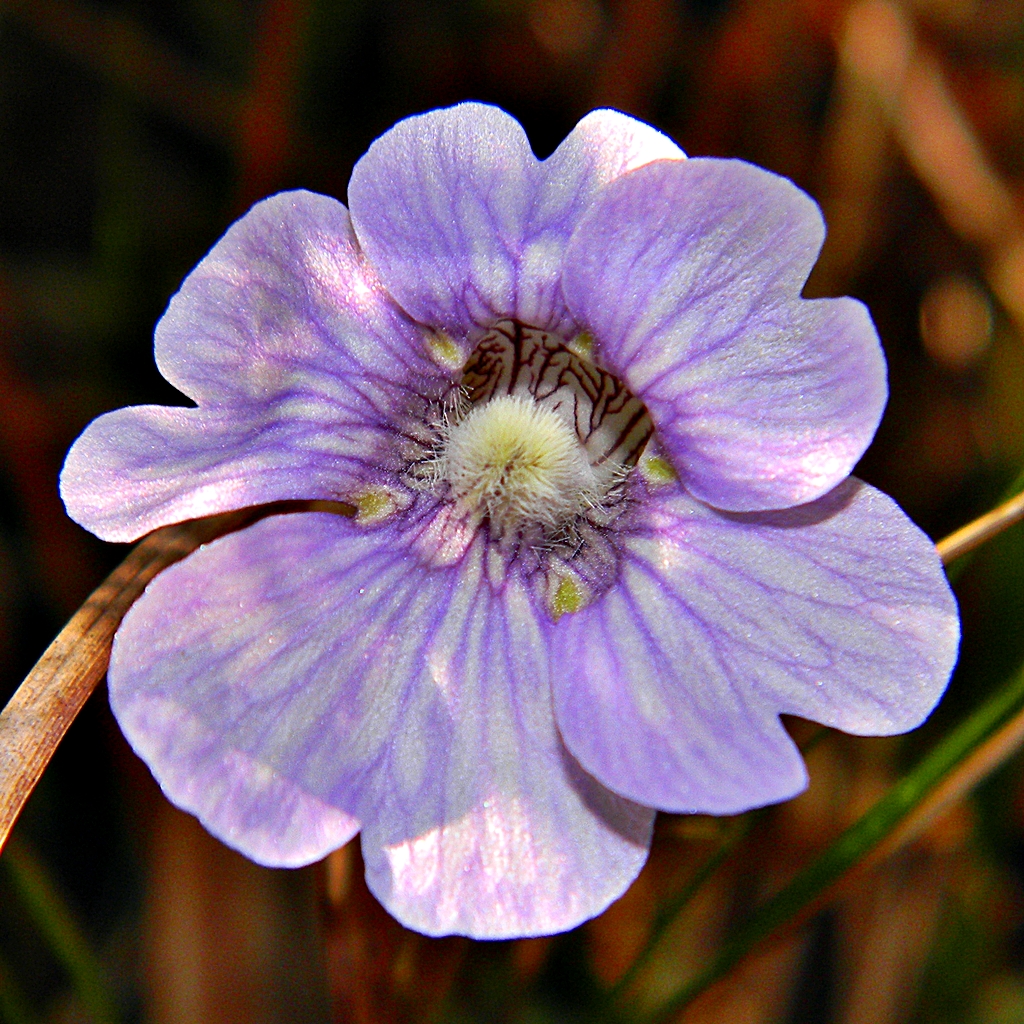
In the wet pine flatwoods of the south-eastern United States this is the species with a violet flower, with a network of dark veins that gives it an almost marbled look. It is also the easiest butterwort of the region to find, because Pinguicula caerulea flowers in winter, when the savanna is bare and there is little other colour about.


Identification
A fleshy, yellow-green rosette, usually five to ten and sometimes up to fifteen centimetres across, with leaves whose margins are strongly rolled inward — a character the descriptions name explicitly. The upper surface is sticky and glistens with glandular droplets. Slender scapes rise from the centre, each with a single flower. That flower is violet, two-lipped and spurred, and the spreading part of the corolla is distinctly darker along the veins, so that it looks striped. White-flowered plants turn up occasionally. The scapes are slender and, like the leaf, set with glandular hairs, which a hand lens shows clearly. After flowering a small capsule remains, splitting in spring to release dust-fine seed.
Similar species
In flower confusion is barely possible: in Florida this is the only butterwort with a large, purple, conspicuously veined flower. Out of flower the rosette closely resembles that of Pinguicula lutea, a frequent companion; the strongly inrolled margins then help. P. planifolia has flat, often reddish leaves without curled margins and grows in wetter, muddier ground. P. pumila is far smaller, with a flower of about a centimetre. P. ionantha has a paler purple to white flower with a protruding palate.
The trap and how it works
The trap is the classic butterwort one: stalked glands bearing a sticky droplet and sessile glands releasing digestive enzymes once prey lies on them. The strongly inrolled margin of this species forms, in effect, a permanent gutter in which the digestive fluid stands — useful on a site that dries out in the dry months. The menu consists of small flies, midges and other winged insects moving just above the vegetation of the wet savanna.
Habitat and ecology
Wet pine flatwoods and wet prairies, mostly in the outer coastal plain, with seepages here and there and the transition from sandhills to pocosin. The common denominator is open, sunny, wet and poor ground kept open by regular fire. Where burning stops, the scrub closes within a few years and the species goes. That makes this plant a good indicator of well-managed savanna: where it flowers in numbers, the fire regime is in order. Wet pine flatwoods are among the most species-rich vegetation on the continent, with dozens of plant species on a single square metre. That assembly depends on light, and light depends on fire; this butterwort is accordingly among the first species to go when management lapses.
Distribution and elevation
From south-eastern North Carolina — Carteret and Johnston counties — south to the southern Florida peninsula and west to the eastern Florida panhandle, with Georgia and South Carolina in between. It is therefore a species of the Atlantic coastal plain that barely reaches the Gulf coast, and so has a narrower range than the yellow-flowered butterwort it often grows with. In the Carolinas it is uncommon in the coastal plain.
- Recorded (quarter-degree cells)
Forms and variation
No wild subspecies or varieties are recognised. What varies is the intensity of flower colour and the emphasis of the venation: some plants are almost white with only blue veins, others deep violet. White-flowered plants have been recorded from North Carolina among other places. Such colour variants occur scattered within normal populations and are not geographic races. Cultivated selections fall outside this account.
Where and when to see it
Winter is the season: from December into early spring the flowers stand above an otherwise colourless savanna, and on a recently burned patch they are visible from a distance. Search wet pine flatwoods and the edges of wet prairies, preferably ground burned the previous year. Kneel to look at the rosette; the inrolled margins and glossy upper surface are then immediately obvious. Keep to firm ground and avoid trampling the sward.
Conservation status
The species has not been assessed for the global IUCN Red List and is not listed in CITES. In Florida it is legally protected as threatened at state level; the threats named are forestry operations and fire exclusion, with recommended management of burning every two to four years and protection from soil disturbance. That pattern holds across the wet coastal plain: the range looks generous on a map, but the number of well-managed savannas in which the species can actually persist is falling. The missing global category is therefore a gap in the file. A practical corollary for the fieldworker: where this species is absent from apparently suitable savanna, that usually signals that the ground has not been burned for years.
Scientific name
Pinguicula caerulea | Walter, 1788
Described by Thomas Walter in 1788. The species occurs in moist, sandy pinelands in the south-eastern United States. The species name caerulea is Latin for "sky-blue, sea-blue" and refers to this species' blue flower colour.
World Checklist of Vascular Plants (WCVP), via Plants of the World Online (POWO), Royal Botanic Gardens, Kew.