All species › Lamiales › Bladderwort family › Pinguicula lutea
Pinguicula lutea
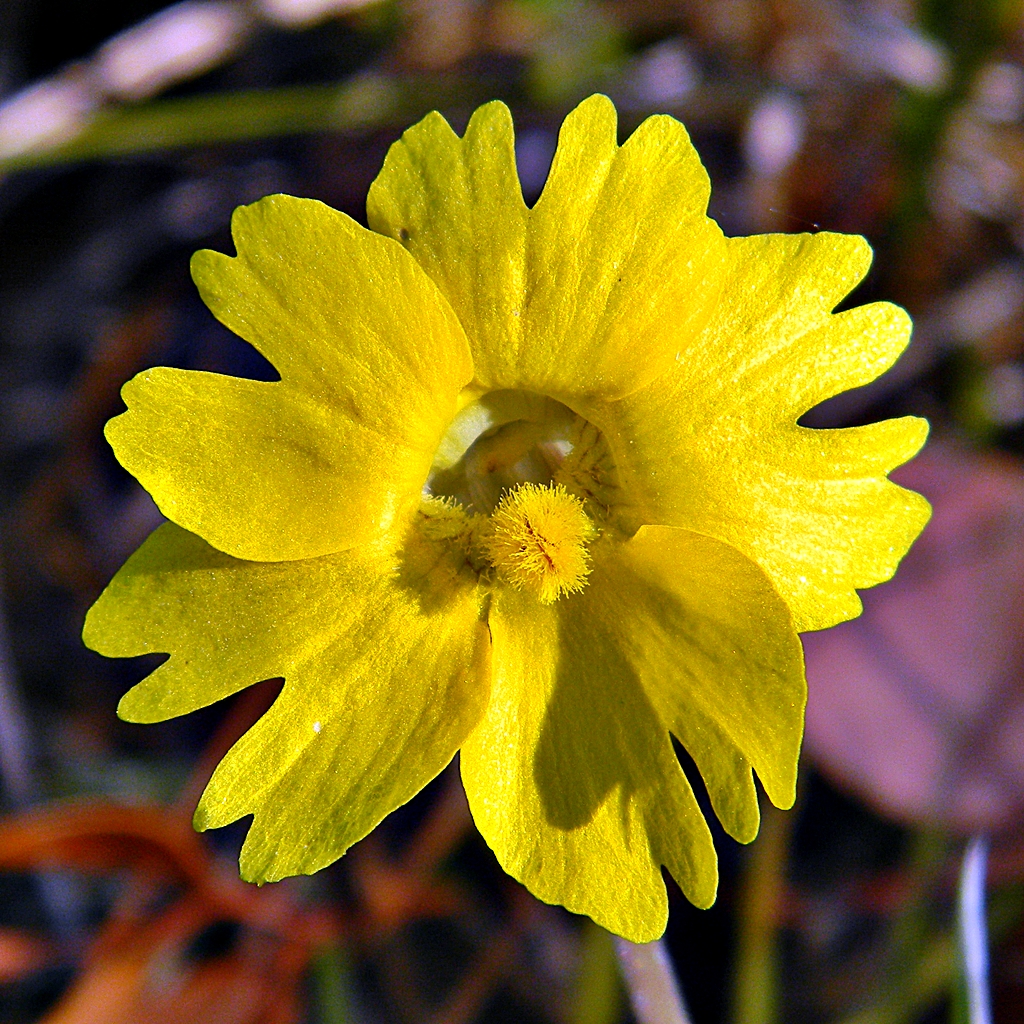
This butterwort of the south-eastern United States has a bright yellow flower, the size of a coin or larger, standing alone above the wet pine savanna. Anyone walking a recently burned flatwood in Florida or Georgia in February sees Pinguicula lutea as a scatter of yellow dots rather than as a plant — the rosette itself lies invisibly flat on the ground.


Identification
A fleshy, yellow-green rosette about five to eight centimetres across, with broadly elliptical leaves whose margins curl up in older plants and whose upper surface feels sticky. One to several slender scapes rise from the centre. The flower is sulphur-yellow, two-lipped, with a cleft lower lip and a spur behind, and measures roughly two and a half to five centimetres across. Straw-coloured plants turn up occasionally and white ones very rarely. The species is known for flowers with extra lobes, which look malformed or double.
Similar species
No other butterwort in this region has a large yellow flower, so in bloom the species is unmistakable. The risk lies with the rosette, which resembles that of Pinguicula caerulea, a frequent companion in the same savanna. Check flower colour as soon as one is present — violet with dark veins in caerulea, pure yellow here. P. planifolia has flatter, often reddish leaves and grows wetter; P. pumila is far smaller, with a rosette of at most a couple of centimetres.
The trap and how it works
The rosette works as a flypaper trap with two gland types: stalked glands with a sticky droplet, and sessile glands releasing digestive enzymes once prey lies on them. The leaf margin then rolls slowly towards the prey so the fluid pools in a shallow dish rather than running off; afterwards the blade flattens again. The catch is mostly small flying insects of the wet savanna. On an old leaf the result shows as a dotted line of black husks along the margin.
Habitat and ecology
Wet pine flatwoods and wet prairies of the coastal plain, with seepage slopes here and there and the transition from sandhills to pocosin scrub. These are fire-maintained open ecosystems: without regular burning the scrub closes, the light goes and the plant with it. The soil is acid, wet and markedly poor — exactly the kind of site where carnivory pays, and where this butterwort is accordingly accompanied by sundews, bladderworts and pitcher plants. The savanna this species grows in is among the most species-rich vegetation in North America: a square metre can hold dozens of plant species, and it is that density which makes keeping it open by fire so important. Without burning the smallest species go first, and the butterwort is among them.
Distribution and elevation
From south-eastern North Carolina — Pender and New Hanover counties — south to southern Florida and west to eastern Louisiana, with Alabama, Georgia, South Carolina and Mississippi in between. It is therefore a species of the Atlantic and Gulf coastal plain, almost entirely confined to low, flat ground. In Georgia it is common in the coastal plain, in South Carolina uncommon and in North Carolina rare, a classic pattern for species reaching their northern limit.
- Recorded (quarter-degree cells)
Forms and variation
No wild subspecies or varieties are recognised. What varies is flower colour, from deep sulphur-yellow to straw and very rarely white, and the build of the flower itself: this species is noted for plants with fused or extra corolla lobes, which read as a double flower. Such oddities are not fixed forms but individual, often annually recurring peculiarities of particular plants. The rosette varies strongly with the season too: after a fire and in strong light the leaves stay small and thick, while plants in taller vegetation make longer, thinner leaves. That is a response to conditions and not a character to identify by.
Where and when to see it
Go in February or March and search recently burned wet flatwoods: ground burned the previous year often gives the densest flowering. Yellow dots above the grass are visible from tens of metres; then approach carefully, because the rosettes lie invisibly between the tussocks. Look around at the same time for other carnivorous plants — such savannas often hold four or five species within a few paces of each other. Bring a small mirror or a phone with a macro setting to inspect the glandular coat closely without touching the plant.
Conservation status
The species has not been assessed for the global IUCN Red List and is not listed in CITES. What is known paints a mixed picture: the range is wide but the habitat is disappearing. In Florida the species is legally protected as threatened at state level and counted fairly rare; the recommended management is burning every two to four years to reduce shrub cover. The core of the problem is the same everywhere: drainage, forestry and above all fire exclusion, which lets open savanna close up. The absence of a global category says nothing about that trend.
Scientific name
Pinguicula lutea | Walter, 1788
Described by Thomas Walter in 1788, in Flora Caroliniana: 63. The species occurs in the southeastern United States; Walter's type material came from South Carolina. The name "lutea" is Latin for "yellow" and refers to this species' bright yellow to straw-yellow flowers.
World Checklist of Vascular Plants (WCVP), via Plants of the World Online (POWO), Royal Botanic Gardens, Kew.