All species › Lamiales › Bladderwort family › Pinguicula primuliflora
Pinguicula primuliflora
The primrose butterwort is the butterwort of running water. Where most species of the south-eastern United States stand in open pine savanna, Pinguicula primuliflora sits in the shade: on the banks of creeks and bayous under forest, often half in the water, and sometimes wholly submerged when the level rises. It is also usually the first of its company to flower, often as early as January.


Identification
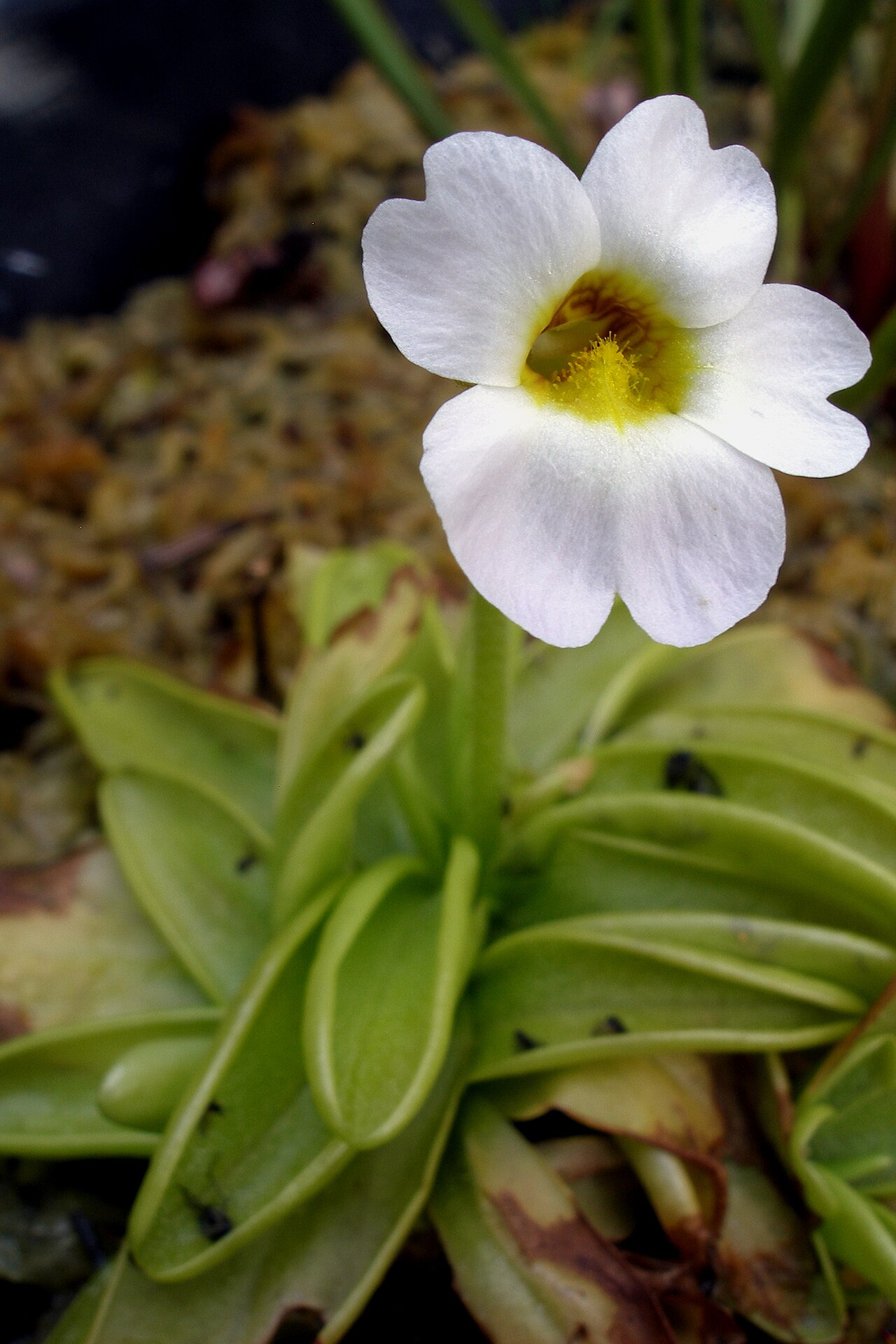
A fresh green rosette four to sixteen centimetres across, with oblong, entire leaves lying flat on the wet bank and glistening above with the glandular coat. The scapes are slender and, as in other butterworts, glandular-hairy themselves. The flower is pale lilac to almost white with a yellow throat, and has the five-lobed, rather flat shape that recalls a primrose — hence the name. Characteristically, older leaves can form small rooting plantlets at their tips, so an old plant is often ringed by a cluster of offspring.
Similar species
The other butterworts of the south-east are plants of open wet savanna rather than shaded creek banks, which usually settles the matter. Pinguicula planifolia does stand in very wet places but has flat, often reddish leaves without inrolled margins and a distinctly more purple flower. P. ionantha has a pale purple to white flower with a conspicuously protruding palate. This species stands out by the pale ring round the throat and by its situation — no other grows so consistently at the waterline under trees.
The trap and how it works
The rosette works as a classic flypaper trap: stalked glands carry a sticky droplet, sessile glands release digestive enzymes once prey lies on them, and the leaf margin rolls slowly towards the prey so the fluid pools in a shallow depression. On a shaded creek bank the prey supply is excellent: swarms of midges and other small two-winged insects hang permanently over running water. Shade brings a further advantage: the droplets hardly dry out, so the trap keeps working even at midday. A second advantage of this habitat is delivery: what the water carries and deposits on the bank regularly ends up on a leaf. A rosette lying half in the water therefore takes in part of what floats, not only what flies.
Habitat and ecology
Shaded, permanently wet banks: the edges of bayous, sandy creek banks, seepages and swamp woodland, often with the rosettes half in the water. In this species' homeland — the lowland forests along the Gulf coast — that means acid, nutrient-poor, flushed sites where few herbs persist. The plant tolerates temporary submergence; observations from its range describe plants standing entirely under water at high stages and simply carrying on afterwards.
Distribution and elevation
Confined to the south-eastern United States and within it to the Gulf coastal plain: from south-eastern Mississippi through southern Alabama to the western Florida panhandle, with records from Santa Rosa, Okaloosa, Greene and Mobile counties among others. It is therefore a lowland species of flat ground close to sea level, with a range running as a narrow band parallel to the coast. Within that band the species is unevenly spread as well: it follows the watercourses, so its distribution reads as lines rather than areas. Where a creek has been straightened or the bank woodland cleared, such a line breaks.
- Recorded (quarter-degree cells)
Forms and variation
No wild subspecies or varieties are recognised. What is striking is the variation in flower colour, from almost pure white to clearly lilac, and the degree to which a plant produces plantlets on its leaf tips — the latter tracking closely how wet and shaded the site is. Because that vegetative increase is so effective, a colony often consists of one large clone; what looks like a population may genetically be a handful of individuals. Cultivated selections fall outside this account. Anyone comparing plants does well, therefore, to set specimens from different creek systems side by side rather than from one colony.
Where and when to see it
Search along water under trees, not in open savanna: sandy creek banks, the edge of a bayou, seepages at the foot of a slope. January to March is the best period, since this species runs ahead of the others; in a mild winter the first flowers open just after New Year. Watch for the pale ring round the yellow throat and photograph the flower from the front and the side. Where you find one plant there are usually dozens — so mind where you put your feet.
Conservation status
The species has not been assessed for the global IUCN Red List and is not listed in CITES. What is known: the range is small and lies wholly in a lowland zone where creeks are straightened, bank woodland is cleared and the water regime is altered by drainage and building. In Florida the species holds legal protection at state level. It is also popular with collectors, which can bring collecting pressure on known sites. The absence of a global category is a gap in the file, not a clean bill of health.
Scientific name
Pinguicula primuliflora | Wood & Godfrey, 1957
Described by Carroll E. Wood and Robert K. Godfrey in 1957, in Rhodora 59: 219. The species occurs in the southeastern United States (including Florida, Louisiana and surrounding states). The name "primuliflora" (primrose-flowered) does not refer to a resemblance to primrose flowers, but to the fact that this species is usually the first in the genus to flower in spring.
World Checklist of Vascular Plants (WCVP), via Plants of the World Online (POWO), Royal Botanic Gardens, Kew.