All species › Lamiales › Bladderwort family › Pinguicula debbertiana
Pinguicula debbertiana
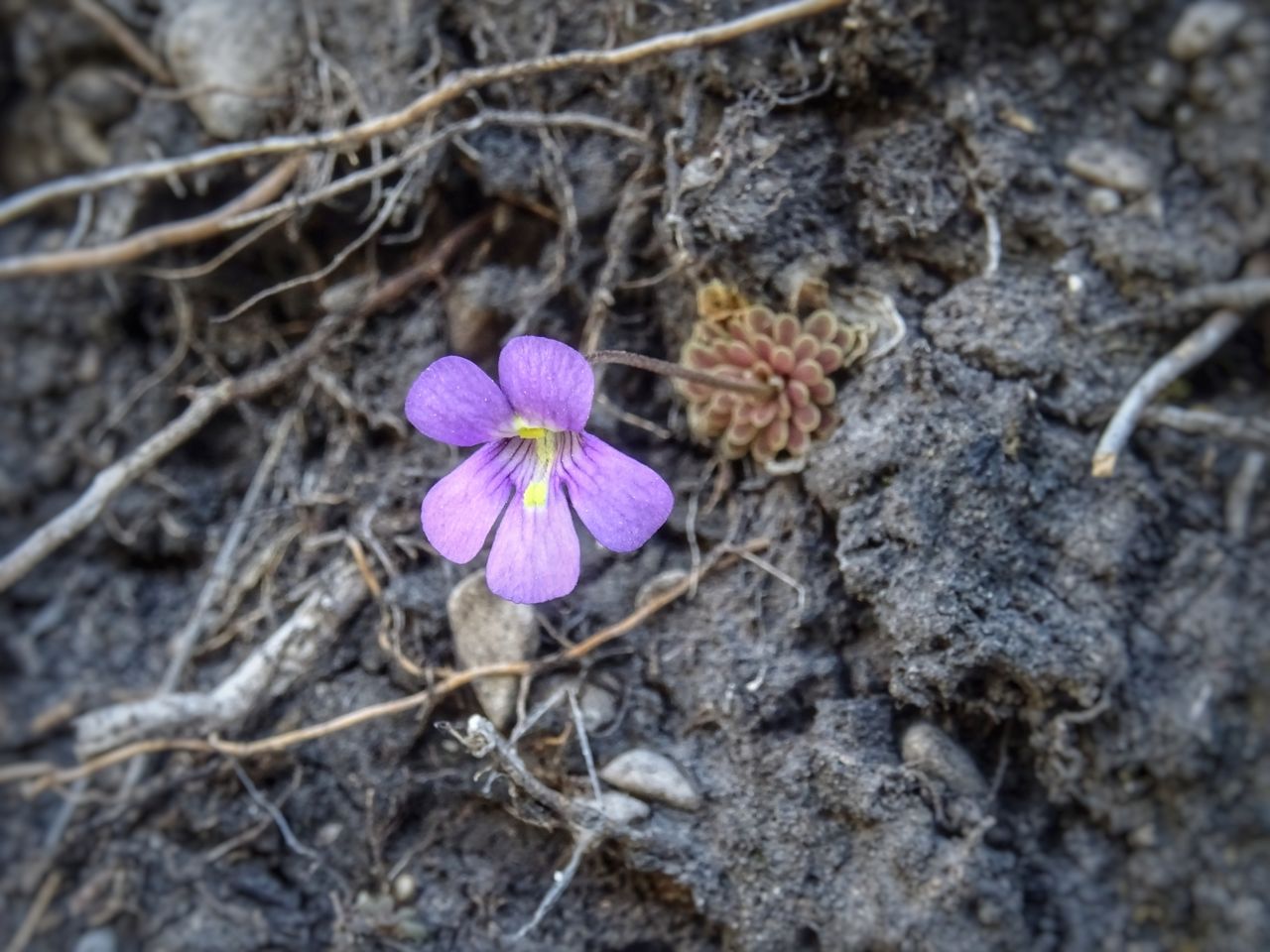
One of the smallest butterworts in Mexico, and one of the least known. Pinguicula debbertiana was described in 1992 from plants on the gypsum hills at the El Huizache junction in San Luis Potosí, and has since been reported from only a handful of places. In the field it is a little rosette you could cover with a coin.
Identification
A compact rosette of thick fleshy leaflets. The winter leaflets are about 8 mm long and 5 mm wide, overlapping like tiles and with few glands; the summer leaflets are slightly larger, about 13 by 8 mm, flatter and with a thin glandular coating. The flowers sit on short slender scapes and appear at the end of the dry season. The corolla is mauve to purple, with lobes about 6 mm long and as wide, and a slightly curved spur about 8 mm long; plants with white flowers have also been reported. As in related gypsum dwellers, shed leaflets readily form new rosettes, so a site may consist of dense clumps.
Similar species
The species stands close to Pinguicula esseriana and P. ehlersiae, which grow in the same gypsum country of San Luis Potosí. P. debbertiana has the smallest flower of the three, with a spur of about eight millimetres, while P. ehlersiae has a longer, clearly hooked spur and P. esseriana a broader lower lip. Out of flower the three are practically inseparable in the field, and several authors doubt whether this is three species or forms of one variable one.
The trap and how it works
A flypaper trap on a very small leaf, and so one of the most modest catching surfaces in the genus. The summer leaflets carry stalked glands with a sticky droplet and sessile glands releasing digestive enzymes as soon as prey lies on them; the margin bends slightly inward as it does. The winter leaflets are thick and nearly glandless and serve as a water store. Prey is correspondingly small: springtails, mites, small midges and flies moving over the damp gypsum in the early morning. Because the plant carries carnivorous leaves for only a few months a year, the catching window is narrow: all the nitrogen it gets must be taken in during that period and then stored in the fleshy winter leaflets. That storage function explains at once why the winter rosette is so thick and so glandless.
Habitat and ecology
Gypsum hills and lime-rich slopes in the dry interior of San Luis Potosí, in thorn scrub with agaves, hechtias and cacti (R2, D4). The plants sit in the lee of shrubs, on north-facing slopes and at the foot of gypsum banks where the surface stays damp longer. The climate is hot and dry with a short, heavy summer rainy season; for the rest of the year night dew supplies most of the water. The extremely infertile, sulphate-rich gypsum soil keeps virtually all competition away and is exactly why a plant of this size can hold its ground here.
Distribution and elevation
Endemic to Mexico. The published sites lie in San Luis Potosí, around the El Huizache junction; the name Huizache is common in that state, which makes locating older records awkward. Our species list gives Oaxaca; that does not match the literature, which consistently places the species in the dry north-eastern highlands, over a thousand kilometres further north. We follow San Luis Potosí here. The known range is very small. That a species described in 1992 is still known from so few places over thirty years later is partly down to the plant and partly to the terrain: the gypsum hills of San Luis Potosí are extensive, poorly accessible and only sparsely surveyed botanically.
- Recorded (one-degree cells)
Forms and variation
Besides the usual mauve to purple form, a white-flowered form has been reported; otherwise no wild varieties are distinguished. Rosettes flush strongly red in full sun and stay grey-green in shade, but that is a response to light and not a fixed character. More important is that the boundary with P. esseriana and P. ehlersiae is blurred: on some hills there are plants falling between the three in flower and spur size, and with present knowledge they cannot be reliably placed.
Where and when to see it
Search from February to April, when the flowers come from the winter rosette and stand out as small purple dots above the pale gypsum. Walk the north and east sides of gypsum hills and look under the edge of shrubs and at the foot of gypsum banks, where a little grit and moss gathers. The rosettes themselves are so small they vanish among the pebbles; sit down and work half a square metre at a time. Leave the plants — they are small, slow, and sit in a soil that does not recover from disturbance.
Conservation status
Not assessed for the global IUCN Red List, and not listed in CITES. Less is known of this species than of almost any other in this group: few published sites, no population counts, and even disagreement over the species boundaries. The obvious pressure is gypsum quarrying, road building and grazing in an area where all three occur. That the species is available in cultivation removes any need to collect in the wild. An assessment would first have to establish how many populations really exist and whether they belong to this species.
Scientific name
Pinguicula debbertiana | Speta & Fuchs, 1992
Described by Franz Speta and Franz Fuchs in 1992, in Linzer Biologische Beiträge 24: 375. The type area lies at the Huizache crossing in the Mexican state of San Luis Potosí. The exact origin of the species name debbertiana (likely honouring a person named Debbert) could not be established with certainty.
World Checklist of Vascular Plants (WCVP), via Plants of the World Online (POWO), Royal Botanic Gardens, Kew.