All species › Lamiales › Bladderwort family › Pinguicula elizabethiae
Pinguicula elizabethiae
A butterwort with a deep, glossy red-purple flower, from the gorge of the Río Moctezuma on the border of Hidalgo and Querétaro. Pinguicula elizabethiae was described by Zamudio in 1999 and belongs to the run of species that has made the Sierra Gorda, within a few decades, one of the richest areas for the genus.


Identification
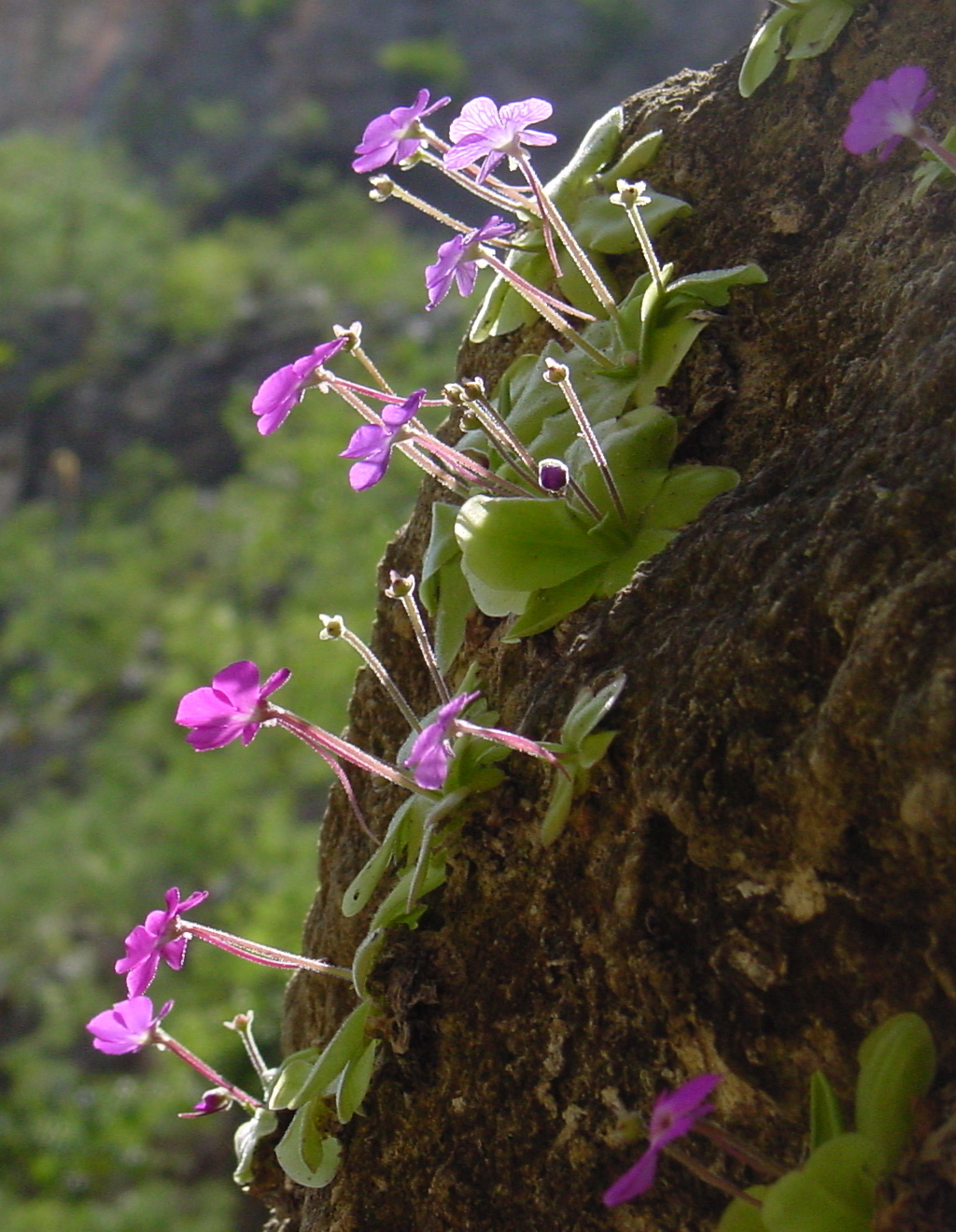
In the dry season there is a small winter rosette of narrow leaflets 5 to 17 mm long and 2 to 4 mm wide. With the rains a far more substantial summer rosette appears: broad, flat, sticky leaves (35) 50 to 72 mm long and (10) 25 to 53 mm wide. One to five erect scapes rise per plant. The flower is 36 to 46 mm long including the spur and glossy red-purple — a strikingly saturated shade in the field. The upper lip lobes measure 6.5 to 10 mm, the lower lip lobes 7 to 13 mm; the spur is (15) 20 to 28 mm long and projects clearly behind the flower. The species is named after Elizabeth Argüelles, who did much fieldwork in Querétaro. After flowering, erect capsules remain on the scapes; the very fine seed blows out over the moss cushion and germinates where the mat is thin enough to let light through.
Similar species
Pinguicula moctezumae grows in the same canyon country and is separated at once by its narrow, strap- to lance-shaped summer leaf and its even longer spur of nearly three centimetres. P. agnata, also from the region, has a pale, almost white flower with a spur of a few millimetres. Further south, P. laueana has a genuinely red flower, but with a four-centimetre spur and a quite different site. Where canyon species grow together hybrids are to be expected, and intermediates deserve attention.
The trap and how it works
A flypaper trap on a broad flat leaf — one of the more generous catching surfaces among the Sierra Gorda species. The stalked glands carry a droplet of sticky mucilage and hold the prey; the sessile glands between them release digestive enzymes on contact. The leaf margin then rolls slowly over the prey, so the fluid stands in a shallow bowl instead of running off the slope. Since the plants grow on steep mossy banks, that retention matters. The catch consists of midges, small flies and ants.
Habitat and ecology
Very steep mossy slopes and calcareous shale and mudstone rocks in the submontane scrub of the Moctezuma gorge, between one thousand and sixteen hundred metres (R1, R2). The plants root in moss cushions together with ferns and Selaginella, rarely in true soil. The climate is warm and markedly seasonal; the summer rains supply most of the water, while in the dry season seepage down the wall and the humidity in the gorge keep the plant going. When the moss of a bank disappears, the species goes with it. Mudstone — a fine-grained calcareous shale — weathers into a thin retentive layer that holds water longer than the surrounding limestone, and that explains why the species sits on those rock bands rather than everywhere in the gorge.
Distribution and elevation
Endemic to Mexico and confined to the gorge of the Río Moctezuma and its side canyons, with sites in Hidalgo and in Querétaro along the road to San Joaquín. Our species list gives Oaxaca; that does not match the literature, which knows the species only from Hidalgo and Querétaro — the original description names both states in its title. We follow Hidalgo and Querétaro here. The range is small and follows the course of the river.
- Recorded (one-degree cells)
Forms and variation
No wild varieties are distinguished. Within the species the intensity of the red-purple flower colour differs between populations, and spur length ranges from fifteen to twenty-eight millimetres. Leaf size depends strongly on how wet a bank is during the rains: at the dampest spots the summer leaves grow over five centimetres wide, at drier ones half that. Because more butterworts grow in the gorge, plants with intermediate characters should first be considered natural hybrids.
Where and when to see it
Go in spring and early summer, when the flowers open; the saturated red-purple is visible from a long way off against grey rock and moss. Search the steepest north-facing banks along the road to San Joaquín and in the side canyons, where moss and ferns grow and the rock feels wet. Stay on the road or path: the slopes are very steep and the moss cushion the plants root in is only a few centimetres thick and comes away easily.
Conservation status
Not assessed for the global IUCN Red List and not listed in CITES. What is known deserves attention: the species was only described in 1999, has a small range along a single river system, and grows by preference on road banks — exactly the places scraped or stabilised during maintenance. The conspicuous flower is also attractive to collectors, and water abstraction and road widening in the gorge have been named as risks. Population figures are entirely lacking. The species is available in cultivation, so collecting in the wild serves no purpose.
Scientific name
Pinguicula elizabethiae | Zamudio, 1999
Described by Sergio Zamudio in 1999, in Acta Botanica Mexicana 47: 15–22. The type area lies in the canyons of the Moctezuma River and its tributary Arroyo Tolimán, in the Mexican states of Querétaro and Hidalgo, at elevations of 1000 to 1600 metres. The species name elizabethiae honours Elizabeth Arguelles, a friend of the author and an enthusiastic collector of the flora of Querétaro.
World Checklist of Vascular Plants (WCVP), via Plants of the World Online (POWO), Royal Botanic Gardens, Kew.