All species › Lamiales › Bladderwort family › Pinguicula grandiflora
Pinguicula grandiflora | Large-flowered butterwort
Groot vetblad
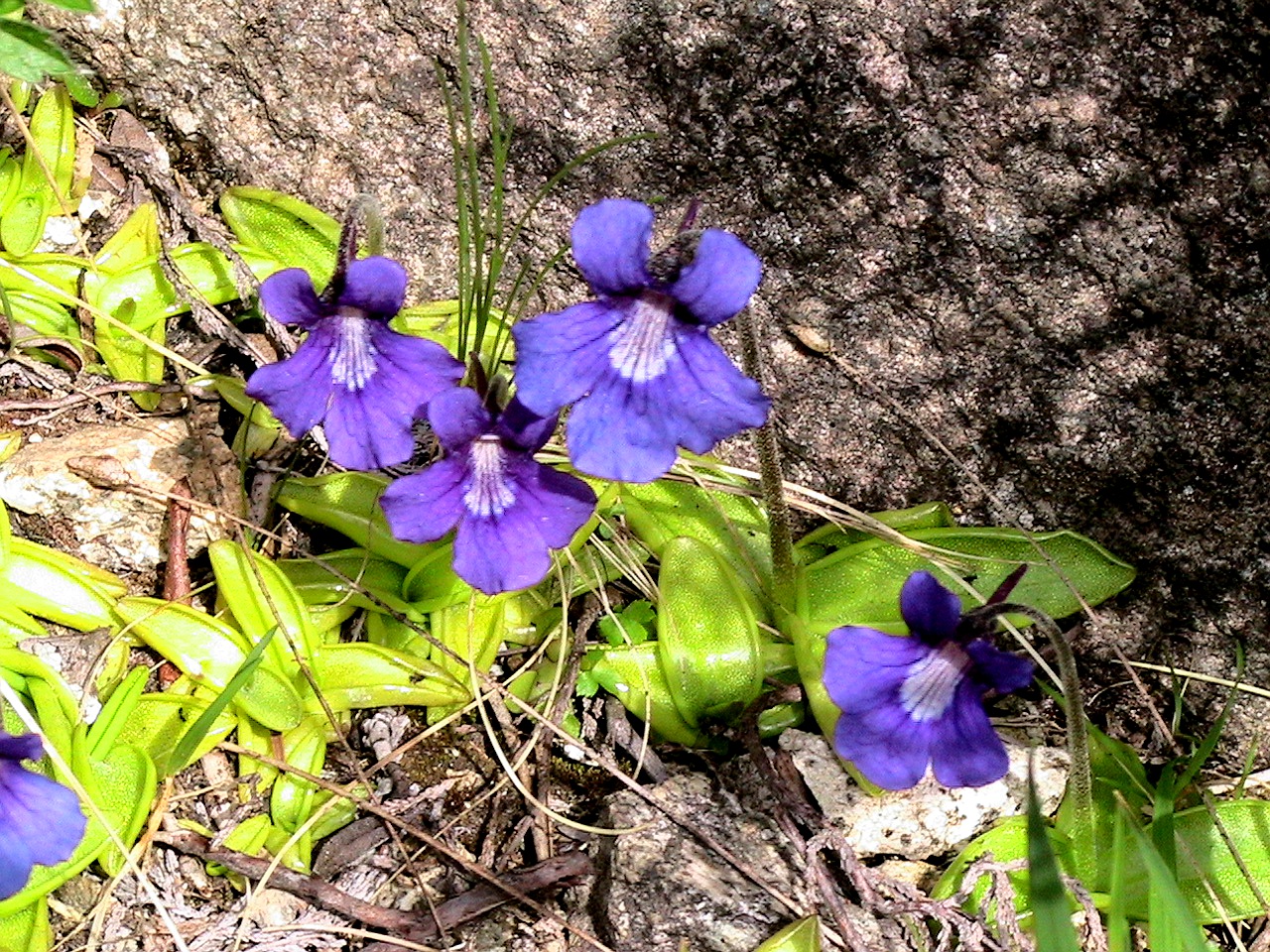
The same greasy leaf as the common butterwort, but a flower that is anything but modest: large, violet-purple, the broad lower lip opening like a violet. It is the butterwort of the mountains of south-western Europe, with one striking exception — it also grows in the south-west of Ireland, hundreds of kilometres from the Pyrenees, among the same Iberian plants that have hung on there since the ice age.


Varieties
Identification
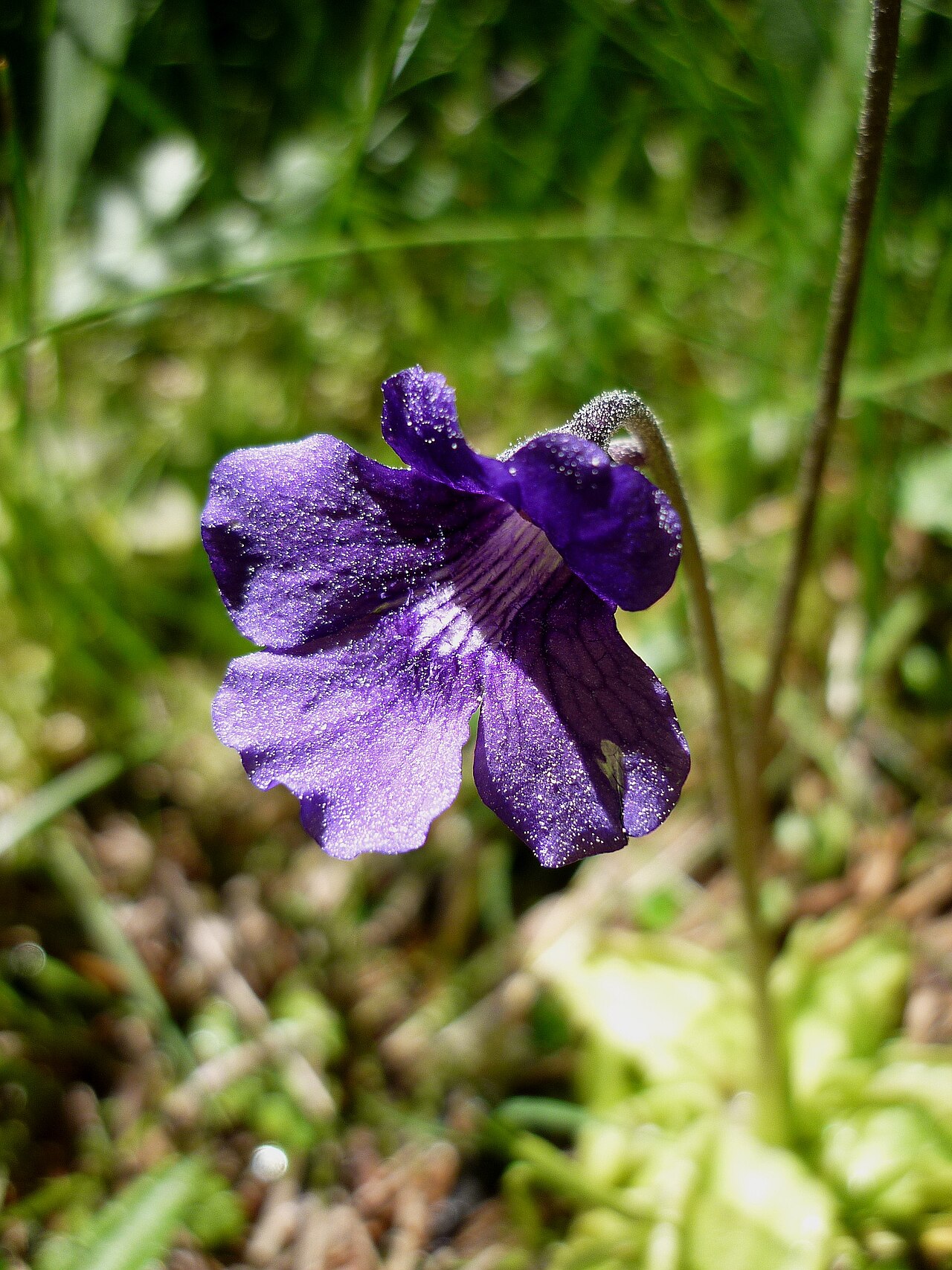
A rosette of yellow, greasily glossy leaves with inrolling margins; the whole plant is 8 to 15 cm tall. The scapes are bare and carry a single flower each. The flower is violet-purple with a white throat; the corolla is 15 to 20 mm long and about as wide as long, and the lobes of the lower lip are broad, shallowly cut and overlapping, so that the flower reads as one plane. The spur is straight and stout and reaches at least two thirds of the corolla's length. Like the common butterwort it overwinters as a bud with brood-buds at its base.
Similar species
The common butterwort (P. vulgaris) is the only real confusion species, and often grows in the same fen. There the corolla is 10 to 15 mm and longer than wide, with narrow lobes standing apart and a slender spur of at most half the corolla; here the flower is 15 to 20 mm, round in outline, with overlapping lobes and a stout spur of two thirds or more. The rosette is generally larger too, and the leaves broader. In Ireland the two grow mixed and the hybrid P. ×scullyi occurs, exactly intermediate. The alpine butterwort (P. alpina) is white with a yellow spot and has a short blunt spur. Distribution helps: the large-flowered butterwort is a plant of south-western Europe and Ireland, while the common butterwort covers the whole of northern and central Europe.
The trap and how it works
The same active flypaper trap as in the common butterwort: stalked glands with glue hold the prey, sessile glands secrete the digestive fluid, and the leaf margin curls around the prey over the course of hours until a shallow dish forms. The leaf is larger than that of the common butterwort and catches correspondingly more; on a good site a rosette in June lies full of midges and springtails. In winter the plant stops altogether: the rosette withdraws into a bud and nothing is caught until the leaves flush again in spring.
Habitat and ecology
Wet, calcareous, nutrient-poor ground in the mountains: seepage slopes, small sedge fens, springs, dripping rock faces and the banks of mountain streams, often on limestone or marl. In Ireland it stands much lower, in wet heath and on peaty, spring-fed slopes near the coast. Everywhere the same conditions apply: cool moving water, open vegetation and no competition from tall grass.
Distribution and elevation
South-western Europe: the Pyrenees and the Cantabrian mountains in Spain, the French ranges from the Alps to the Massif Central and the Jura, the Swiss Alps, and in addition, natively, the south-west of Ireland. In Great Britain, Germany and Czechia-Slovakia it is naturalised: planted out by enthusiasts and holding on in a few places. The source followed here gives no altitudes; in the Pyrenees and the Alps it runs from the valleys to above the treeline, while in Ireland it grows almost at sea level.
- Recorded (quarter-degree cells)
Forms and variation
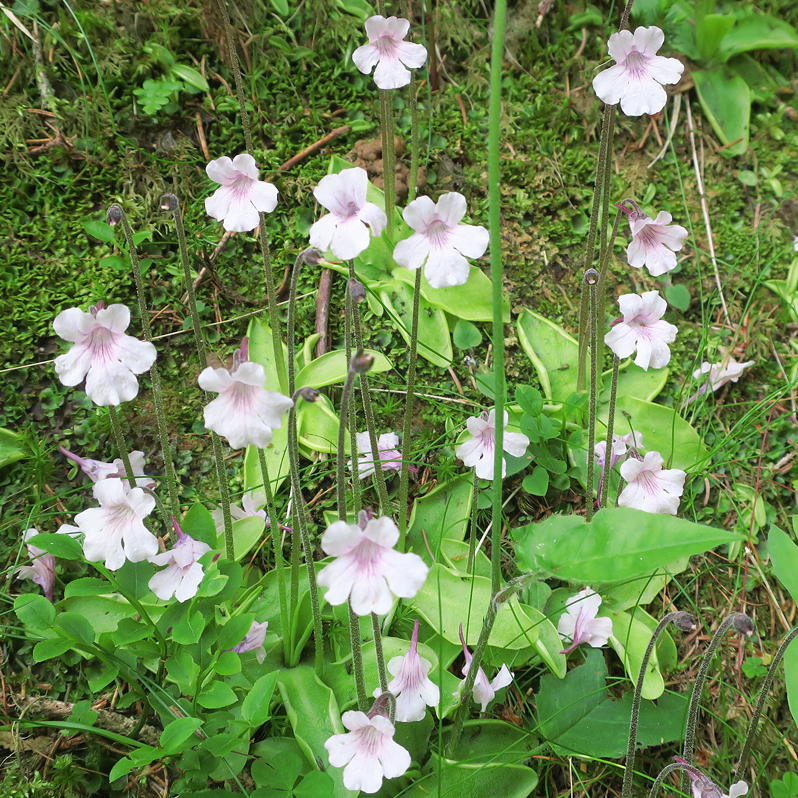
The variation lies mainly in flower colour: besides the usual violet-purple there are pale and pure white plants, and in south-eastern France a pink-flowered form described as a separate subspecies. Otherwise the species is fairly uniform. Where it grows with the common butterwort the natural hybrid P. ×scullyi arises, best known from Ireland, with flowers intermediate in size between the parents.
Where and when to see it
May to August, and later in the mountains as the snow retreats upwards: the valleys flower first, then the seepage slopes up above the treeline. Ireland is the easiest: in the south-west it stands along wet road cuttings and on heath slopes at eye level from the road. In the Pyrenees look for it at springs and along streams in limestone country. In case of doubt look at the spur and at the lower lip; those are the two characters that separate it from the common butterwort, and both are visible with the naked eye.
Conservation status
Not assessed on the global Red List — that assessment is missing. National pictures differ: in Switzerland it counts as endangered, while in Ireland and the French mountains it is still locally ordinary, though tied to a habitat that is disappearing fast. The threats are the same everywhere: drainage of seepage slopes, the capture of springs for drinking water and stock, trampling, and the digging up of plants. That it has been planted out here and there beyond its range blurs the map without helping the species.
Scientific name
Pinguicula grandiflora | Lamarck, 1789
Described by Jean-Baptiste de Lamarck in 1789. The species occurs in western Europe, from Ireland and northern Spain to the Alps. The species name grandiflora combines the Latin grandis ("large") and flos ("flower") and refers to this species' notably large flowers.
World Checklist of Vascular Plants (WCVP), via Plants of the World Online (POWO), Royal Botanic Gardens, Kew.