All species › Lamiales › Bladderwort family › Pinguicula moranensis
Pinguicula moranensis | Mexican butterwort
The best-known butterwort of Mexico, and the strangest: it is not one plant but two that take turns. From summer into autumn there is a broad sticky rosette that catches anything landing on it; in the dry season that disappears and is replaced by a dense, succulent-looking bud of small smooth leaves which catches nothing and simply waits for rain.

Identification
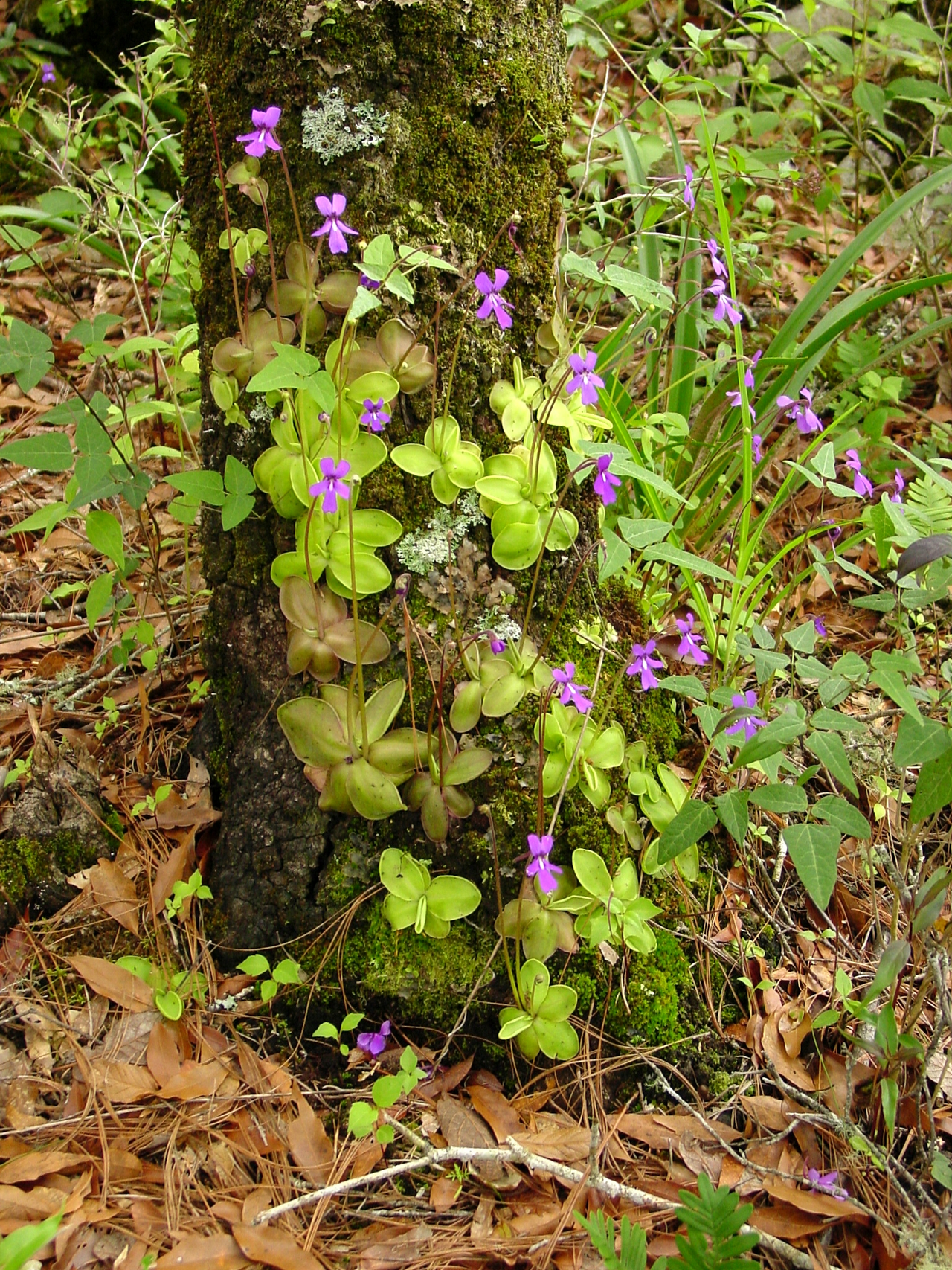
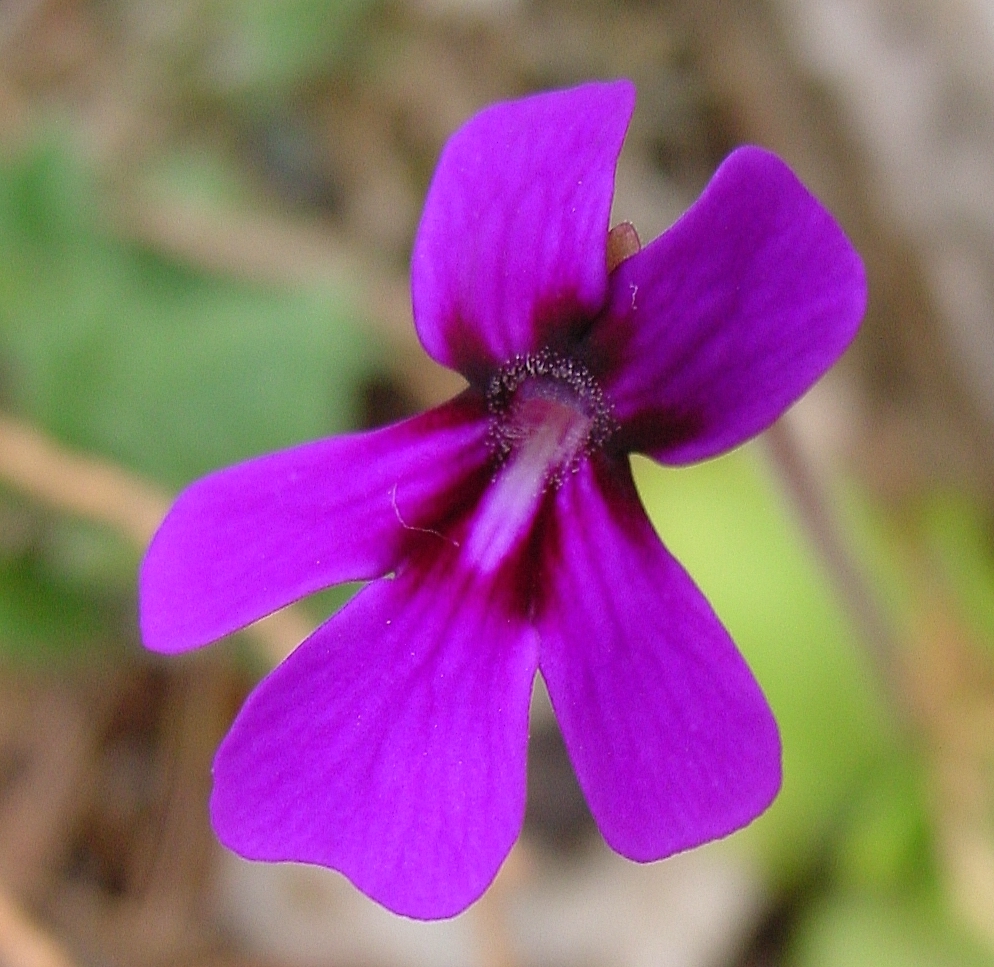
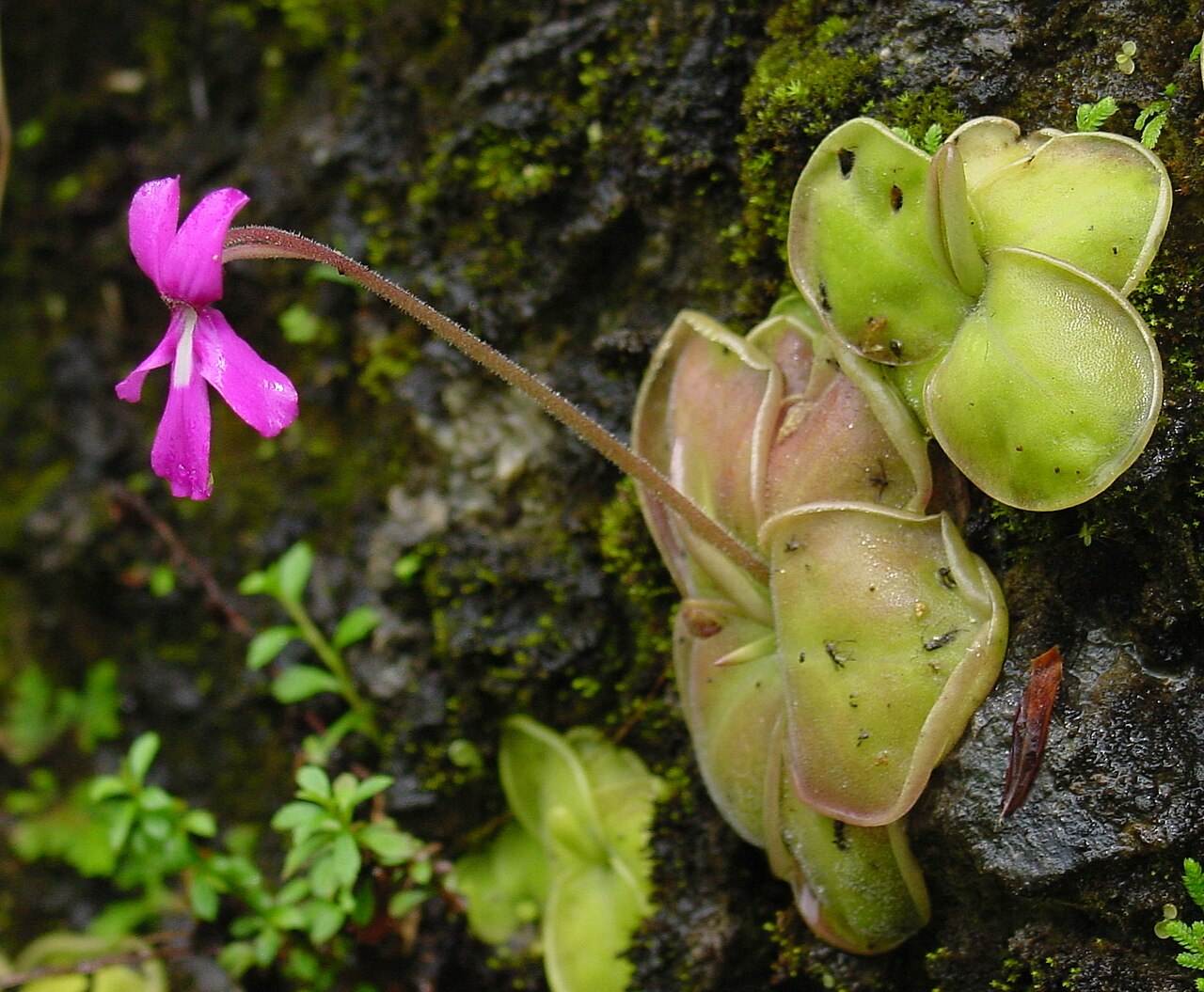
The summer rosette carries four to fourteen leaves, with a petiole 1 to 2.5 cm long and a blade 3 to 10 cm long and 2.3 to 7.3 cm wide: broadly obovate, yellow-green, sticky above and with inrolled margins. The winter rosette is something else entirely: thirty to a hundred or more small, thick, glossy leaves 0.5 to 4 cm long and at most a centimetre wide, overlapping like roof tiles, without glands and without a droplet. From the rosette rise one to seven, sometimes more, scapes 10 to 24 and rarely 30 cm tall. The flower is pink to purple with a white throat and 2.7 to 5 cm long including the long slender spur; the spur alone measures 1.6 to 3 and occasionally almost 4 cm. The corolla is two-lipped and widely spread.
Similar species
Mexico has dozens of butterworts and many of them have been split out of this one; P. moranensis is the most widespread and the most variable of all, and for that reason the hardest to delimit. Watch for the combination of three things: broad summer leaves with a distinct petiole, a long slender spur making up more than half the flower's length, and a winter rosette of numerous thick leaves. Species with a short spur, with sessile leaves, or without a winter rosette drop out on that. Beyond the genus confusion is impossible: no other plant in this mountain forest lays a sticky rosette on the rocks.
The trap and how it works
An active flypaper trap with a double peculiarity. When something lands on the summer leaf the stalked glands hold it, the sessile glands secrete fluid and the leaf margin curls slowly around it — ordinary butterwort work. What this species adds is that once a year it gives up the trap altogether: as the dry season sets in the sticky rosette dies away and the plant builds a winter rosette of thick smooth glandless leaves. That rosette catches nothing and loses almost no water, and it keeps the root bud alive until the rains return. The plant is therefore carnivorous for only half the year, which is exactly why the summer rosette has to catch so much.
Habitat and ecology
Moist, shaded places in pine and oak forest in the mountains: mossy rocks, limestone faces, steep stream banks and, very commonly, the bare ground of road cuttings, where the plant sits on the raw earth the digger left behind. The climate is that of the Mexican highlands, with a wet summer and a firmly dry winter, and its two leaf forms are set to that rhythm.
Distribution and elevation
From Mexico into Central America: across almost the whole of the Mexican highlands, from the north-west and north-east to the south and the Gulf slope, and on into Guatemala, Honduras and El Salvador. It is a plant of the middle mountains; the source followed here gives 800 to 2900 m for its area.
- Recorded (quarter-degree cells)
Forms and variation
This is a species that falls apart as soon as you look at it closely. Flower colour runs from nearly white through pink to deep purple, and the shape of the lower lip differs from valley to valley; two varieties are distinguished within the species. Part of what was once called P. moranensis has since been described as separate species, and that process is not finished. The names in quotation marks that circulate in collections refer to selected cultivated plants and have no place here.
Where and when to see it
July to September, in the middle of the rainy season: it flowers most freely then, although there is a flower somewhere all year round. Look along mountain roads in pine and oak forest, on the first metres of a cutting and on wet rock faces — this is above all a species you find from the road. Anyone coming in the dry season has to look for the winter rosette: a small tight bud of thick leaves on bare ground, easily taken for a little succulent. Leave the rosette alone; it sits loosely in the soil and comes away at the slightest pull.
Conservation status
Not assessed on the global Red List. What is known does not suggest a species in trouble: it is widespread, occurs in many mountain districts and even thrives on man-made cuttings. Locally it does disappear, through the felling of mountain forest, road widening and the digging of plants for the trade; because it is easily propagated from seed and from leaves, that last pressure weighs less heavily than it does on the rare Mexican butterworts with small ranges. So an assessment is missing, but the species itself is the least worrying member of its genus in Mexico.
Scientific name
Pinguicula moranensis | Kunth, 1817
Described by Carl Sigismund Kunth in 1817, in Nova Genera et Species Plantarum, based on material collected by Alexander von Humboldt and Aimé Bonpland during their Latin American expedition (1799–1804). The type material was collected near the Mina de Morán mine, in the Sierra de Pachuca, in what is now the Mexican state of Hidalgo. The name refers to the type locality: the Mina de Morán mine.
World Checklist of Vascular Plants (WCVP), via Plants of the World Online (POWO), Royal Botanic Gardens, Kew.