All species › Passerines › Nuthatches › Algerian nuthatch
Algerian nuthatch | Sitta ledanti
Algerijnse boomklever | Trepador de Kabilia
A small, dull-coloured nuthatch found only in 1975, on a single mountain in Kabylia, and known to this day from four patches of forest and nowhere else on earth. It was the last bird in the Mediterranean to be described new to science, and it is at once one of the most threatened species in this whole map area. Seeing it means travelling to north-eastern Algeria and walking uphill — and if you wonder why a field guide gives space to a bird almost nobody sees, it is because there are about a thousand of them.

Voice
Nasal and repetitive, and far-carrying in a quiet mountain forest. The ordinary call is a run of short, slightly tinny notes, wit-wit-wit, quickening and sharpening when the bird is agitated. There is also a drawn-out, plaintive and markedly nasal tchehh, the most characteristic sound the species makes and one that suggests a small raptor at a distance. The song is a rapid series of five to ten similar nasal notes at much the same pitch, faintly trilling or rolling, usually delivered from a high branch, from March into May. Standing in the Guerrouch forest, sound is almost always the first sign: the bird forages quietly and high, and gives itself away only when it calls.
No freely licensed recording is available for this species yet.
Identification
Small and compact, short-tailed and large-headed, in shape exactly a nuthatch but a size smaller and with a shorter, finer bill. The upperparts are dull blue-grey, a shade flatter than Eurasian nuthatch; chin, throat and cheeks are off-white, and the rest of the underparts run from pale buff on the breast to warmer cinnamon-buff on belly and flanks, without the rust-red the Eurasian nuthatch carries there. The male has a black forehead and crown, a narrow black eye-stripe below it, and between them a white supercilium reaching behind the eye. On the female the crown is grey like the back, at most with a darker wash at the front, and the eye-stripe is greyish and much fainter, so that the head looks almost plain; the supercilium still shows. Juveniles resemble the female but are duller again and shorter-billed. The behaviour is any nuthatch's: it walks head-down along a trunk, climbs without using its tail for support, and wedges seeds into a crack in the bark to work at them.
Confusion species
Within its own woods there is no second nuthatch: Eurasian nuthatch does not reach north-eastern Algeria, so confusion with a relative is impossible. Short-toed treecreeper shares the forest and works the same trunks, but always upwards and propped on a stiff pointed tail, is mottled brown rather than blue-grey and has a thin curved bill; a bird descending a trunk head-first is never a treecreeper. Coal tit and crested tit occur in the same wood and are as small, but have short thick bills, do not climb bark and hang at the tips of branches. For anyone who knows the other small nuthatches: Corsican nuthatch has a comparable head pattern but whiter, colder underparts and a broader, more sharply drawn white band above the eye, and lives two thousand kilometres away; Krüper's nuthatch carries a large rufous breast patch that this species entirely lacks.
Habitat
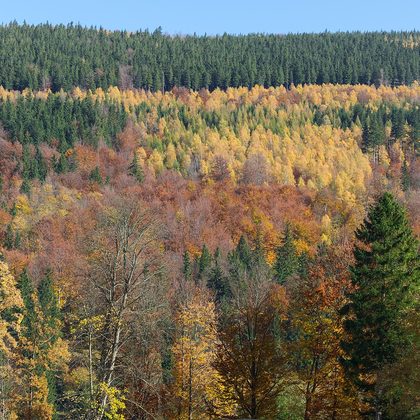
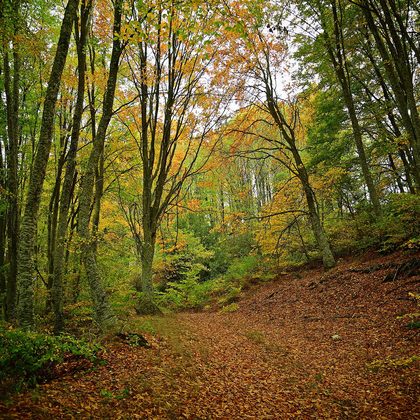
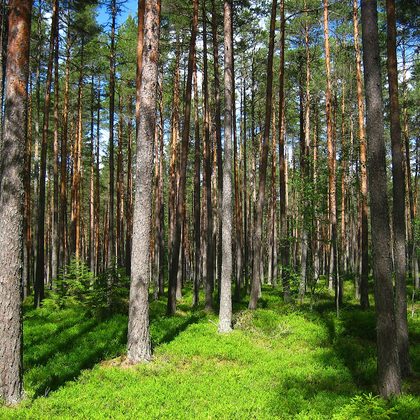
Mountain forest in Petite Kabylie, between roughly three hundred and fifty and two thousand metres, with a quite different forest type at each site. On the Babor, the mountain where the species was found, it is old mixed forest of Algerian fir and Atlas cedar with holm oak and Algerian oak among them, on the highest slopes above eighteen hundred metres. At Guerrouch, Tamentout and Djimla the picture is different and much lower: closed broadleaved forest of Kabyle oak and Algerian oak, with some cork oak, alder and maple, on damp north-facing slopes and in ravines. What all these woods share is the age of the trees. The nest goes into a cavity in an old, rotten or dead trunk, sometimes excavated by the birds in soft wood, sometimes an old woodpecker hole taken over; without old trees carrying rot there is no nest site, and the fate of the species is tied to the survival of old forest. Outside the breeding season the birds wander within the same wood, often in mixed parties with tits.
Where the bird is most at home, classified with EUNIS — the European standard for habitats.
Range and movements
Four forest blocks in Petite Kabylie, in north-eastern Algeria, and nothing else anywhere. The first is the wood on Djebel Babor, where Jean-Paul Ledant came across the species in October 1975 and where it was named after him the following year; that is also the smallest stronghold, with no more than a handful of pairs on a few hundred hectares of fir forest. The second and much the largest is Guerrouch, in Taza national park near Jijel, which holds the bulk of the world population. Then come the forests of Tamentout and Djimla, all three along the same range to the east and west. Together those four places cover an area that is barely a dot on this book's map. The total world population is put at about a thousand mature birds. The species does not migrate and has never been recorded outside Algeria.
- Resident
- Breeding (summer)
- dark = core range, pale = thinly spread
Where and when to look
This is a destination, not an outing. The most accessible site is Taza national park near Jijel, where the Guerrouch forest can be reached from the coast road and where the odds are best in April and May; on the Babor the track is poor and the population so small that a visit is rarely worth it and does the birds no favours. Walk into an old, closed oak slope and switch the engine off; listen for the nasal tchehh and the repeated wit-wit before you start looking. The birds stay in the upper half of the canopy and seldom come low, so choose a spot that gives you a view over the top of the wood — a steep slope worked from below beats a path through the trees. Early morning is the best time. Arrange the visit through a local guide or the park service; roads and permits are complicated here, and it is simpler with someone alongside.
Conservation status
Listed as endangered, and that is not an overstatement. The whole species is estimated at about a thousand mature birds, split between four woods that are not connected to one another; there is hardly any exchange between the subpopulations, so a loss at one site is not made good from elsewhere. The smallest of the four is also the most famous: on Djebel Babor, where the species was found in 1975, only a handful of pairs remain. That fir forest has shrunk over the past century through logging, through grazing by cattle and goats that removes the regeneration, and through the failure of young firs to come up beneath the old ones; what stands there is ageing with nothing to follow it. The heaviest and fastest threat, though, is fire. The forests of Kabylia burn in most summers, and the run of fires in 2020, 2021 and 2022 hit large areas in precisely this district; a fire destroys in one afternoon the old, cavity-rich woodland the bird depends on, and that takes a century to return. Add to this the felling of dead and rotten trees, which removes the nest trees, and in the longer term the drying of the North African mountain forests. There is protection on paper — Guerrouch lies within Taza national park and the Babor is a reserve — but enforcement is limited and independent counts are few. A species of this size cannot survive a second bad decade.