All species › Passerines › Nuthatches › Krüper's nuthatch
Krüper's nuthatch | Sitta krueperi
Turkse boomklever | Trepador de Krüper
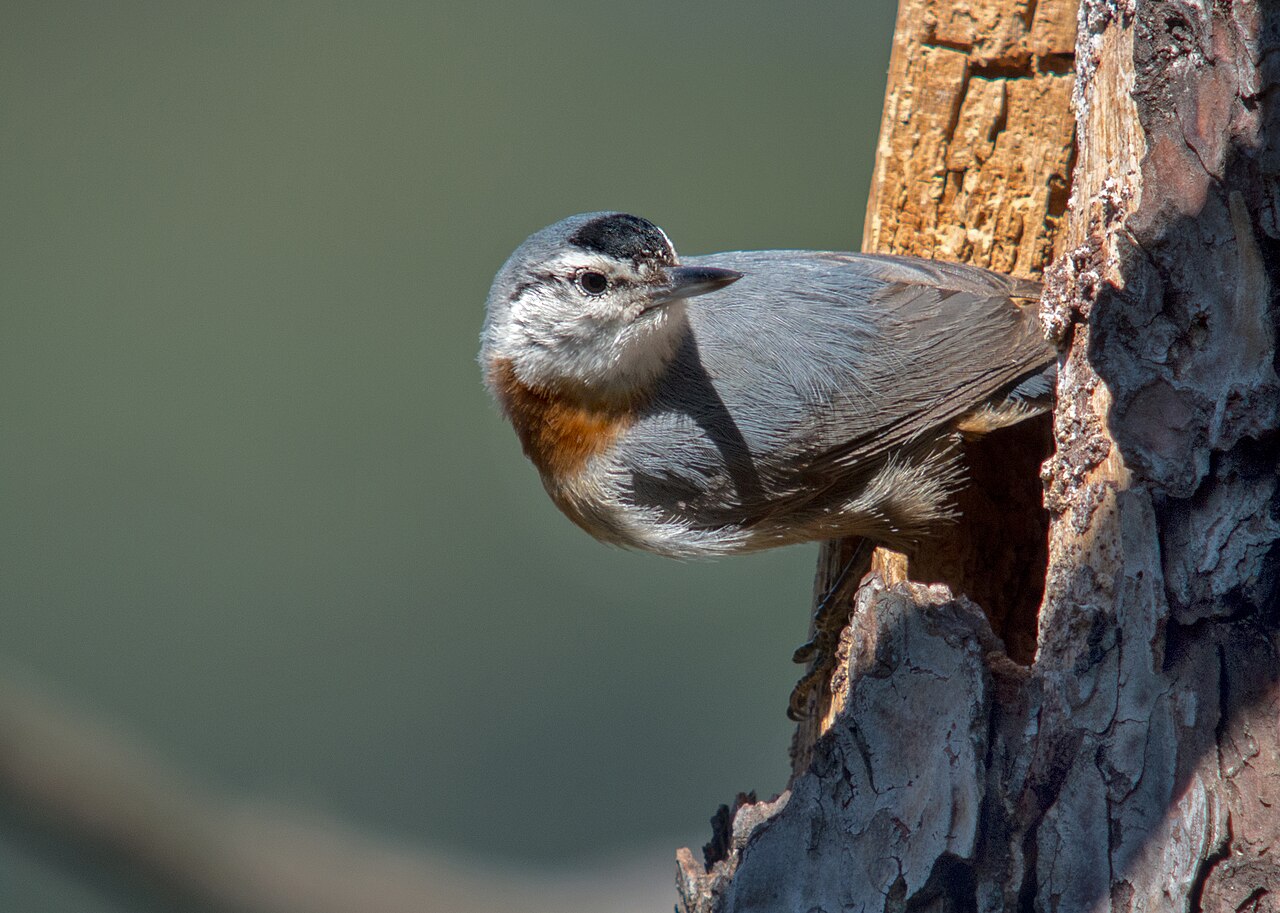
A small, short-tailed nuthatch of Turkish conifer forest, with a black cap and a large rufous crescent on the breast — a pattern no other nuthatch in the region shows. For European birders it is above all the prize of Lesvos, where a single pine wood at Achladeri holds the only breeding site inside the European Union.
Voice
Lively and high-pitched. The contact call is a clear, slightly plaintive dvui, often repeated into a steady series, dui-dui-dui-dui. Agitated birds give a rough, drawn-out ehhch, and the song is a nasal run in which high and low notes alternate in an uneven rhythm. The sound carries a long way through pine forest and is almost always the first sign of the species; the birds themselves stay high in the crowns.
No freely licensed recording is available for this species yet.
Identification
Clearly smaller and finer than Eurasian nuthatch, short-tailed and with a proportionately long, sharp bill. Upperparts blue-grey, throat white, underparts off-white to greyish buff. Two marks settle it: the black cap, covering forehead and crown but not running back onto the nape, and the large crescent-shaped rufous patch in the centre of the upper breast, lying like a rusty scarf under the white throat. Above the cap runs a broad, clean white supercilium, below it a narrow black eyestripe. The male's cap is glossy black and sharply cut off; the female's is duller, less extensive and vaguer at the rear, and her underparts are buffer. Juveniles lack the black head altogether and show the breast patch only as a rusty wash — these are the difficult ones.
Confusion species
Eurasian nuthatch is larger and longer, has no black cap and no breast patch, and is buff over the whole underside rather than only on the breast. Western rock nuthatch is larger again and much paler, has a heavy black eyestripe with no white supercilium above it, and lives on bare rock rather than in pines. Corsican nuthatch shares the black cap and white supercilium but lacks the rufous breast patch and occurs only on Corsica, a thousand kilometres away, so the two never meet. Treecreepers are mottled brown, climb only upwards propped on a stiff tail, and have a fine curved bill.
Habitat
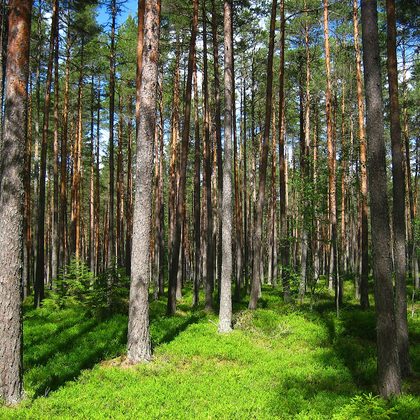
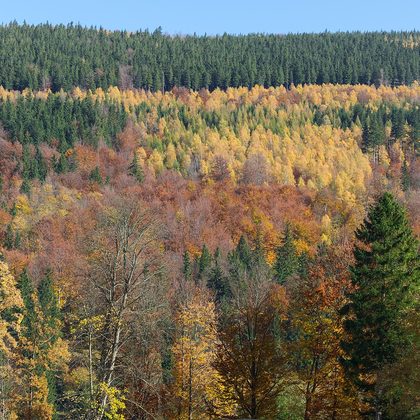
Coniferous forest, above all Turkish pine on the lower slopes and Caucasian fir, Caucasian spruce, Cilician fir, black pine and cedar higher up. In Turkey it is usually found between 1,000 and 1,600 m, though it has been recorded from sea level to 2,500 m; on Lesvos it lives close to the sea in a wood of Turkish pine. It prefers dense, closed stands with old trees. The nest is in a tree cavity, on average about twelve metres up, and the female lines the cup with bark chips, rotten wood, pine scales, moss, hair and feathers. The clutch is four to seven eggs, and laying starts early, often before the snow has gone from the higher forests.
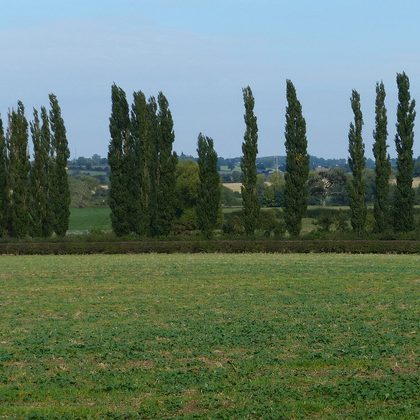
Where the bird is most at home, classified with EUNIS — the European standard for habitats.
Range and movements
Almost the entire range lies in Turkey: western Anatolia, the Mediterranean coast and the mountains along the Black Sea. Beyond that only the Greek island of Lesvos, southern Georgia and a strip of the Russian Caucasus around Krasnodar Krai and Karachay-Cherkessia. The species is resident and moves only up and down the slopes. Around 2015 the world population was put at somewhere between a hundred thousand and several hundred thousand pairs, virtually all of them Turkish. For anyone wanting the species inside the European Union, Lesvos is the only address.
- Resident
- Breeding (summer)
- Passage
- dark = core range, pale = thinly spread
Where and when to look
Go in April or early May to the pine wood at Achladeri, on the south side of the Gulf of Kalloni on Lesvos. Walk the unmade track into the forest, stop, and listen: the repeated dui-dui is sharp and carries well. Follow the sound further in, then search high in the pines for a small nuthatch working along the branches. Look straight at the breast — the rufous crescent shows even against the light, and settles the record at once.
Conservation status
Assessed as of least concern, although the species was briefly listed as near threatened in 2014 before being downlisted again in 2015. Numbers are nonetheless falling. The range is small and lies almost entirely within one country, and the coastal pine forests the bird depends on are under pressure from logging, fire and holiday development. On Lesvos the population is a handful of pairs in a single wood, which leaves the European stronghold vulnerable to one bad fire.