All species › Passerines › Wallcreepers › Wallcreeper
Wallcreeper | Tichodroma muraria
Rotskruiper | Treparriscos
The Wallcreeper is the only member of its family and the bird most Alpine visitors would rather see than any other. At first there is no bird at all: a grey smudge shuffles across a bare limestone face, and only when it spreads its wings does crimson flash out of the rock. In flight it moves along the cliff in slow, irregular, floppy beats, more like an enormous butterfly than a passerine. For anyone working the Alps it is the classic reward of a day in a gorge, and the classic reason to come back.

Voice
The song carries over the noise of a mountain torrent and is often the first sign that the bird is there. It is a series of clear, long-drawn whistles, each on a different pitch, usually three to five in a row, rising and then falling away: tsee — tsoo — tseeee. The tone is pure and piping, with something plaintive in it, and it is delivered from a ledge or during the fluttering flight, chiefly from March to June. The call is a thin, high tui, short and sharp, heard outside the breeding season too. In a gorge, wait for a lull in the wind before deciding nothing is there.
No freely licensed recording is available for this species yet.
Identification
About house sparrow size but built on quite another plan. The plumage is slate grey, paler on the belly, with a long, thin, strongly decurved bill that works into rock cracks like a pair of tongs. In breeding plumage the male has a jet-black throat and upper breast cut sharply against the grey; the female shows at most a dull or incomplete patch, and in winter both are white-throated. The wings are broad, short and rounded, and that is the image that stays: the coverts are crimson to deep pink, the flight feathers black with two rows of round white spots on the outer primaries. The tail is short with a pale tip. There is no stiff propping tail as in the treecreepers; the bird grips with long toes and big curved claws and balances by flicking its wings half open and shut continuously, as though breathing. That flicking is the best long-range mark, because every flick shows the red.
Confusion species
Confusion is barely possible once the wings open. At long range, or in silhouette against rock, it most resembles a butterfly or a bat, and many observers first take a Wallcreeper for a drifting leaf. Nuthatch is about as grey and also climbs, but it lives on trees, has a straight dagger bill, a black eye-stripe and rusty flanks, and goes head-down. Crag Martin is brown and hunts on the wing rather than climbing. Alpine chough is far larger and black. Dipper, black redstart, Alpine accentor and rock sparrow share the same cliffs and gorges but none of them is grey with red.
Habitat
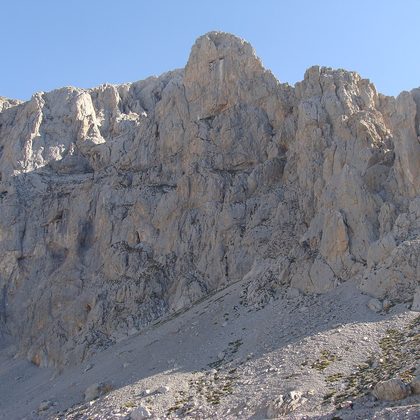
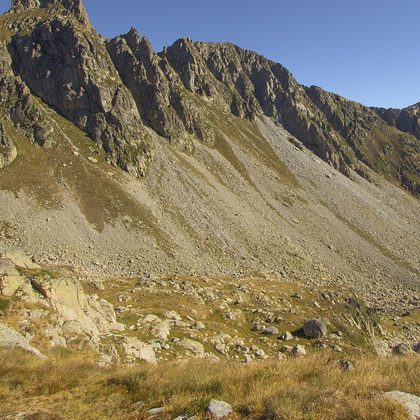
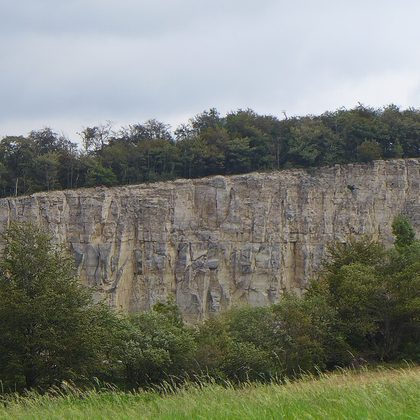
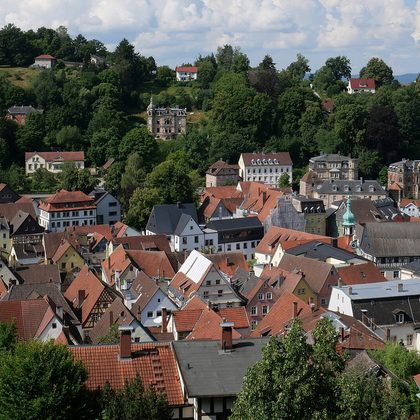
Steep rock faces, by preference limestone, well supplied with cracks, ledges and overhangs, usually between a thousand and three thousand metres, and often above a gorge or beside a waterfall where the rock stays damp and insects are plentiful. The scree slopes at the foot of the face and the mouths of caves and clefts are part of the same territory and are worked for food as well. The nest is set deep in a crevice or under an overhang, out of reach. In winter the birds drop to lower cliffs and gorges and readily take to man-made rock: disused quarries, dams, viaducts, castle ruins, town walls and the facades of cathedrals, where the joints hold the same spiders and insects as a limestone crag.
Where the bird is most at home, classified with EUNIS — the European standard for habitats.
Range and movements
From the Cantabrian Mountains and the Pyrenees through the Alps, the Apennines, the Carpathians and the Dinarics to the Balkans, Greece, Turkey and the Caucasus, and on east through Iran and Central Asia to the Himalaya and western China; most of that range lies well outside Europe. In the Alps it breeds across the whole arc, from the Maritime Alps to Austria and Slovenia, and it is present the year round with a strong altitudinal shift. Wanderers reach the lowlands in hard winters and there is a scatter of records well north and west of the breeding range, including Britain, but these are exceptional.
- Resident
- Breeding (summer)
- Winter
- Passage
- Migration direction
- dark = core range, pale = thinly spread
Where and when to look
In summer, pick a deep limestone gorge with a waterfall and a north-facing wall that stays shaded into late morning. Stand well back so the whole face is in view and scan it systematically in horizontal sweeps; a telescope on a tripod beats binoculars in the hand. You are not looking for a bird shape but for a movement: a grey speck jumping across the rock and flashing red at every hop. Early morning and late afternoon are the active hours. Winter is easier. From November to March birds descend to low cliffs, dams and old masonry, where they can be watched at eye level; a number of Alpine and Jura churches, castles and valley crags hold returning individuals year after year, and local birding networks publish the sites.
Conservation status
Not globally threatened, but the rating hides how thinly it is spread everywhere. Each pair holds a large stretch of cliff, densities are low throughout, and the species is exceptionally hard to census, so trends are poorly known. Warming is the concern most often raised, since it squeezes suitable high ground upward and dries the seepages the bird feeds along, and disturbance by climbers on breeding faces can cause desertion. Some Alpine cantons and Spanish protected areas now close specific routes during the breeding season for exactly this reason. Where a face is left alone, the pair stays.