All species › Passerines › Nuthatches › Corsican nuthatch
Corsican nuthatch | Sitta whiteheadi
Corsicaanse boomklever | Trepador corso
The only bird species in the world confined to Corsica, and the smallest nuthatch in Europe. It lives in the mountain forests of Corsican pine, working high in the crowns among the needles and giving itself away with a soft whistled pu. Its entire world covers some two hundred square kilometres, and that world burns too often.

Voice
A light, whistling pu, usually repeated in short series, is the ordinary contact note and much the easiest thing to learn. Agitated birds give rough, drawn-out sounds recalling a starling. The song is clear, ringing and fast, a rolling series that in the mountains has been likened to the screaming of Alpine swifts. In a quiet laricio wood the call carries a long way, and it is almost always the sound that betrays the bird rather than the sight of it.
Recording: Tanguy Loïs — CC BY-SA 4.0 · xeno-canto
Identification
Small, round and very short-tailed — noticeably smaller than Eurasian nuthatch and with a finer, shorter bill. Upperparts blue-grey, underparts greyish white washed buff on flanks and belly, throat and cheeks whiter. The male has a black forehead and crown and a black eyestripe below, separated by a broad, sharply drawn white supercilium that runs well behind the eye; those three parallel bands make the head strikingly marked. On the female, crown and supercilium are the same grey as the back, so the head looks much plainer, though the dark eyestripe still shows. The outer tail feathers are black with white spots and grey tips. Juveniles resemble the female.
Confusion species
Confusion with another nuthatch is impossible on Corsica: there is no second species, and Eurasian nuthatch is entirely absent from the island. Short-toed treecreeper climbs in the same pine forests, but always upwards and propped on a stiff, pointed tail, is mottled brown rather than blue-grey, and has a fine curved bill; a bird walking head-down settles the matter at once. Coal tit and crested tit share the wood and the size but have short, thick bills and do not climb trunks. Krüper's nuthatch has the same head pattern but carries a large rufous breast patch and lives two thousand kilometres away.
Habitat
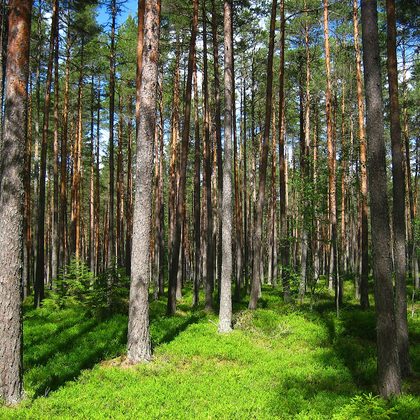
Mountain forest of Corsican pine, between roughly a thousand and fifteen hundred metres in the breeding season, with outliers from seven hundred and fifty to eighteen hundred metres and a slight descent in winter. Where the laricio pine gives way to beech or maritime pine the bird follows, but the core of the range is and remains old pine forest. A pair defends three to ten hectares. The nest goes into a cavity that both birds excavate themselves in a dead or worm-eaten pine two or three centuries old, between two and thirty metres up; old woodpecker holes are taken over as well. The clutch is four to six eggs. Without old standing dead pines there is no nest site, which makes the tidying away of dead wood weigh more heavily here than almost anywhere.
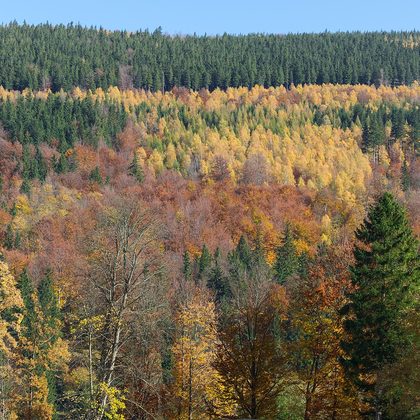
Where the bird is most at home, classified with EUNIS — the European standard for habitats.
Range and movements
Corsica only, from the forest of Tartagine-Melaja in the north to that of l'Ospedale in the south, with the largest numbers on the massifs of Monte Cinto, Monte Rotondo, Monte Renoso and Monte Incudine, plus two separate populations in the Castagniccia and the forest of Cagna. The whole occupied range amounted to about a hundred and eighty-five square kilometres in 2011, and the population was put at three thousand one hundred to four thousand four hundred mature birds around 2013. The species never leaves the island; no wild bird has ever been recorded away from Corsica.
- Breeding (summer)
- dark = core range, pale = thinly spread
Where and when to look
In April, May or June drive to the Col de Sorba, the forest of Vizzavona, the Aitone forest or Valdu-Niellu, park beside a stand of old laricio pine and switch the engine off. Listen for the soft, repeated pu high above you. Then work the upper branches with binoculars: the birds stay in the crowns and seldom come low. A bare dead pine standing in the middle of the wood is the best place to wait. Early morning is much the easiest time; in the heat of the day these forests fall silent.
Conservation status
Listed as vulnerable, and has been since 2010. The range is small and fragmented and numbers are slipping — a decline of about a tenth over ten years was recorded around 2011. Fire is the heaviest threat: the fires of summer 2000 affected some four per cent of the population, and after the fires of August 2003 counts the following spring in the burnt sector were down by more than a third. On top of that, burnt ground often comes back as maritime pine or holm oak rather than laricio, and the felling of dead pines removes precisely the nest trees. Corsican pine grows slowly; what is lost does not return within a human lifetime.